Elastic Yarn Manufacturers
Core-spun and covered elastic yarns that give hosiery, socks and knit fabrics their stretch and recovery.
Elastic yarn is yarn built around a stretch core. A filament or thread of elastane — the generic name for the stretch fibre sold under names such as spandex and Lycra — or a rubber thread forms the centre, and textile yarn such as nylon or polyester is wrapped, covered or core-spun around it. The core supplies the stretch and the snap-back; the covering supplies the look, the hand feel, the dyeability and the protection the core needs, because bare elastane is delicate, hard to dye and easily damaged by heat, light and machine friction.
The manufacturers in this directory are Taiwanese specialists in covered elastic yarns for the hosiery trades and beyond: spandex and metallic covered yarns, Lycra/spandex and rubber thread covered with nylon or polyester in various counts, elastic bands and flexible tapes, and cotton core yarns for sock knitting. Their yarns go into socks, tights, stockings, gloves, sweaters, knit fabrics, underwear and clothing generally. The sections below explain how covered and core-spun yarns are built, how to specify stretch, and where each construction is used.
Yarn & Elastic Resources
Covered Yarn: A Stretch Core in a Textile Skin
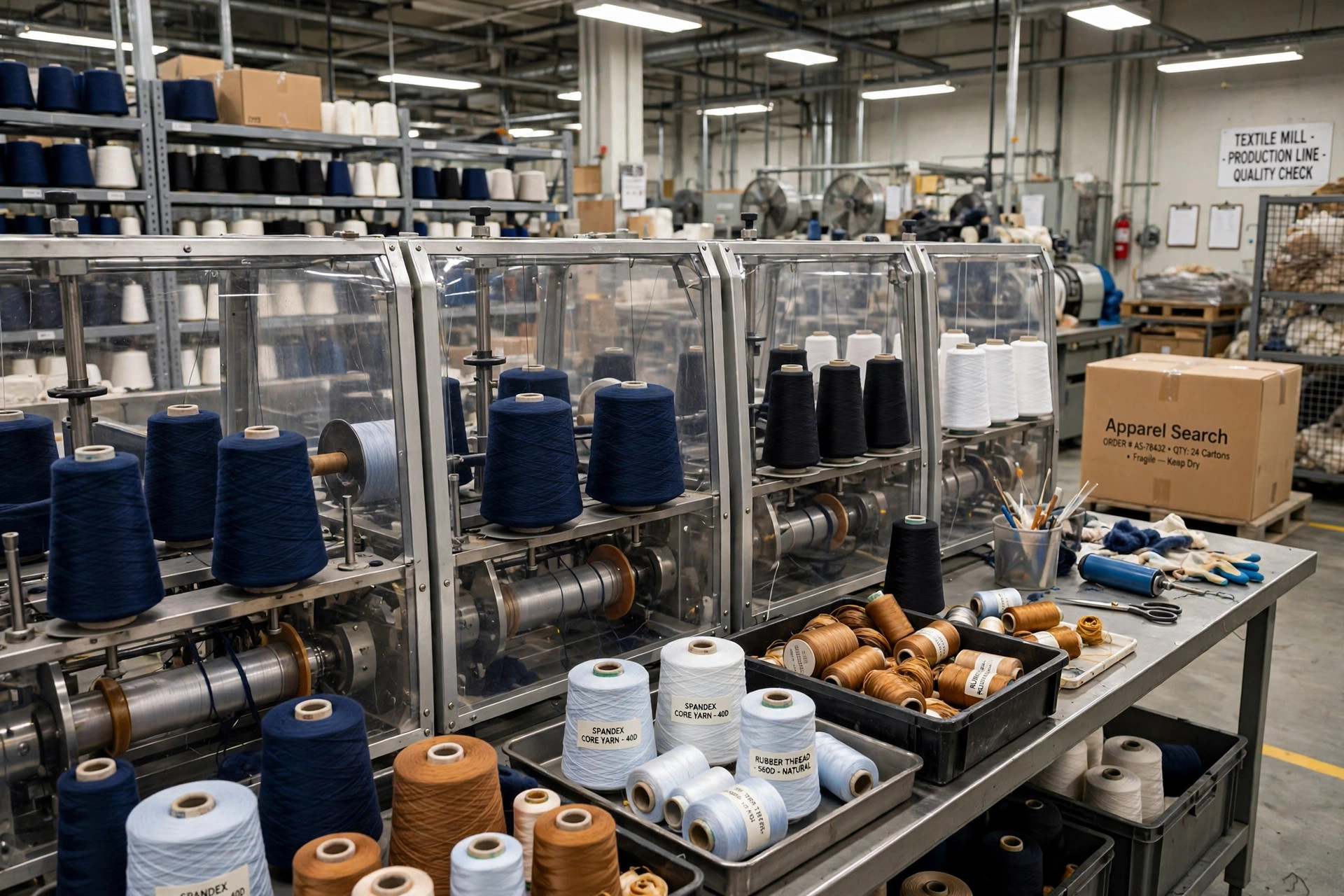
In a covered yarn, the core is fed through a hollow spindle under controlled draft — stretched to a set multiple of its resting length — while a covering yarn winds helically around it. Single-covered yarn wraps the core in one direction; double-covered yarn adds a second wrap in the opposite direction, which balances torque so the yarn hangs straight instead of twisting, covers the core more completely, and gives a rounder, more textile feel. The listings describe exactly this product family: spandex and metallic (lurex) covered yarns, and elasticity covering yarn produced for narrows, hosiery, embroidery, knitwear and weaving plants.
Core-spun yarn is the spun-yarn cousin: the elastane filament is fed into the heart of a staple-fibre roving at spinning, so the finished yarn has a staple surface — cotton core yarns for sock knitting are one example in the listings — with stretch hidden inside. Air-covered and intermingled constructions exist as well. The construction choice decides how the fabric feels and how much bare core can grin through at maximum stretch, so it belongs in the order specification, not in an assumption.
Elastane, Spandex, Lycra and Rubber Thread Cores
Elastane cores dominate modern elastic yarn. Lycra is a brand name for an elastane fibre; spandex is the generic term used in North America, and elastane the term used in much of the rest of the world — the listings use all three names for the same class of core. Elastane offers high stretch with strong, immediate recovery and good resistance to body oils and washing, which is why it took over the hosiery and underwear trades from rubber.
Rubber thread covered with nylon or polyester remains in the listings, and in the trade, for good reasons: it is economical, its stretch feel is firm, and some sock, glove and band constructions are engineered around it. Rubber ages differently from elastane — it is more sensitive to heat, oils and oxidation — so a buyer switching a construction from rubber to elastane, or the reverse, should re-test the finished article rather than treating the cores as interchangeable at the same draft and cover.
Specifying Stretch, Count and Cover
An elastic yarn is specified by the core (material and size, usually in denier), the covering yarn (fibre, filament or spun, and its count), the construction (single-covered, double-covered, core-spun), the draft at covering, and the resulting yarn count. Together the draft and the cover determine the two numbers the knitter actually feels: how far the yarn will stretch, and how strongly it pulls back. State the end use and the fabric construction with the enquiry — a yarn covered for sheer hosiery, like the tights and stocking yarns both listings serve, is a very different product from a heavy elastic yarn for waistbands or webbing.
Ask for stretch and recovery figures measured on the yarn, and then prove them in fabric. Elastic yarn is drafted again on the knitting machine, so the same yarn can produce gentle comfort stretch or firm power stretch depending on machine settings, loop length and the share of elastic yarn in the fabric. Agree a fabric sample, at stated machine settings, as the approval standard — approving yarn on a cone alone is how stretch disputes happen.
Where Elastic Yarns Are Used
Hosiery is the home trade: socks, tights, stockings and pantyhose need elastic yarn in tops, welts and legs to stay up and to fit a range of sizes, and both manufacturers here name those products first. Gloves use elastic yarns for wrists and fit — one listing includes various yarns for glove knitting, plus elastic bands, special bands with printing or silicone, and flexible knit tape as related products. Sweaters and knit fabrics use elastic yarns in rib cuffs and hems so the rib keeps its recovery instead of bagging, and underwear and clothing generally use them in waistbands, leg openings and stretch panels.
Elastic yarn also enters weaving and narrow fabrics: covered yarns are woven into stretch fabrics and narrow elastic tapes, and metallic covered yarns put stretch into decorative fabrics. One listing's range extends to special technical yarns such as bamboo yarn, nano silver yarn and recycled PET yarn alongside its elastic range. Whatever the end use, tell the maker the heat the yarn will meet — dyeing, boarding hosiery and heat-setting can all exceed what a core tolerates — and get the maker's temperature limits in writing.
Elastic Yarn Manufacturers
Manufacturers of covered and core elastic yarns. Contact details are given in the listings where they were provided.
Maw Chawg Enterprise Co. Ltd. (Taiwan)
It is a manufacturer of spandex & metallic (lurex) covered yarns as well as qualified artificial yarns. The yarns they produce are widely used in many fields of the textile industry. They are used in the production of narrows, hosiery (tights, stocking and socks), embroidery, knitwear, knitted fabrics (flat and round knitting machines) and at weaving plants. Some of them are also used for special technical purposes such as bamboo yarn, nano silver yarn, recycling PET and so on. They produce elasticity covering yarn.
Spandex & Metallic (Lurex) Covered Yarns · Artificial Yarns · Elasticity Covering Yarn · Bamboo Yarn · Nano Silver Yarn · Recycled PET Yarn — bamboo yarn manufacturer · metallic yarn manufacturer · elastic yarn manufacturer
Address: No. 374 Fan Hua RD., Shiow Shui Township, Chung Hua County, Taiwan Phone: 886-4-7683889 Fax: 886-4-7683974 E-mail: maw.chawg@msa.hinet.net or webmaster@machangx.com Contact: David Tsao
Shinwittex Co. Ltd. (Taiwan)
Exporter and manufacturer with more than 18 years' experience, specialized in various yarns and elastic yarns for sock, tight, stocking, hosiery, glove, sweater, fabric knitting and similar uses.
Lycra/Spandex Covered with Nylon/Polyester Yarn (various counts) · Rubber Thread Covered with Nylon/Polyester Yarn (various counts) · Various Yarns for Gloves Knitting · Elastic Bands, Special Bands with Printing or Silicone · Webbings and Flexible Knit Tape · Cotton Core Yarns for Sock Knitting · Nylon or Polyester Texturized / Filament Yarns
Address: 7F-4, Kuan Chien Road, Taichung City, Taiwan R.O.C. Tel: 886-4-2323 5752, 23235762 Fax: 886-4-2323 2593 E-mail: jane.hu@msa.hinet.net
More Yarn & Textile Resources
- Acrylic Yarn
- Bamboo Yarn
- Metallic Yarn
- Yarn Cones & Spiral Paper Tubes
- yarn Machinery
- yarn Wholesaler
- yarn Agents
- yarn Consultants
- Sheep Research
- Sheep
- fibers
- Thread
- Chenille
- Weaving Process Chenille Scarves
- Components / Trimming
- yarn Definition
- Warp Definition
- Loom Definition
- Knitting Definition
- Weaving Definition
- Fashion Models
Common Questions
What is the difference between covered yarn and core-spun yarn?
In covered yarn, a covering yarn is wound helically around a stretched elastane or rubber core — once for single-covered, twice in opposite directions for double-covered, which balances torque and covers the core more fully. In core-spun yarn, the elastane filament is fed into the centre of a staple roving during spinning, so the yarn has a normal staple-fibre surface with stretch hidden inside.
Are Lycra, spandex and elastane the same thing?
They name the same class of stretch fibre. Lycra is a brand name, spandex is the generic term used in North America, and elastane is the generic term used in much of the rest of the world. Rubber thread is a different, older core material with different ageing and heat behaviour, and it is still supplied covered with nylon or polyester.
How should stretch be specified when ordering elastic yarn?
State the core material and denier, the covering fibre and count, the construction (single-covered, double-covered or core-spun), the draft used at covering, and the end use with its fabric construction. Then approve a knitted fabric sample at stated machine settings, because the knitting draft changes the stretch the wearer finally feels.