Yarn Cone Factory Directory (Yarn Cones, Spiral Paper Tubes)
Paper cones and spiral paper tubes — the packaging every cone of yarn is wound on.
Every cone of yarn a knitter or weaver buys is wound onto something, and in most spinning mills that something is a paper cone or a spiral paper tube. This page is therefore a packaging page as much as a yarn page: it covers the factories that make paper cones of various sizes, conicity and specifications, and the spiral-wound paper tubes — POY tubes, DTY tubes, paper cores and cheese tubes — that filament and spun yarns are wound, textured, shipped and unwound on. A cone that collapses, a tube that is out of round, or a surface that snags yarn will stop production lines far more expensive than the cone itself.
The manufacturer in this directory is an Indian maker with over two decades of experience supplying paper cones and tubes to yarn manufacturers exactly to their desired specifications and delivery schedules. The sections below explain how spiral paper cones and tubes are built, what cone angles and dimensions mean, which specifications a spinner should put in an order, and how cones and tubes are chosen for different yarn processes.
Yarn, Machinery & Trim Resources
Spiral Paper Tubes: How They Are Built
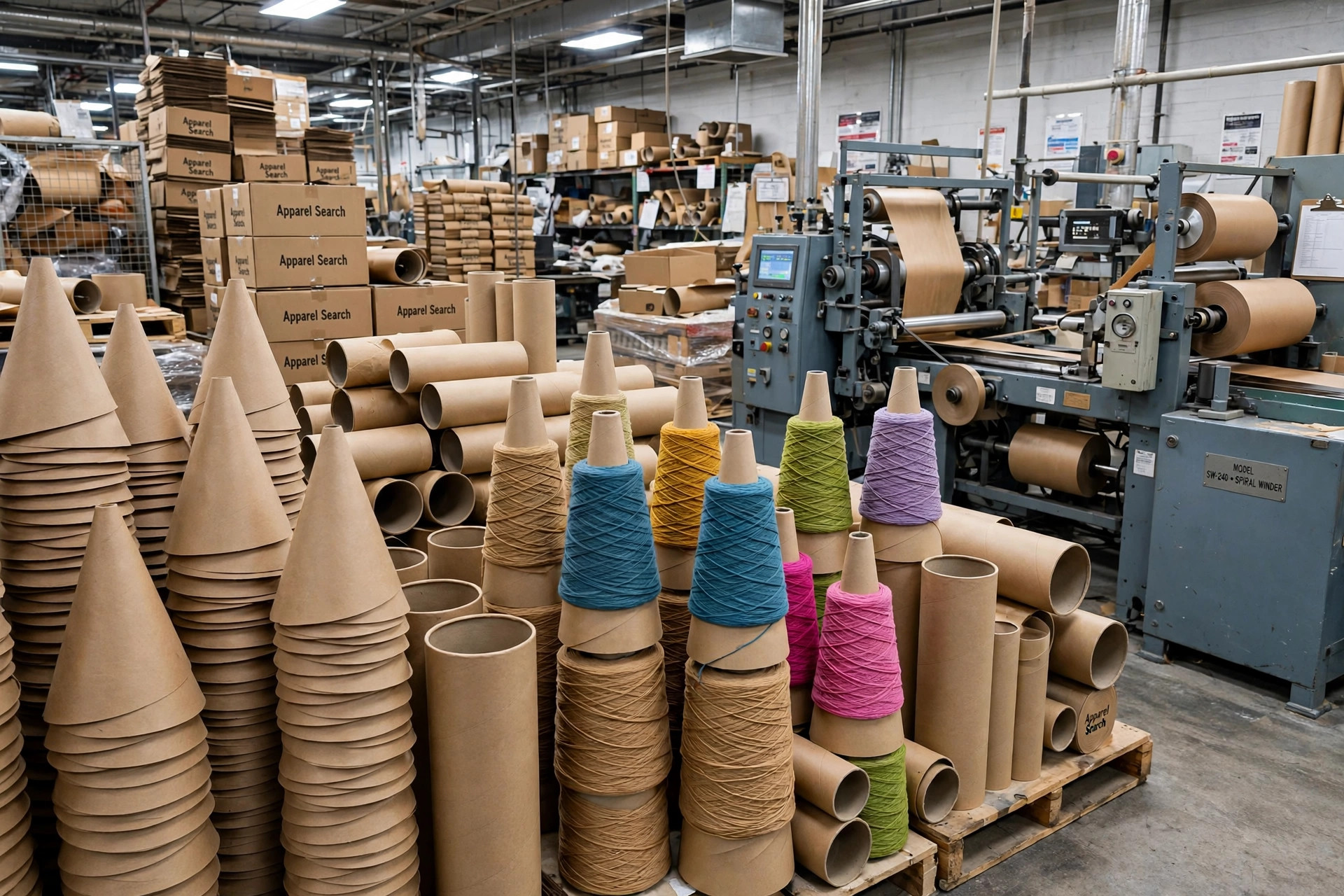
A spiral paper tube is made by winding long plies of paperboard diagonally around a steel mandrel, gluing each ply to the next as it wraps, so the finished tube is a continuous spiral laminate rather than a single rolled sheet. Ply count and paper grade set the wall thickness and the crush strength; the winding angle and the mandrel set the inner diameter and roundness. Tubes are cut to length, and their ends and outer surface can be finished — polished, grooved, notched or covered — for the process they will serve. Cones are formed on the same principle into a tapered shape, so a wound yarn package can be unwound over-end, from the tip, at high speed without the package collapsing.
Because the tube is the yarn's first packaging and its transport protection, its tolerances are functional, not cosmetic. Inner diameter decides whether the cone seats correctly on winding-machine holders and creel pins; length decides whether it fits the winder traverse and the shipping carton; wall strength decides whether the bottom cones in a pallet survive the weight above them; and moisture content decides whether a tube stays round in a humid mill or a container crossing the tropics.
Cone Angles, Conicity and Package Shapes
Paper cones are identified by their taper, expressed as an angle. The sizes named in the listing — cones of 5°57′, 4°20′ and 3°30′ among others — are the standard tapers widely used across yarn spinning industries, and the choice is not arbitrary: the angle has to match the winding machine's cone holder, the yarn type and the unwinding method. Steeper cones suit shorter, faster-unwinding packages; shallower tapers hold larger packages for weaving and knitting cones that are unwound over a longer run. A mill ordering the wrong conicity discovers it immediately, in packages that will not seat, slip, or collapse on the creel.
Alongside cones sit the straight tubes. POY tubes carry partially oriented filament yarn from the spinning plant to texturing; DTY tubes carry the draw-textured yarn that comes off the texturing machine; paper cores and cheese tubes — named for the cylindrical 'cheese' package shape — carry yarns wound in parallel-sided packages, and can be supplied in any dimensions and length, as the listing states. Each process grips its tube differently, so tube ends may be plain, rolled, notched for yarn capture at the start of winding, or fitted with features that let automatic winders find and tie the yarn tail.
Surfaces, Strength and Yarn Protection
The outside of a cone or tube touches yarn for the whole of its journey, so surface finish is a yarn-quality feature. A smooth, hard surface lets yarn slide off cleanly in over-end unwinding; textured or velvet-type finishes grip the first layers so the package builds without slipping; grooves and embossed patterns can help particular yarns hold their package shape. Paper quality matters equally at the nose and base of a cone, the points that take knocks in handling: a crushed nose makes a cone unusable even if the yarn on it is perfect.
Strength specifications should be agreed in numbers: wall thickness, ply construction, radial crush strength, and resistance to the humidity of the route the cones will travel. Yarn is wound under tension, and a full package presses outward on its tube continuously — weak tubes slowly ovalise in storage, and oval packages unwind unevenly and break yarn. Spinners shipping through hot, humid routes should say so when ordering, and test a trial quantity on their own winders before switching a whole mill's supply.
Specifying a Cone or Tube Order
A complete order states the article (paper cone, POY tube, DTY tube, paper core or cheese tube), the inner diameter, the length, the cone angle for tapered cones, the wall thickness or ply build, the surface finish, any end finish or notch, the colour or printing if packages are colour-coded by yarn type, and the quantity and delivery schedule. Makers who supply to specification, as in the listing, work from a sample or a drawing of the cone currently in use — sending a physical sample of the existing cone, with a length of the yarn that will be wound on it, is the surest way to match a running production setup.
Finally, weigh paper against reusable plastic cones on total cost, not unit price. Paper cones are light, saving freight on every shipment; they are recyclable single-trip packaging; and they arrive ready for the winder with no washing, sorting or return logistics — which is why they remain the spinning industry's standard carrier for export yarn.
Yarn Cone & Spiral Paper Tube Factories
Manufacturers of paper yarn cones and spiral paper tubes supplying yarn manufacturers and spinning industries.
Sunny Texcone India Pvt. Ltd. (India)
Sunny Texcone is providing some of the best packaging solutions to the industry in the form of paper cones of various sizes, conicity and specifications. Sunny Texcone India Pvt. Ltd is one of the leading manufacturers and exporters of paper cones in India, catering to the packaging requirements of yarn manufacturers. Experience of over two decades has made Sunny Texcone an expert and pioneer in the field of paper cones. They can supply cones and tubes exactly as per your desired specifications and quality, and as per your specified delivery schedules.
Paper Cones: 5°57′ / 4°20′ / 3°30′ and others (widely used by all yarn spinning industries) · Paper Tubes: POY Tubes / DTY Tubes / Paper Core / Paper Cheese in any dimensions & length
Address: Agarwal Campus, Modi Nagar Road, Hapur-245101, Dist. Ghaziabad (U.P.), India Ph: 91-0122-3205100 Telefax: 91-0122-2306929 E-mail: sunnytexcone@gmail.com
More Yarn & Industry Resources
Common Questions
What does the cone angle on a paper yarn cone mean?
It is the taper of the cone, and standard paper cones are made in angles such as 5°57′, 4°20′ and 3°30′. The angle must match the winding machine’s cone holder, the yarn type and the way the package will be unwound; the wrong conicity gives packages that will not seat properly, slip, or collapse on the creel.
What is the difference between POY tubes, DTY tubes and paper cores?
They are spiral paper tubes built for different process steps. POY tubes carry partially oriented filament yarn from spinning to texturing, DTY tubes carry draw-textured yarn coming off the texturing machine, and paper cores carry cylindrical cheese packages of yarn. They can be made in any dimensions and length, with end finishes suited to each machine.
How are spiral paper tubes made?
Plies of paperboard are wound diagonally around a steel mandrel and glued ply to ply, forming a continuous spiral laminate. The ply count and paper grade set wall thickness and crush strength, the mandrel sets the inner diameter, and the tube is then cut to length and finished — smooth, grooved, notched or otherwise surfaced — for the winding process it will serve.