Retail Buying & Merchandise Planning · The Exit
Markdown Strategy
The last stage of the buying cycle, and the most misunderstood: clearing stock on a planned cadence that protects margin, instead of a clearance panic that gives it away.
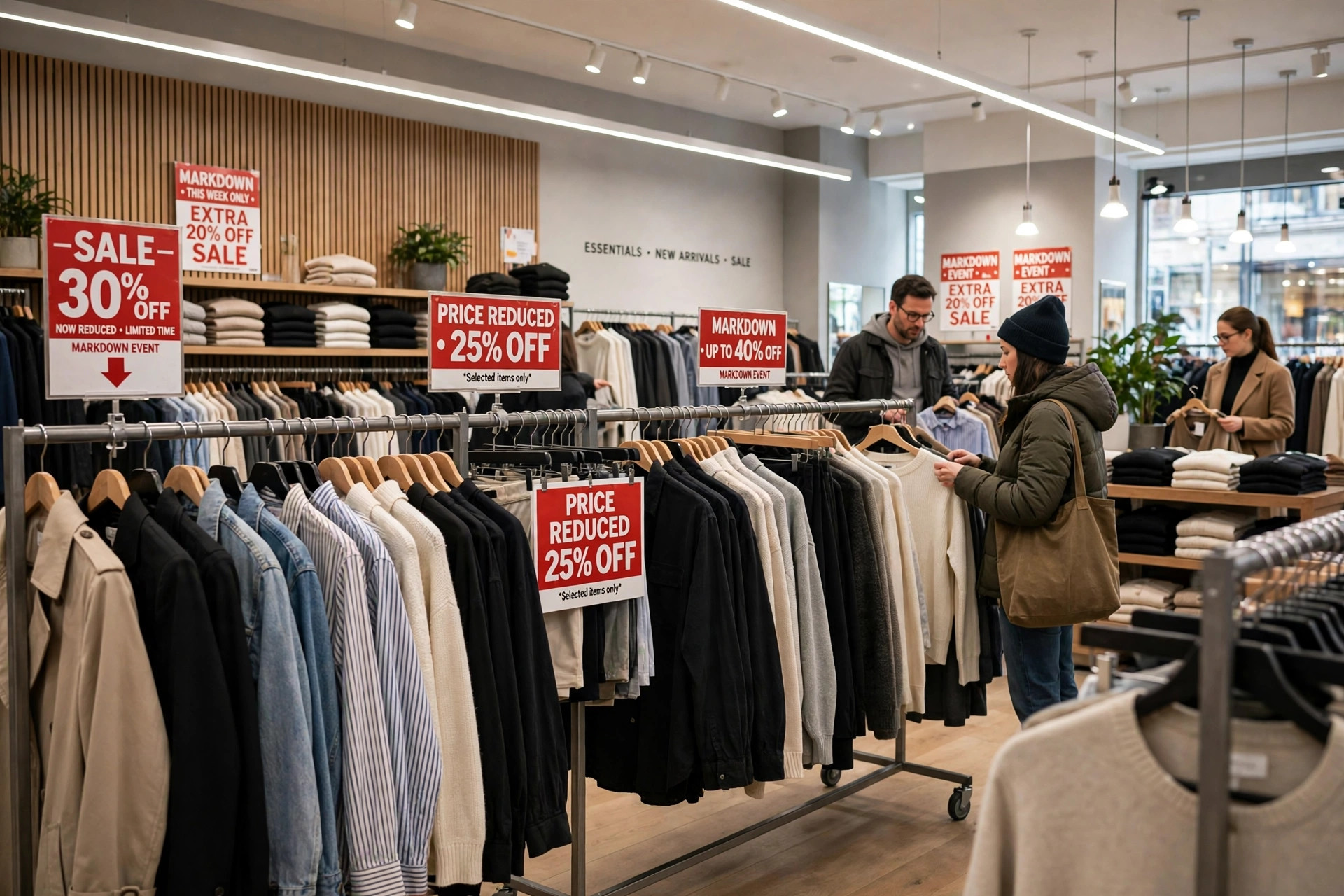
Every fashion season ends with stock that did not sell at full price. What separates professional buying from hopeful buying is whether that stock is cleared by strategy or by surrender. This closing page of the Retail Buying & Merchandise Planning Guide covers markdowns as a planned discipline: funded in the season plan before the season begins, triggered by in-season evidence, and executed on a cadence. The markdown formulas themselves are on the markdown retail math page; this guide is about when, how deep, and in what order.
Two Different Tools Called Markdown
Promotional markdowns are temporary reductions — events, weekends, category promotions — designed to drive traffic and volume, after which prices restore. Clearance markdowns are permanent reductions whose job is to end a style's life and convert its remaining units into cash and empty rail space for the next season. Strategy treats them separately: promotions are scheduled in the trading calendar; clearance is scheduled against each style's evidence.
The Arithmetic of Early Versus Late
The oldest argument in buying is whether to reduce a weak style now or give it more time at full price. Run the numbers on a typical case — a style bought 200 units deep at a $40 ticket, which has sold 130 units at full price and stalled with 70 left:
| Decision | What happens to the 70 remaining units | Total retail taken |
|---|---|---|
| Early planned markdown: 25% off ($30) with eight selling weeks left | Sells through at $30 → $2,100 | $5,200 + $2,100 = $7,300 |
| Hold at full price, then end-of-season clearance at 50% off ($20) | Sells at $20 in the final event → $1,400 | $5,200 + $1,400 = $6,600 |
| Difference | The early markdown gives up $10 on units that were not selling; the late one gives up $20 on all of them | $700 kept |
The figures are illustrative, but the shape is the trade's oldest lesson: the early reduction is shallower and smaller in total, because it works while customers and weeks remain. Waiting does not avoid the markdown; it usually enlarges it. (The example assumes the early reduction actually clears the units — which is why depth and timing are judged together, and why a token cut that changes nothing is the worst of both worlds.)
Building the Cadence
Trigger on evidence, not dates alone
Styles enter clearance when their sell-through after a fair window says they will not clear at full price — not simply because the calendar reached a sale month. Calendar events exist, but the style list for them should come from the trading evidence.
First cut: meaningful, not terminal
The first reduction must be large enough to change the decision of customers who already refused the style at full price — commonly in the 20–30% range for fashion goods — while leaving room for further steps on whatever remains.
Step down on a schedule
Remaining units step down at planned intervals, each step reviewed against the units and weeks left. Unsold styles are also consolidated — gathered from many stores into fewer locations — so the reduced offer still looks like a range, not a residue.
Final clearance is a designed event
The season's last reduction is merchandised like any other event — signed, grouped and time-boxed with the visual merchandising team — because even at clearance prices, presentation decides how much of the residue actually converts.
Close the loop into next season
Every markdown is data: which categories, price points, colors and vendors consumed the markdown money. That post-mortem feeds the next six-month plan and the next assortment — the cycle this guide began with.
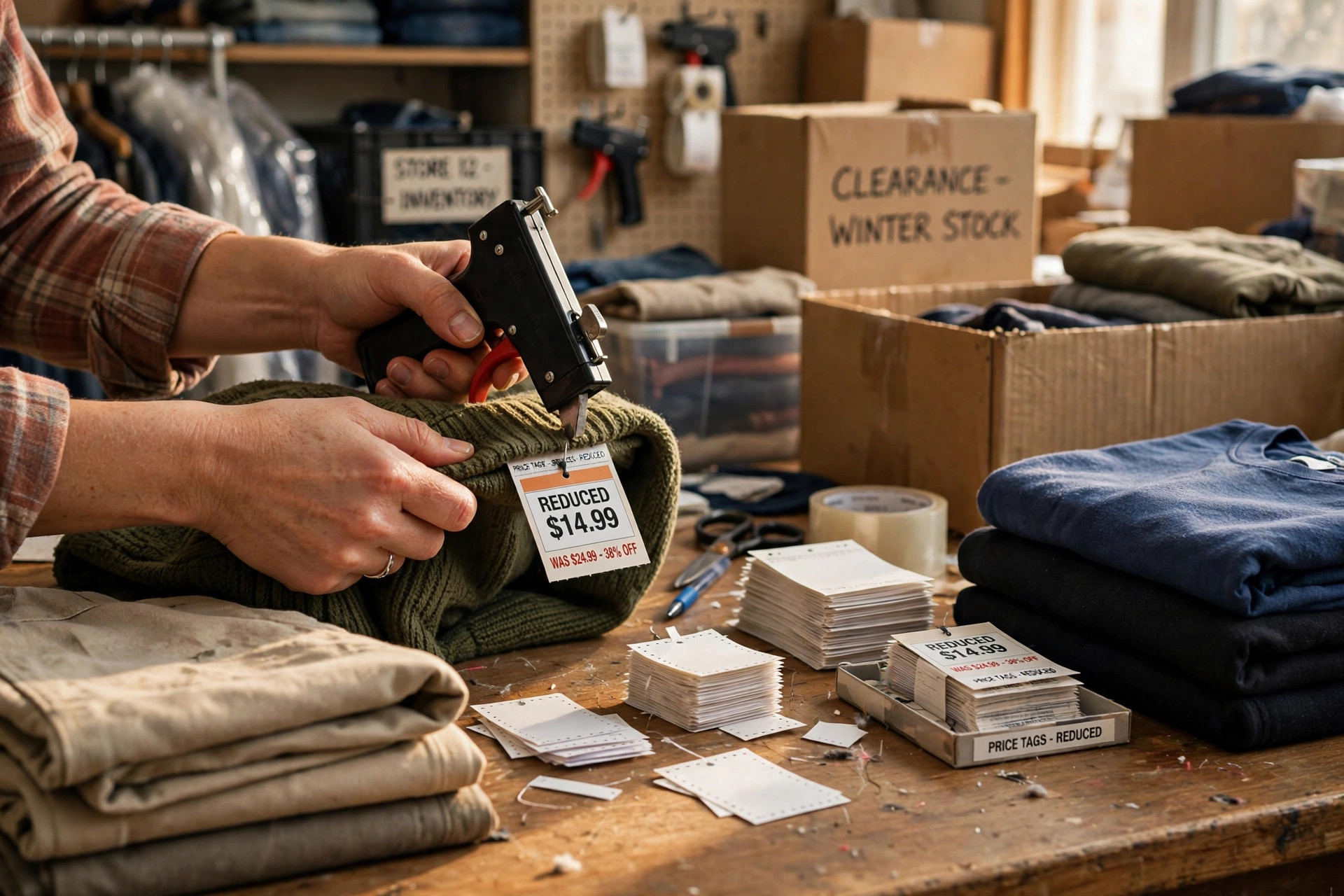
The Customer Side of the Cadence
Markdown strategy also manages what customers learn. A store that trains its shoppers to wait — perpetual promotions, predictable deep events on everything — finds its full-price weeks quietly dying, because the rational customer never buys early again. The disciplines that protect the full-price business are part of the strategy: reduce the specific styles that need it rather than the whole department, keep genuine full-price newness flowing while clearance runs, and make events feel like events — bounded in time and stock — instead of a permanent state of apology. Margin is protected twice: once in the arithmetic of each reduction, and once in the customer's belief that full price is real.
Continue Through the Guide
Common Questions
What is the difference between a promotional markdown and a clearance markdown?
A promotional markdown is temporary and tactical — a planned event or short reduction designed to drive traffic and sales across the store, after which prices return to normal. A clearance markdown is permanent and terminal: the price is reduced to end the style's life and recover whatever value remains before the season closes. The two use different depths, timing and signage, and confusing them trains customers to ignore both.
Why do buyers say an early markdown is cheaper than a late one?
Because the earlier reduction works while selling weeks remain. A style reduced 25% with eight weeks of season left can sell most of its remaining units at that price; the same style held at full price until the end usually needs 50% or more in the final clearance, on the same unsold units. The total markdown dollars are often smaller when taken early — the saving shows up as units that never needed the deeper cut.
How deep should a first markdown be?
Deep enough to change the customer's decision, shallow enough to leave room to go further. A token 10% rarely moves a style that has already been refused at full price for weeks; first clearance reductions commonly land in the 20–30% range in fashion retail, with further steps reserved for what remains. The right depth depends on the units left, the weeks left and the style's rate at full price — which is why it is a calculation, not a habit.
Do markdowns mean the buyer failed?
No — markdowns are a planned cost of fashion risk, funded in the season plan before a single order is placed. A department with zero markdowns usually bought too safe and missed sales; a department whose markdowns far exceed plan bought badly or traded poorly. The measure is markdowns against plan, not markdowns against zero.
Back to the Guide
This page is one of six in the Retail Buying & Merchandise Planning Guide — return to the hub for the full buying cycle, from the six-month plan to the final markdown.