Crochet Stitches Guide · Foundation & Basics
Double Crochet (dc)
Double crochet — abbreviation dc, and in British patterns treble crochet — is the workhorse stitch of the craft. One yarn over, the hook enters and draws up a loop, and the three loops on the hook are closed two at a time. It is tall enough to build fabric quickly, open enough to drape, and the stitch most pattern stitches are built from.
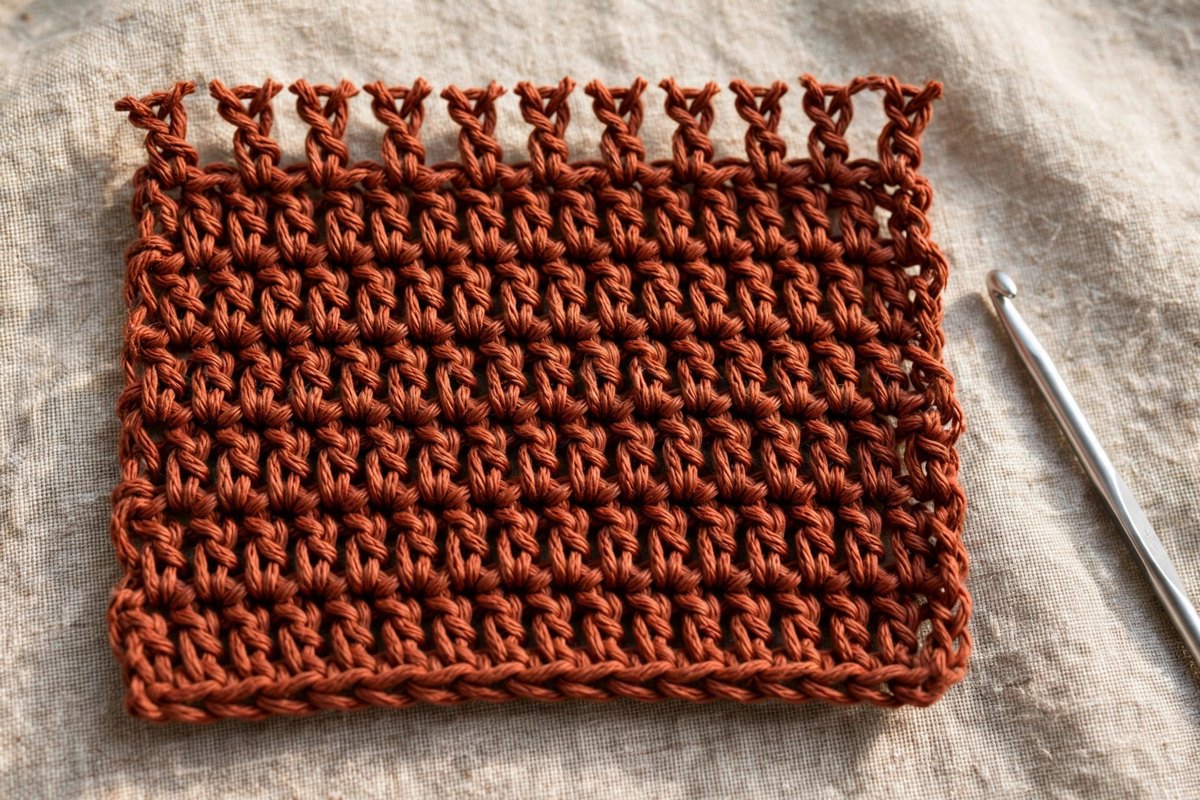
Ask a room of crocheters which stitch they have worked most and the answer is this one. Double crochet sits at the family's centre of gravity: twice the height of single crochet, so fabric grows at a satisfying pace; closed in two stages, so the posts stand upright and the cloth keeps some body; open enough between posts to drape over a shoulder or fold into a blanket. It is also the craft's unit of construction — the stitch that shells fan out from, that clusters gather, that post stitches relocate to the front or back of the work, that the classic granny square is built from almost entirely.
This guide covers the formation itself, the turning chain that causes more confusion than any other three chains in crochet, the fabric's character, and the variations that lead outward to the texture and post-stitch families.
How to Work It
Double crochet — an original Apparel Search drawing. Three loops on the hook, closed two at a time. Illustration by Apparel Search.
- Yarn over the hook once, wrapping the yarn from back to front over the shaft.
- Insert the hook into the next stitch, under both top loops. Yarn over again and draw the yarn through the stitch — three loops now sit on the hook.
- Yarn over and draw through the first two loops on the hook. Two loops remain.
- Yarn over and draw through the last two loops. The double crochet is complete: a tall post standing on the row below, one loop on the hook.
The first row. Into a foundation chain, the first double crochet is worked into the fourth chain from the hook: the three skipped chains are the turning chain, standing in for the row's first stitch.
The turning chain — read this part twice. At a row's end, chain three and turn. Unlike single crochet's chain one, the double crochet turning chain counts as a stitch — it is the row's first double crochet, standing at the edge. The row's first true double crochet therefore goes into the second stitch of the row below, and the row's last double crochet is worked into the top of the turning chain of the row below — into its third chain. Forget the first rule and the piece gains a stitch every row; forget the second and it loses one. Between them they explain nearly every trapezoid a beginner ever produced. (Some modern patterns substitute a stacked single crochet or a standing start for the chain three to avoid its slight gap; the stitch count logic is the same.)
The Fabric It Makes
Double crochet fabric is the balanced cloth of the craft: distinct upright posts, a small diamond of air between each group of four stitches, a hand that is neither boardy nor limp. It drapes — genuinely drapes, in a way single crochet cannot — while still reading as a solid fabric rather than a lace, and it grows at roughly twice single crochet's speed on about the same yarn budget per row count halved. Rows show a clear rhythm of post and gap that makes counting easy and mistakes visible, one more reason patterns default to it.
The fabric's one structural habit is a slight bias: worked in turned rows, double crochet can lean almost imperceptibly, which long pieces sometimes show as a gentle skew. Alternating the direction of work — as in rounds, or by turning and working into the back of the fabric in some constructions — cancels it; in ordinary garments and blankets it is too small to matter.
Working Notes
Know the post's anatomy
A double crochet stitch has three places a later stitch can go: under its two top loops (the default), around its post from the front, and around its post from the back. The post stitches of Family 3 — and with them ribs, cables and waffle — are nothing but this stitch worked around the post instead of into the top. Learning to see the post now makes that whole family a formality later.
The drawn-up loop sets the height
A double crochet's height is decided at step two: the loop drawn up through the stitch should rise to the full height of the stitches beside it before the closings begin. Short-changed loops make short, leaning posts and the small holes crocheters blame on the pattern. Pull up generously; the closings will set the size.
Yarn over direction
The wrap goes over the hook from back to front, every time, without thinking about it. A reversed wrap twists the stitch's legs and subtly changes the fabric's face — invisible in a swatch, obvious across a garment front.
Where It Is Used
Garments — sweaters, cardigans and tops default to double crochet for its drape-to-body balance. Blankets and afghans — fast coverage with a fabric that folds and keeps warmth. The granny square — the classic motif is groups of three double crochets separated by chains; much of crochet's motif tradition is this stitch arranged in rounds. Shells and fans — five or more double crochets into one stitch make the shell, the first texture stitch most crocheters meet (Family 2). Scarves and shawls in its plainer rows, and as the ground into which post stitches, clusters and colourwork are set.
Variations
Back loop and front loop only
As with single crochet, working under one strand of the top only leaves a ridge and changes the fabric's stretch and face — the simplest texture available, and the basis of ribbed bands worked in rows.
Front post and back post double crochet
The hook goes around the post of the stitch below — from front to back, or back to front — instead of into its top. The stitch stands proud of or behind the fabric's surface, and alternating the two builds true ribbing, crochet cables and the waffle stitch. These are Family 3's foundation and the natural next step from this page.
Linked double crochet
Each stitch is begun by drawing a loop through the horizontal bar of the previous stitch instead of a plain yarn over, linking the posts into a fabric without the usual gaps — a firmer, more woven double crochet cloth, valued for garments that should not show light through them.
Herringbone double crochet
A small reordering — the first drawn loop is pulled through one loop on the hook before the normal closings — slants each post slightly, giving a fabric with a subtle diagonal grain that suits plain garments wanting a quiet texture.
Where It Goes Wrong
Gaps at the row ends
The chain-three turning chain stands a little apart from the first true stitch, leaving a notch at each edge. The cures, in order of fuss: work the turning chain tighter; replace it with a stacked single crochet (two single crochets piled at the edge); or begin rows with a standing double crochet when working in rounds. All preserve the stitch count.
The piece is becoming a trapezoid
Stitch count is drifting — a stitch gained at the row's start by working into the first stitch as well as counting the turning chain, or lost at its end by missing the stitch into the turning chain's top. Count one full row slowly, mark the first and last stitches, and the shape recovers within a row or two.
Holes between the posts
Either the drawn-up loops are short (see Working Notes) or the yarn is thin for the hook. Double crochet always shows small gaps — that is its character — but window-sized holes mean the loop is being closed before it reaches full height.
Related Stitches
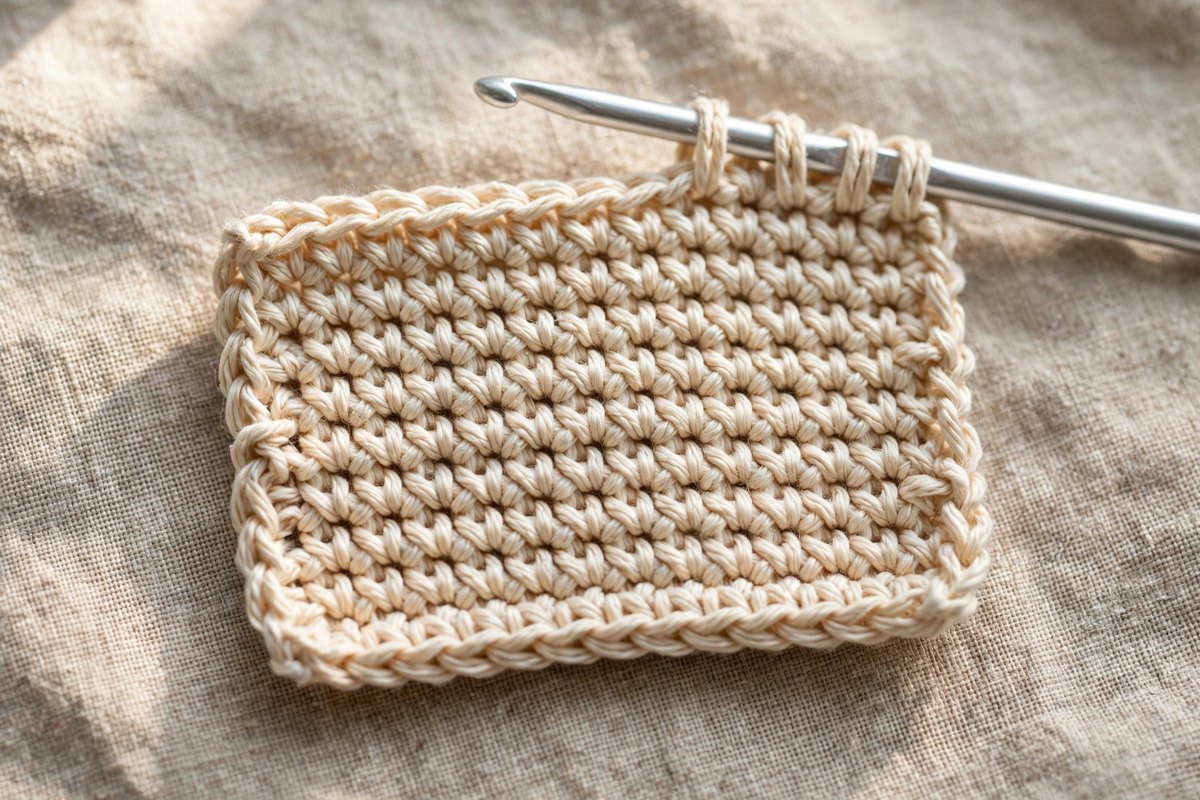 Single CrochetHalf the height, twice the density — the full guide.
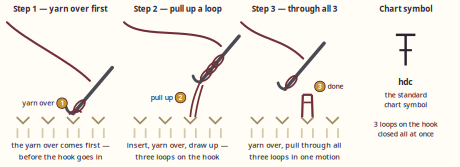 Half Double CrochetDouble crochet's closest sibling, closed all at once.
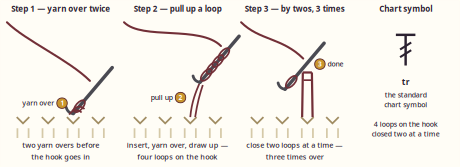 Treble CrochetOne more yarn over: taller, airier — and it has a full guide.
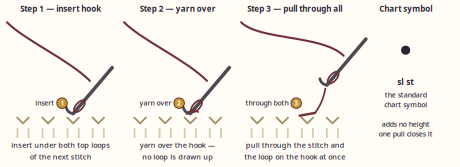 Slip StitchFor joining double crochet rounds without a step.
 Foundation & BasicsAll seven basic stitches with diagrams, on the family page.
Common Questions
Does the chain-three turning chain count as a stitch?
Yes — in double crochet the turning chain stands in for the row's first stitch. The first worked double crochet goes into the second stitch of the row below, and the last double crochet of the row goes into the top of the previous row's turning chain. Treating it as a non-stitch, the way single crochet's chain one is treated, is the commonest cause of narrowing double crochet fabric.
What is the difference between half double and double crochet?
Both begin with one yarn over and draw up a loop to leave three loops on the hook. Half double closes all three loops in one motion, making a shorter, denser stitch; double crochet closes two loops, then two again, making a taller, more open stitch. The formations are identical until the closing — which is why the two are taught together.
Why are there holes in my double crochet fabric?
Small, regular gaps between posts are the stitch's normal character. Large or irregular holes usually mean the loop drawn up at the start of each stitch is being pulled too short, so the post closes below full height, or the hook is large for the yarn. Draw each loop up to the height of the finished stitches beside it before closing.
Is double crochet the same as British treble?
Yes. American double crochet (dc) is British treble crochet (tr) — the same formation under two names, one step apart in the two terminologies. The hub page's conversion table translates the whole basic family in both directions.
More to Explore
Search Apparel Search