Crochet Stitches Guide · Foundation & Basics
Treble Crochet (tr)
Treble crochet — abbreviation tr, and in British patterns double treble — wraps the yarn twice before the hook goes in, draws up a long loop, and closes its four loops two at a time, three times over. The result is the family's tall, open stitch: fabric at its fastest and lightest, and the post that lace and summer crochet are built around.
Every rung of the basic ladder trades structure for speed and air, and treble crochet is where the trade becomes dramatic. A treble row stands nearly twice as tall as a double crochet row, so a shawl grows under the hands at a pace no other basic stitch matches — while the fabric it leaves behind is mostly post and opening, a cloth that moves like netting and lets light and air through. Worked well, it is the most elegant of the basics; worked carelessly, its long posts lean, twist and snag, and the piece looks tired before it is finished.
This guide covers the formation — above all, control of the double yarn over, which is the stitch's whole skill — the fabric's character and limits, and the places treble crochet earns its keep: shawls, summer garments, lace panels and the tall spokes of motifs.
How to Work It
Treble crochet — an original Apparel Search drawing. Four loops on the hook, closed two at a time, three times. Illustration by Apparel Search.
- Yarn over the hook twice — two full wraps around the shaft, held lightly with the yarn hand's finger so they cannot slide off or cross.
- Insert the hook into the next stitch, under both top loops. Yarn over and draw through the stitch, pulling the loop up to the full height of the stitches beside it — four loops now sit on the hook.
- Yarn over and draw through two loops. Three remain.
- Yarn over and draw through two loops again. Two remain.
- Yarn over and draw through the last two loops. The treble stands complete: a long post with three closings stacked along it.
The first row. Into a foundation chain, the first treble is worked into the fifth chain from the hook; the four skipped chains are the turning chain.
The turning chain. Chain four at each row's end. Like double crochet's chain three, it counts as the row's first stitch: the first worked treble goes into the second stitch below, and the last treble of the row goes into the top of the previous turning chain. Treble edges punish a loose turning chain more than any other stitch's — its four chains must be worked at the same tension as the posts, or the edge scallops.
Holding the wraps. The two yarn overs are the stitch's only difficulty. Keep them side by side on the shaft, not crossed, and pin them gently with the index finger of the yarn hand until the hook has entered the stitch and drawn its loop up; after that the four loops hold each other in order and the closings are plain double-crochet rhythm, once more over.
The Fabric It Makes
Treble fabric is a colonnade: long, slender posts with open space between them, connected only at their heads and feet. It is the lightest solid-row fabric in the family and by far the fastest to accumulate — a treble blanket front grows at nearly twice the rate of the same front in double crochet. The cloth drapes completely, folds to almost nothing, and shows its pattern of posts and openings beautifully in plain colours.
The limits are the same facts read from the other side. Long posts catch and pull; a snagged treble can distort several stitches. The fabric has little body, so edges wander without a firmer border — a round of double or single crochet is the standard frame. And because each stitch is closed in three separate motions, small tension differences multiply visibly along the post: treble crochet rewards an even hand more than any other basic stitch, and exposes an uneven one just as faithfully.
Working Notes
Draw the loop up to full height
A treble's post is only as straight as the loop it began from. Draw the loop up until the stitch stands at the height of its finished neighbours before starting the closings; a loop closed short makes the post lean toward the working direction, and a row of leaning posts is the commonest treble fault there is.
Count the closings, not the loops
With four loops on the hook it is easy to close twice, admire the stitch, and move on with two loops still aboard. The rhythm to internalise is two, two, two — three closings, every stitch, until it is as automatic as double crochet's two.
Tension on tall stitches
Work trebles slightly firmer than instinct suggests. The long post amplifies slack: a relaxed treble row can grow a visible wave along its head within a few rows. If the fabric ripples, the cure is a half-size smaller hook, not tighter hands — the wraps and loops must still slide freely.
Where It Is Used
Shawls and wraps — the stitch's home ground: maximum drape and coverage per gram of yarn. Summer tops and beach cover-ups, where the open fabric is the point. Lace panels and insertions — treble posts frame chain spaces and filet-style mesh with a longer, more graceful unit than double crochet gives. Motifs — the tall spokes of wheels, stars and flower centres are trebles, reaching across the short stitches around them. Edgings — a final row of trebles gives skirts and cloths a long, light fringe-like finish, often with picots from Family 2 worked along it.
Variations
Back loop only
Working trebles under the back loop only softens the fabric further and lays a fine ridge along each row's head — used in light scarves where the treble's plain face wants a little more incident.
Front post treble
Worked around the post of a double or treble below, the front post treble stands in relief and runs long — the stitch of crochet cables that travel, and of raised diagonals in textured panels. It belongs to Family 3's post-stitch set and is the natural next step from this page.
Treble clusters and fans
Several trebles left with their last closing shared — a cluster — or fanned into one stitch as a tall shell, give the lace designer her main ornaments. Both are Family 2 formations built entirely from this page's stitch.
Where It Goes Wrong
The posts lean or curve
The drawn-up loop is being closed below full height, or the wraps are crossed on the shaft, twisting the post as it forms. Uncross the wraps, pin them until the loop is drawn, and pull that loop up to the neighbours' full height before the first closing.
The wraps slide off the hook
Two wraps are a crowd on a slim shaft. Use the yarn hand's index finger as a gate until the hook is in the stitch, and choose a hook with a deeper throat for treble-heavy work — shallow-throated hooks shed wraps constantly.
The edges wave
Turning chains worked looser than the posts, or an extra stitch hiding at a row end. Treble's height magnifies both. Work the four chains deliberately at post tension, and count the row: with a counting turning chain, the last stitch belongs in the chain's top, not beside it.
Related Stitches
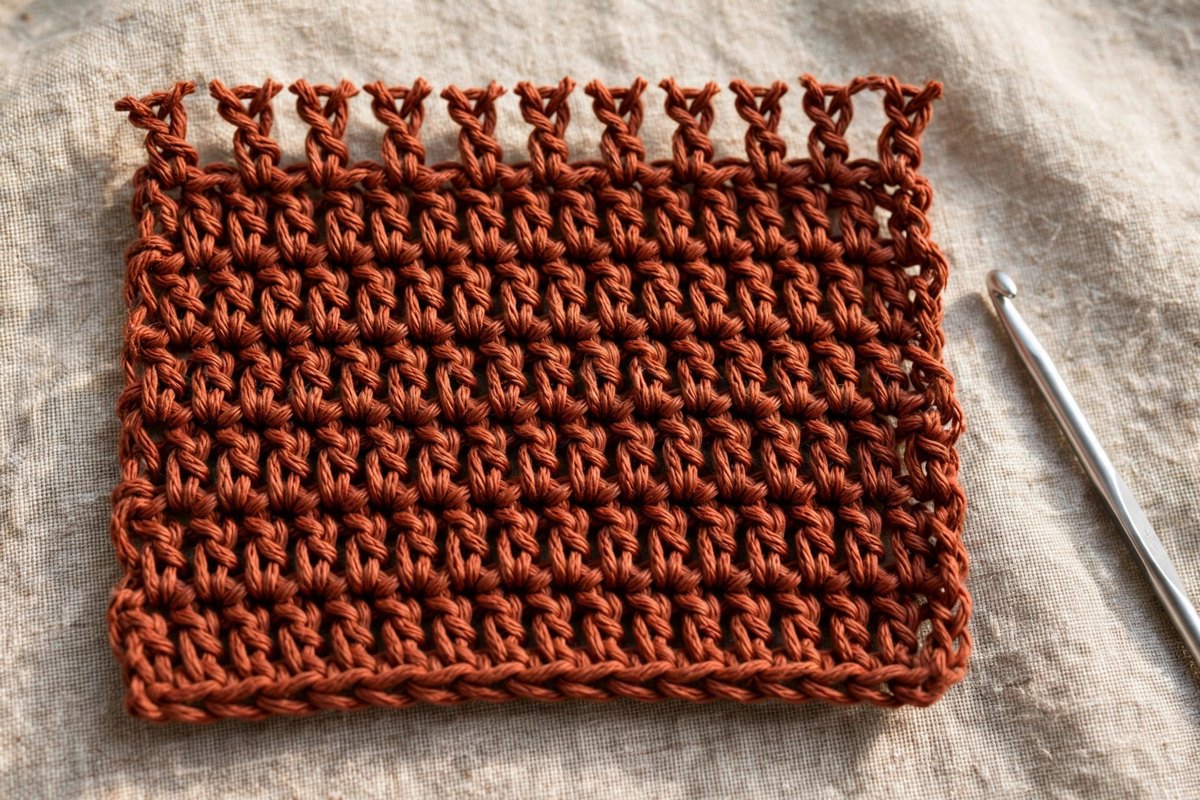 Double CrochetOne wrap fewer: the workhorse — the full guide.
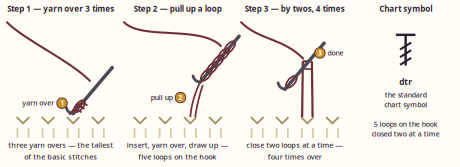 Double Treble CrochetOne wrap more: the tallest basic stitch.
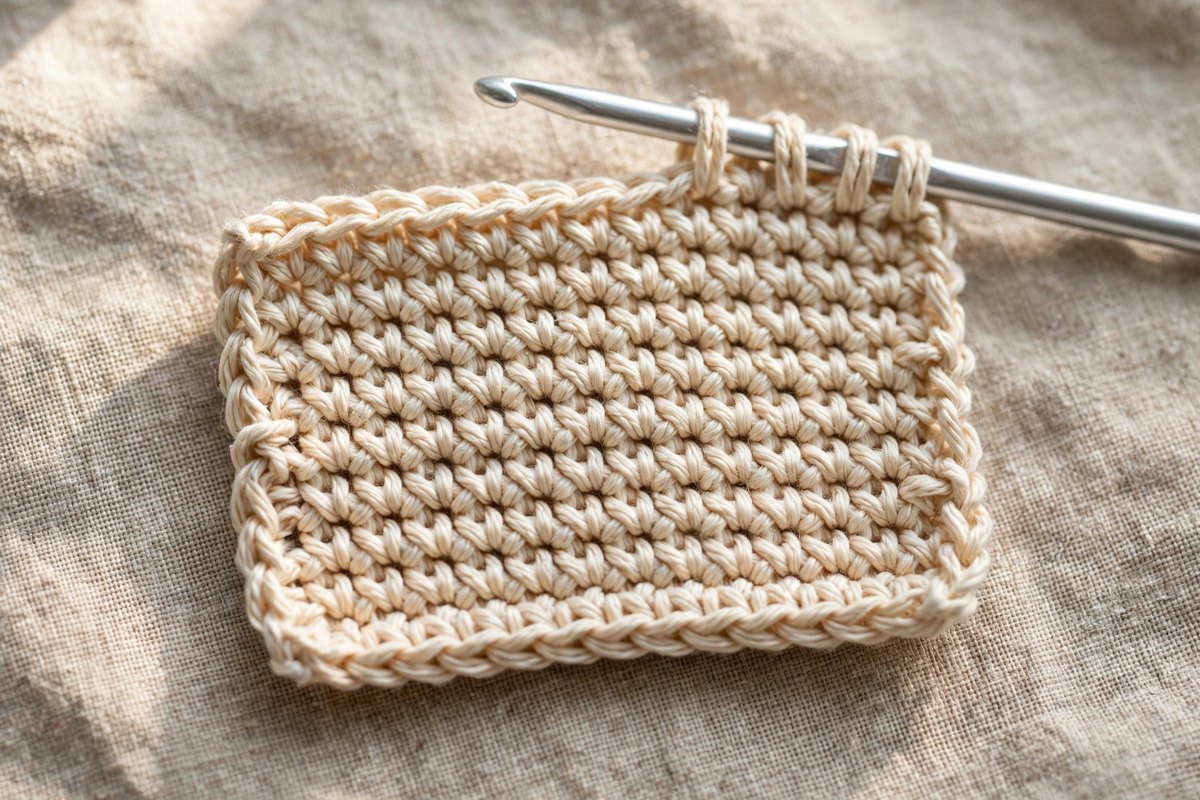 Single CrochetThe dense opposite pole of the family — the full guide.
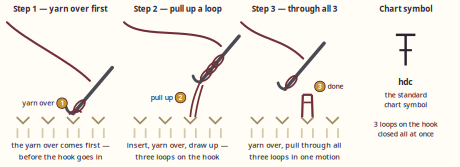 Half Double CrochetThe middle stitch, closed all at once.
 Foundation & BasicsAll seven basic stitches with diagrams, on the family page.
Common Questions
Is treble crochet the same as British double treble?
Yes — American treble crochet (tr) is British double treble (dtr), the same two-wrap formation under the two terminologies. The step that trips readers is the next one up: the American double treble is the British triple treble. The hub page's conversion table sets the whole family side by side.
Why do my treble stitches lean?
Leaning posts mean the loop drawn up at the stitch's start is being closed below the full height of its neighbours, so each post finishes tilted toward the working direction — or the two yarn overs are crossing on the shaft and twisting the post. Keep the wraps parallel, pin them until the loop is drawn, and pull that loop up to full height before the first of the three closings.
How many times do you pull through two in a treble?
Three. A treble has four loops on the hook at its fullest — the original loop, the two wraps' worth carried through the stitch, and the drawn-up loop — and they are closed two at a time: four loops become three, then two, then one. Double crochet closes twice; double treble, four times. The count of closings is the ladder's arithmetic.
When is treble crochet the wrong stitch?
Wherever the fabric must be dense, warm or hard-wearing: its open colonnade of posts lets air and light through, snags readily, and gives edges little stability. Bags, amigurumi, pot holders and warm blankets belong to single and half double crochet. Treble is for drape, speed and lace — pieces where openness is the design.
More to Explore
Search Apparel Search