Crochet Stitches Guide · Foundation & Basics
Single Crochet (sc)
Single crochet — abbreviation sc, and in British patterns double crochet — is the shortest and densest of the crochet fabric stitches. The hook enters the stitch with no yarn over first, one loop is drawn up, and the two loops on the hook are closed together. Nothing in the stitch is wasted, and the fabric it builds is the firmest crochet makes.
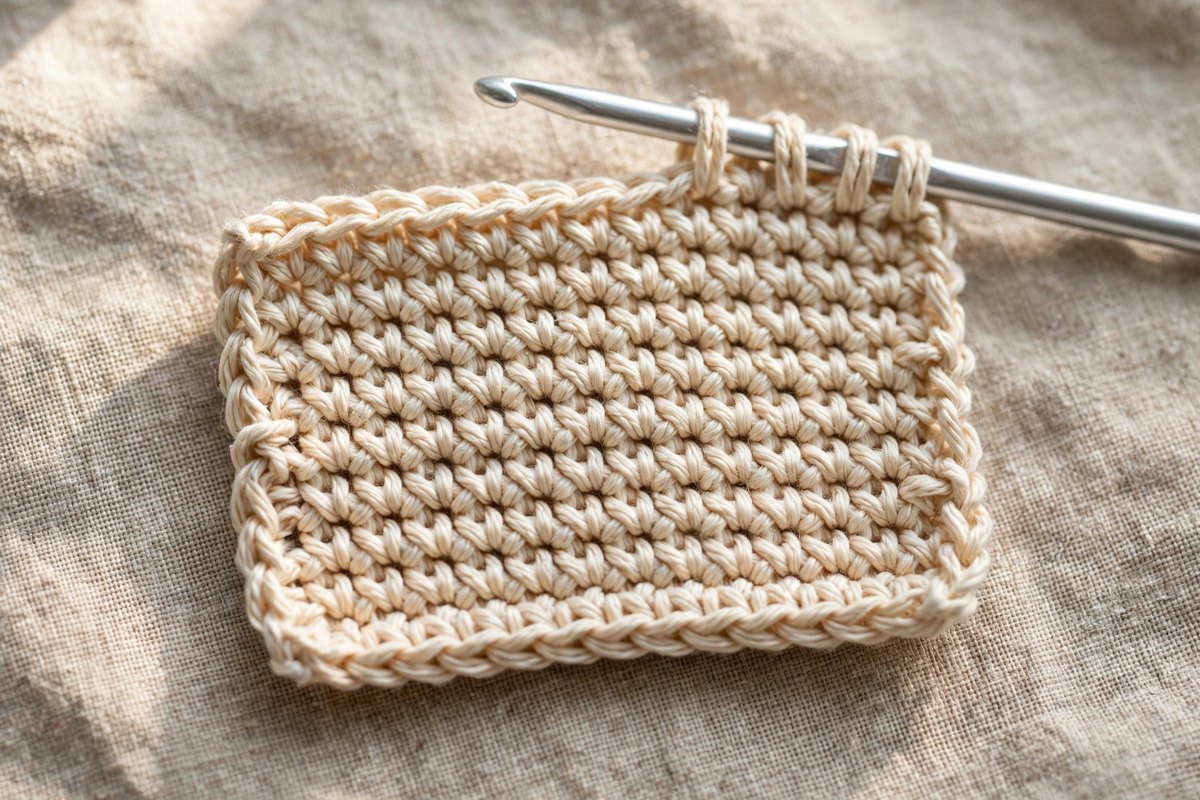
If crochet has a foundation garment stitch, this is it. Single crochet is usually the first fabric stitch a beginner makes successfully, and it remains — long after the taller stitches are familiar — the stitch professionals reach for whenever the fabric must behave: hold a shape, take a load, survive washing, present a smooth dense surface for embroidery or appliqué. Its very shortness is the point. A single crochet stitch is barely taller than the yarn is thick, so a fabric of it has more stitches, more interlocking and more yarn per square inch than any other basic fabric — and behaves accordingly.
This guide works the stitch completely: the formation, the first row and the turning chain, the fabric's character, the counting discipline its edges demand, and the variations — back loop, front loop, extended — that turn one small stitch into a small family of fabrics.
How to Work It
Single crochet — an original Apparel Search drawing. Two loops on the hook, closed together. Illustration by Apparel Search.
- Insert the hook into the next stitch, under both top loops. There is no yarn over before this step — that absence is what makes the stitch single crochet.
- Yarn over and draw the yarn through the stitch. Two loops now sit on the hook, and the drawn-up loop should be pulled up only to the hook's shaft thickness — no higher.
- Yarn over again and draw through both loops on the hook. The stitch is complete: one loop remains, and the finished single crochet stands as a small, tight knot at the top of the stitch below.
The first row. Working into a foundation chain, the first single crochet goes into the second chain from the hook — the chain nearest the hook is the turning allowance, never worked into. Work one single crochet in each chain across, keeping the chain relaxed; a tight chain makes this row pucker before the fabric has a chance.
The turning chain. At each row's end, chain one and turn. That single chain is a step up to the new row's height, and in standard US practice it does not count as a stitch: the row's first single crochet goes into the very first stitch of the row below — the one at the base of the turning chain — and the row's last single crochet goes into the last stitch of the row below, not into the turning chain itself. Most narrowing edges in beginner single crochet are born right there.
The Fabric It Makes
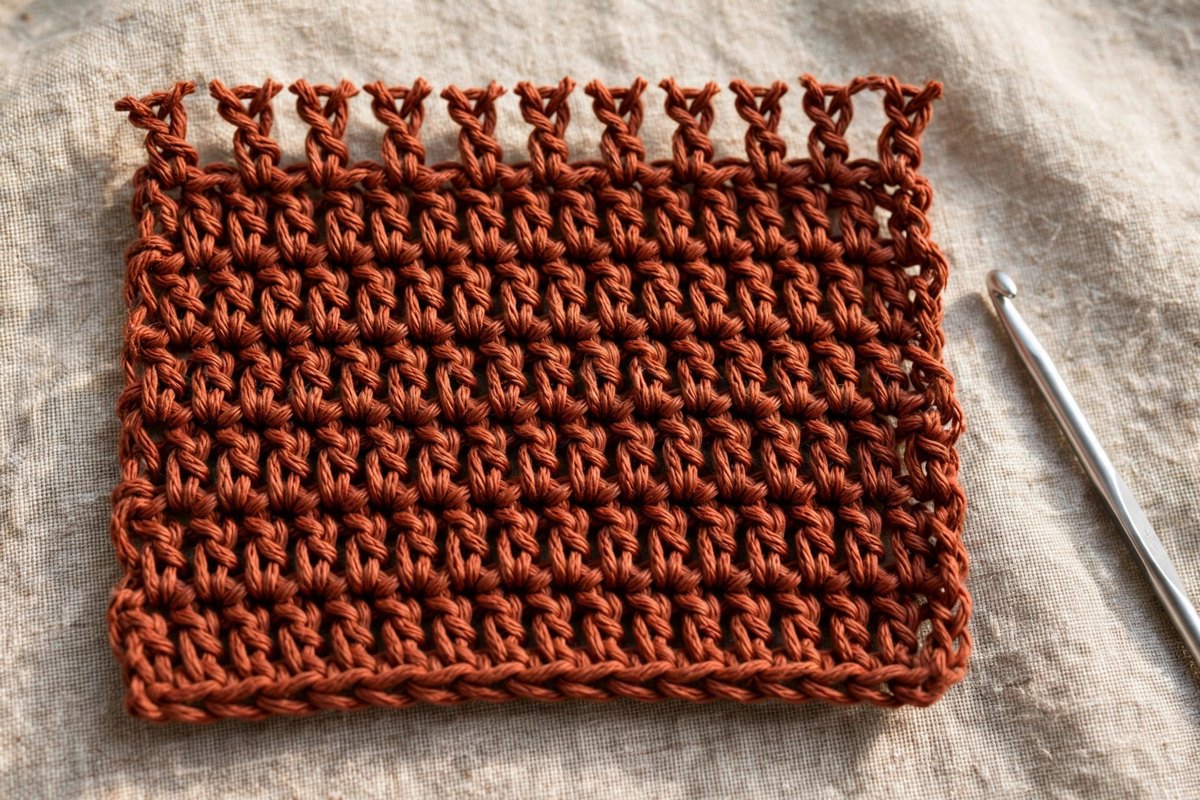
Rows of single crochet build a cloth that barely resembles the open lattice most people picture as crochet. The stitches sit as tight, interlocked knots with no visible holes; the fabric is firm, flat and almost woven in character, with very little stretch in either direction and excellent resistance to snagging and distortion. It is also the slowest basic fabric to grow — each row adds only a stitch's small height — and the hungriest: a single-crochet blanket can take a third more yarn than the same blanket in double crochet.
The surface reads differently on its two faces. The front shows neat rows of small V-topped knots; the back shows horizontal ridges. Neither face curls — single crochet lies flat, which is one reason it is chosen for pieces that must sit still: coasters, mats, bags that stand up, and the bodies of amigurumi figures, where its density also keeps stuffing invisible.
Working Notes
Counting is the whole game
Single crochet rows are short, so a lost stitch shows quickly as a slanting edge. Count the stitches at the end of every few rows until the count is automatic. The two places stitches vanish are the row's beginning — where the first stitch hides at the turning chain's base — and its end, where the last stitch sits tight against the edge and is easy to skip. Placing a marker in the first and last stitch of a row is the standard professional habit on long pieces.
Tension and the drawn-up loop
The stitch's density tempts tight work. If the fabric feels like cardboard and the hook fights to enter each stitch, the drawn-up loop is being pulled too small: let it ride up the hook's shaft to the shaft's full thickness before closing. The hook size against the yarn decides the rest — single crochet worked with a hook a size smaller than the yarn's band suggests gives the firm fabric amigurumi wants; a size larger gives a cloth that can drape a little.
Working in the round
In rounds, single crochet is usually worked in a continuous spiral with no joining — the amigurumi method — with a marker tracking the round's start. Joined rounds are used where a visible seam or a colour change per round is wanted. The stitch itself does not change; only the bookkeeping does.
Where It Is Used
Amigurumi and toys — the defining use: dense, stuffing-proof, shape-holding, and its small scale suits small work. Bags, baskets and storage — especially in cotton or cord-like yarns, where the fabric's firmness is structural. Pot holders, mats and washcloths — flat, thick, washable, with no holes to catch. Borders and bands — a round or two of single crochet steadies and finishes the edge of almost any piece, and provides the even top that later stitches or a crab-stitch finish can work into. A ground for surface work — its smooth, grid-like face takes cross-stitch and surface slip stitch cleanly, the same role Tunisian simple stitch plays in its own family.
Variations
Back loop only (BLO)
Insert the hook under only the back strand of the stitch's top. The unworked front loops form a horizontal ridge on the fabric's face, and the cloth gains sideways stretch — the standard construction for hat brims, cuffs and any ribbed-looking band, worked in rows turned at each end.
Front loop only (FLO)
The mirror choice leaves the back loops as a ridge on the underside and gives a slightly softer, more open face. Alternating BLO and FLO rows is an easy route to subtle texture from a single stitch.
Extended single crochet
Draw the loop up, yarn over and close one loop first — a tiny chain inside the stitch — then close the remaining two. The stitch stands a little taller and the fabric a little more open, bridging the gap toward half double crochet while keeping single crochet's tight face.
Where It Goes Wrong
The fabric is too stiff
Almost always tension plus hook size: the drawn-up loops are being closed too small, or the hook is a size under what the fabric wants. Go up a hook size before blaming the yarn — in single crochet, one hook size changes the fabric more than in any taller stitch.
The edges are narrowing
A stitch is being lost at a row end — most often the last stitch, skipped because it sits tight and low, or the first stitch, replaced by working into the turning chain. Count for a few rows and mark both ends; the edge will straighten itself once the count holds.
The hook splits the yarn
Insertion catches only part of the strand, usually when the stitch below was worked tightly. Enter under both top loops with the hook's point angled slightly upward, and keep the previous row's tension honest — split yarn is normally a debt collected from the row before.
Related Stitches
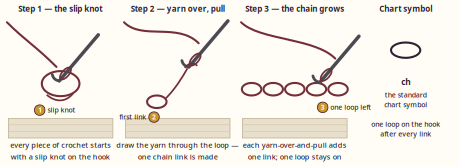 Foundation ChainThe starting row every single crochet piece stands on.
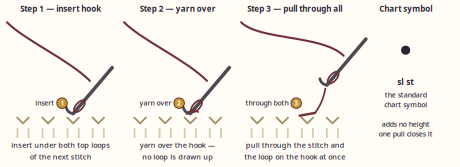 Slip StitchThe flat joining stitch — single crochet's partner for seams and rounds.
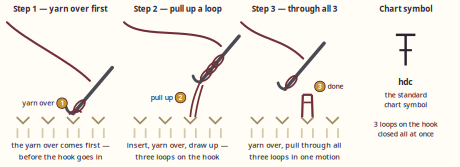 Half Double CrochetOne yarn over taller: the middle fabric of the family.
 Double CrochetThe workhorse stitch — the full guide.
 Foundation & BasicsAll seven basic stitches with diagrams, on the family page.
Common Questions
Is single crochet the same as British double crochet?
Yes — the stitch is identical; only the name changes. American single crochet (sc) is British double crochet (dc). The confusion runs both ways and is the commonest cause of a vintage pattern working up at the wrong size: check which terminology a pattern uses before the first chain, using the conversion table on the guide's hub page.
Does the chain-one turning chain count as a stitch?
In standard US practice, no. The chain one is a step up to the new row's height only. The first single crochet of the row is worked into the first stitch of the row below, and the last into the last stitch — never into the turning chain. A pattern that counts it will say so explicitly.
Why is my single crochet fabric so stiff?
Density is the stitch's nature, but board-like fabric means the loops are being closed too small or the hook is too small for the yarn. Let the drawn-up loop reach the hook shaft's full thickness, and try one hook size up — single crochet responds to hook size more dramatically than any other basic stitch.
How do I keep single crochet edges straight?
Count stitches every few rows, and put a marker in the first and last stitch of each row until the habit sets. The stitches are lost at the ends: the first hides at the turning chain's base, and the last sits low and tight against the edge. A held count is a straight edge.
More to Explore
Search Apparel Search