Sewing · Crochet Stitches
Crochet Stitches Guide
Every core crochet stitch, taught the way it is actually worked: an original step diagram that follows the yarn and the hook, the stitch's standard chart symbol, its working steps, and the fabric it makes. Twenty-six stitches and techniques in four families — the complete core repertoire a crocheter meets in patterns.
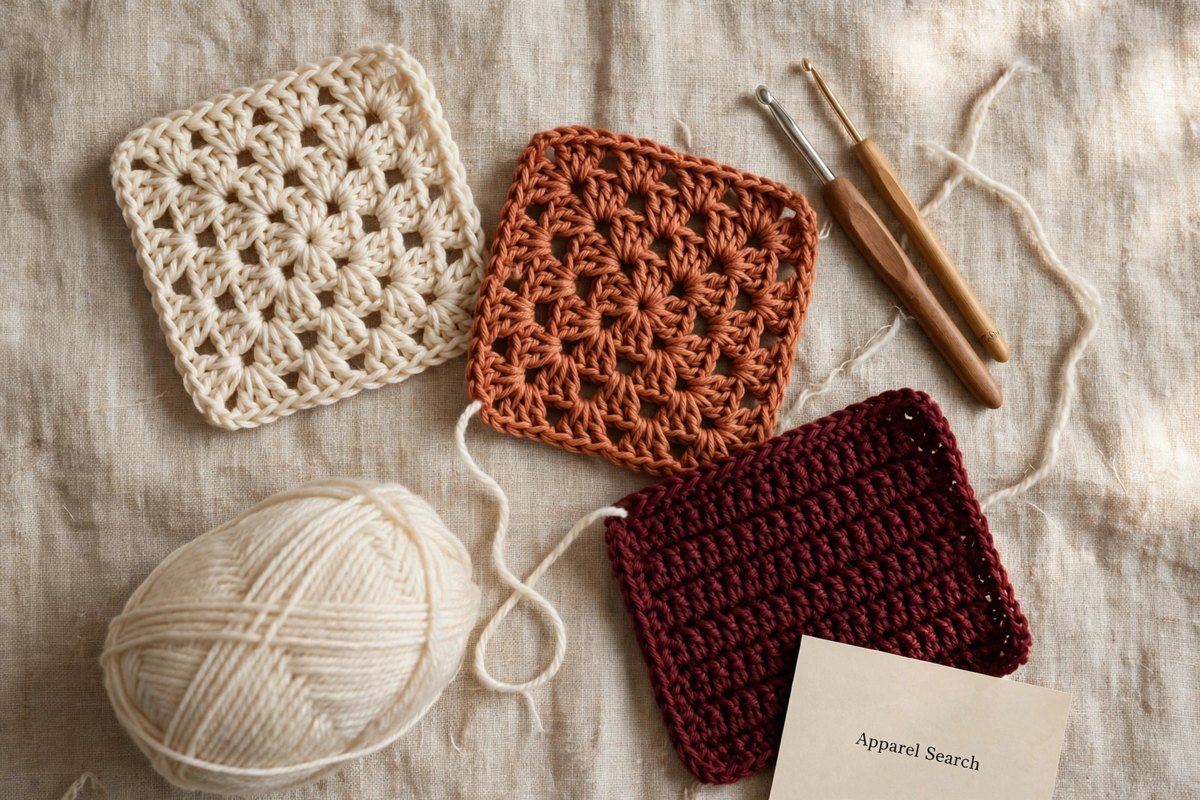
Crochet is the only common textile craft that builds fabric from a single strand and a single tool, one loop at a time — which is why its stitches can be taught completely. Unlike a woven or knitted structure, each crochet stitch is a small, finished event: the yarn is wrapped, the hook enters, loops are drawn up and closed in a fixed order, and the stitch stands complete before the next begins. This guide takes the stitches one at a time, in the order their formations build on each other, and treats completeness literally: if a stitch heads a family or is named in ordinary patterns, it is here, with a diagram drawn from its real formation.
Search Apparel Search
The Four Families
The repertoire sorts by formation — by what the hook and yarn actually do — into four families. Each family has its own page, and every stitch named below is taught there with its step diagram, its chart symbol and its working steps.
Family 1 — Foundation & the Basic Stitches
The ground floor: foundation chain, slip stitch, single crochet, half double crochet, double crochet, treble crochet and double treble crochet. Seven stitches that between them account for the overwhelming majority of all crochet fabric ever made — and the movements every other stitch recombines. Three of them carry full guides of their own: single crochet, double crochet and treble crochet.
Family 2 — Shells, Clusters & Texture
The decorative core: shell stitch, V-stitch, cluster, bobble, puff, popcorn, picot and moss stitch. All are basic stitches grouped, gathered or left unfinished and closed together — the family's lesson is that texture is arithmetic: how many stitches, into how many places, closed in how many motions. Two of them carry full guides of their own: shell stitch and popcorn stitch.
Family 3 — Post, Crossed & Long Stitches
Stitches worked somewhere other than the top of the row below: front post and back post double crochet (and the waffle stitch built from them), crossed double crochet, the long spike stitch that reaches down rows, and crab stitch, single crochet worked backwards along the edge. Two carry full guides of their own: front post double crochet and waffle stitch.
Family 4 — Tunisian & Special Techniques
The branch of the craft that holds a whole row of loops on a long hook: Tunisian simple stitch, Tunisian knit stitch and Tunisian purl stitch — plus filet crochet's counted mesh and Irish crochet's padded motifs, the two named techniques every crocheter meets. Our Tunisian crochet definition and filet crochet definition carry those techniques' history and character in depth.
Prefer to browse by picture? The Explore Crochet Stitches gallery shows all 26 stitches as diagram cards, grouped by family — click any card to go straight to that stitch.
How to Read the Step Diagrams
Every diagram in the guide uses the same visual language. The working yarn is wine, the hook is gray, and the row below — the stitches already made — is drawn in muted tan. Gold numbered dots mark the key movement of each step, in order. Three frames show the formation in sequence, and a fourth frame gives the stitch's chart symbol: the standard mark a printed crochet chart uses for that stitch, so the diagrams and the world's charts teach each other. The foundation chain's diagram shows the whole system at work:
Foundation chain — an original Apparel Search drawing. The slip knot, the first link, and the growing row of links. Illustration by Apparel Search.
One convention matters throughout: crochet is drawn as a right-handed crocheter works it, rows building from right to left. Left-handed crocheters mirror every diagram — the formations are identical, the direction reversed.
The Basics at a Glance
The seven foundation and basic stitches differ by a single decision — how many times the yarn wraps the hook before it goes in — and everything else follows from it.
| Stitch | Abbr. | Yarn overs | Loops on hook | Turning chain | Character & typical work |
|---|---|---|---|---|---|
| Foundation chain | ch | — | — | — | the starting row; also turning chains and lace spaces |
| Slip stitch | sl st | 0 | 1 | none | joining rounds, travelling, seaming, surface lines |
| Single crochet | sc | 0 | 2 | 1 chain | the densest fabric: amigurumi, bags, sturdy cloth |
| Half double crochet | hdc | 1 | 3 | 2 chains | the middle fabric: blankets, simple garments |
| Double crochet | dc | 1 | 3 | 3 chains | the workhorse: garments, shells, most patterns |
| Treble crochet | tr | 2 | 4 | 4 chains | tall and open: shawls, lace, fast coverage |
| Double treble crochet | dtr | 3 | 5 | 5 chains | the specialist: motifs, spokes, openwork |
The full treatment, with a step diagram for each stitch, is on the Foundation & Basics family page.
US and UK Terms — One Stitch, Two Names
Crochet's one genuine trap is vocabulary. American and British patterns name the same stitches one step apart, so an unconverted pattern silently changes fabric. This guide uses US terms (the Craft Yarn Council standard) and prints the UK equivalent in every stitch's heading line; the table below converts the basics in full.
| US term | US abbr. | UK term | UK abbr. |
|---|---|---|---|
| chain | ch | chain | ch |
| slip stitch | sl st | slip stitch | ss |
| single crochet | sc | double crochet | dc |
| half double crochet | hdc | half treble | htr |
| double crochet | dc | treble | tr |
| treble crochet | tr | double treble | dtr |
| double treble crochet | dtr | triple treble | trtr |
The rule of thumb: a British term names the stitch one rung taller than the American term of the same words. Chain and slip stitch are the exceptions — they keep their names on both sides of the Atlantic.
Choosing a Stitch
For dense, firm fabric — bags, baskets, amigurumi, anything that must hold a shape: single crochet, or half double where a little softness is acceptable. For garments and blankets with drape and reasonable speed: double crochet, the craft's default. For shawls, summer tops and lace, where air is part of the design: treble and double treble, chains used as spaces, and the texture family's shells. For joining and finishing: slip stitch, the invisible labourer — rounds joined, yarn repositioned, pieces seamed, edges steadied with crab stitch. And for a fabric that behaves almost like knitting, dense and two-faced: the Tunisian family.
Three Guides, Three Crafts
This guide completes a trio of Apparel Search stitch guides, and the boundaries are clean. The Stitch & Seams Guide classifies the stitches a machine makes, by the ASTM D-6193 numbering the garment industry uses. The Embroidery Stitches Guide teaches the decorative stitches a needle works on fabric that already exists. This guide teaches the stitches that create the fabric itself, from one strand and one hook. A reader who wants to know what crochet is — its history, its place among the textile crafts — will find it in our crochet definition; a reader choosing the tool itself should start with crochet hooks.
A note on completeness: no standards body owns the list of crochet stitches. The set in this guide follows the standard terminology and chart-symbol system published by the Craft Yarn Council and the repertoire as patterns actually use it — every stitch that heads a family or is independently named in ordinary patterns, with variants treated inside their parent stitch rather than as separate entries.
Common Questions
How many crochet stitches are there?
Patterns draw on a core repertoire rather than an infinite list: seven foundation and basic stitches, and a standard set of named texture, post, crossed and Tunisian stitches built from them — 26 stitches and techniques presented as a set in this guide. Beyond the core, combinations multiply without limit, which is why the guide defines completeness as the core repertoire: every stitch a crocheter meets by name in ordinary patterns.
What is a crochet chart symbol?
Charts draw each stitch as a small standard symbol — an oval for a chain, a cross for single crochet, a slashed T for the taller stitches — arranged exactly as the stitches sit in the fabric. The symbols are an international language published in standard form by the Craft Yarn Council: a chart can be followed without a word of the pattern's language. Every stitch in this guide is shown with its symbol beside its step diagram.
Which crochet stitch should a beginner learn first?
The foundation chain, then single crochet, then double crochet. The chain starts every piece; single crochet teaches the basic movements at the smallest, most forgiving scale; and double crochet's close-by-twos rhythm is the one every taller and fancier stitch extends. The Foundation & Basics family page teaches all seven basic stitches in that order.
Why do American and British crochet terms differ?
The two traditions named the same stitches from different starting points, so the vocabularies sit one step apart: the American single crochet is the British double, the American double is the British treble, and so on up the ladder. The stitches themselves are identical — only the labels move. This guide uses US terms throughout and gives the UK equivalent for every stitch; the conversion table on this page translates a pattern in either direction.
More to Explore
Stitch names, abbreviations and chart symbols follow the standard terminology and symbol system published by the Craft Yarn Council. Diagrams on these pages are original Apparel Search drawings.