Crochet Stitches Guide · Post, Crossed & Long Stitches
Waffle Stitch
Waffle stitch is a pattern stitch, not a single stitch: plain double crochet and the two post stitches arranged on a three-stitch repeat so that raised posts frame sunken squares — the pressed grid of a breakfast waffle. Two alternating rows do all the work, and the fabric they build is thick, warm, emphatically textured, and hungry for yarn.
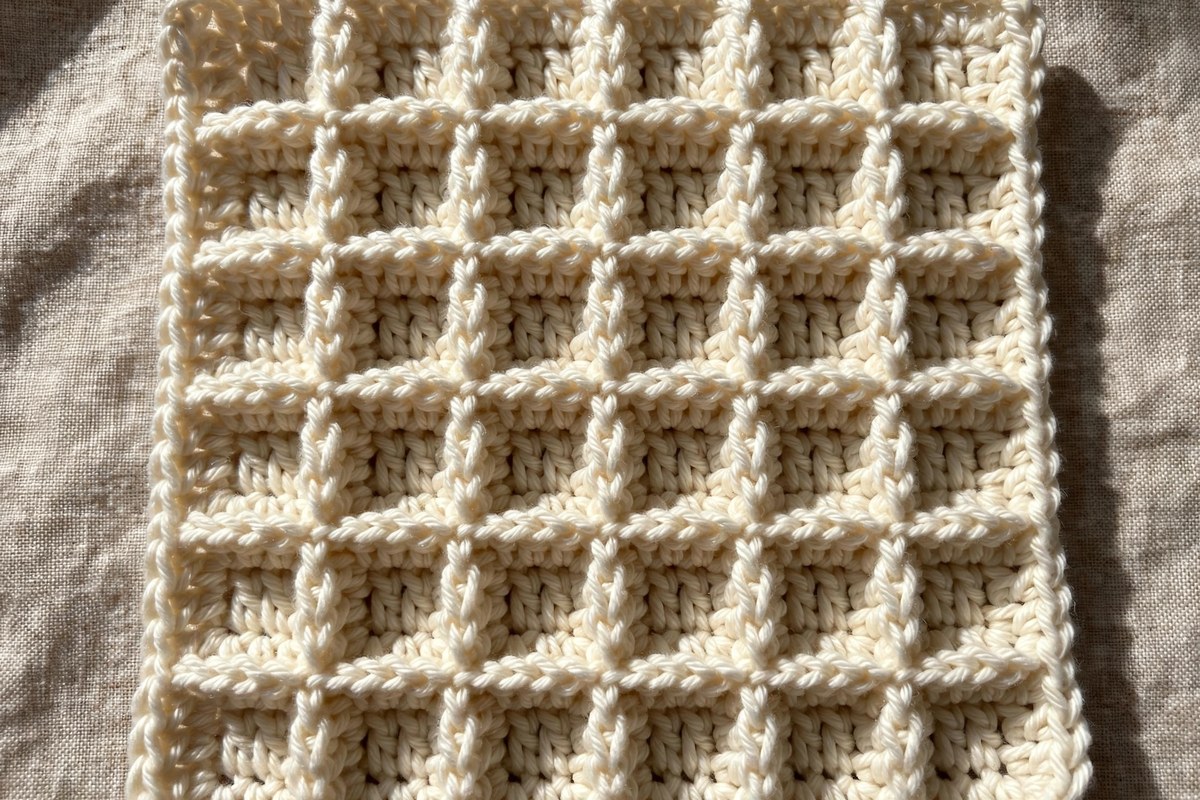
Some pattern stitches decorate a fabric; waffle stitch rebuilds it in three dimensions. A swatch of waffle is a grid you can read with your fingertips in the dark: firm raised frames, soft sunken squares, row after row, as regular as the iron that gives the stitch its name. Yet nothing in it is new. Every stitch is a double crochet — some plain, some around a post from the front, some from the back — and the entire effect is placement: push here, pull there, repeat. It is the post-stitch family's clearest proof that where a stitch is worked matters as much as what the stitch is.
This guide gives the pattern exactly as the family page states it, explains the two-row relief logic that makes the squares indent, and covers the counting and yarn questions that decide whether a waffle piece comes out crisp or confused.
How to Work It
Waffle stitch — an original Apparel Search drawing. A plain row, a post stitch raising the relief, and the indented squares. Illustration by Apparel Search.
- Chain a multiple of 3, plus 2. Row 1: a plain double crochet in each chain across; turn.
- Row 2: repeat across — one front post double crochet around the next post, then a plain double crochet in each of the next two stitches.
- Row 3: repeat across — one back post double crochet, then a front post double crochet around each of the next two posts.
- Repeat rows 2 and 3, checking the squares as they form.
The pattern, stated plainly. Chain a multiple of 3, plus 2. Row 1: a plain double crochet in each chain across; turn. Row 2: repeat across — one front post double crochet (FPdc) around the next post, then a plain double crochet in each of the next two stitches. Row 3: repeat across — one back post double crochet (BPdc), then a front post double crochet around each of the next two posts. Repeat rows 2 and 3 for the pattern. Edge and turning details follow usual double crochet practice — a chain 3 (or standing start) at each row's beginning as the edge stitch — and the repeat never changes: three-stitch groups, alternating which of the three stands forward.
Why the squares indent. Follow one group of three stitches through the two pattern rows. On row 2 the group's first stitch is a front post stitch: it seizes the post below and pulls it toward you, so that column advances; the two plain stitches beside it sit at normal depth. On row 3 the arrangement reverses around the same posts: a back post stitch presses the first column back while front post stitches pull the other two forward. Because the rows alternate, the advanced posts form continuous raised frames while the recessed stitches settle into hollows between them. The square is not drawn on the fabric; it is the valley left between four frames. One row of relief can make ribs — only the alternation closes the grid.
The Fabric It Makes
Waffle fabric is thick — noticeably thicker than plain double crochet of the same yarn — because so much of its yarn stands in relief rather than lying flat, and warm for the same reason: the sunken squares trap air in pockets. It is emphatically one-sided: the face is all grid and shadow; the back shows the pattern in negative, flatter and less defined. It has very little stretch and holds crisp edges.
Its appetite deserves plain warning: expect waffle to take roughly half again the yarn of plain double crochet for the same finished area. Running short in a dye lot that cannot be matched is the stitch's classic project disaster — buy for the relief, not for the flat measurement. Smooth, firmly twisted yarn keeps the squares crisp; soft or fuzzy yarn melts the grid into general warmth, pleasant but no longer really waffle.
Working Notes
Keeping the count on post rows
Waffle's one real difficulty is bookkeeping. A post stitch consumes the stitch whose post it wraps — that stitch's top is not worked separately — and a crocheter on autopilot will work the top as well, gaining a stitch, or skip a plain stitch after a post stitch, losing one. The defences are simple: count the row in its groups of three as you work it (post, plain, plain — back post, front, front), and total the row at its end for the first few rows of a piece. The total must never change; a drifting count shows up two rows later as squares that will not align, with the error buried underneath them.
Read the posts, not the tops
On post rows, aim by the posts standing in the fabric, not by the row of tops. The post you need is the vertical bar directly below the working position; on row 3 the two front post stitches wrap the two posts row 2 left recessed. If a group feels ambiguous, look at the face: the raised frames are the front post columns, and the repeat follows them.
Height on post stitches
Post stitches stand slightly shorter than plain double crochet, and post stitches that run very short will cup the fabric. Draw each loop up to the row's full height before closing, as the front post guide teaches, and the grid stays flat.
Where It Is Used
Dishcloths and washcloths — the stitch's most practical home: the grid scrubs, the thickness absorbs, and cotton waffle improves with washing. Blankets and throws — maximum warmth and texture from plain yarn, the squares giving a single colour all the interest it needs. Cushion covers — the relief face is made for them, with a plain back panel. Pot holders and mats, in cotton, where the double thickness protects. Baby blankets in soft, smooth yarn, with no holes. Scarves and cowls for cold weather, accepting the yarn appetite as the price of warmth.
Variations
Working waffle in the round
Waffle can be worked in rounds for baskets, hats and circular blankets: with the right side always facing, the back post row is replaced by its mirror arrangement worked from the front, and the repeat continues around without turning.
Single-colour and two-colour waffle
The stitch is designed for one colour — its pattern is relief, not colour — but changing colour on the row 3 repeat drops the second shade into the hollows and doubles the grid's depth.
Half double waffle
The same three-stitch logic with front and back post half double crochets gives a shallower, denser grid — slower and firmer, useful where full waffle would be too thick, such as garment panels.
Where It Goes Wrong
The squares will not form
Almost always a repeat error: the two pattern rows worked in the wrong order, or row 3's front post stitches wrapping the wrong posts. Lay the work flat after the first row 3 and check it — raised frames, sunken centres. If the first two pattern rows are right, every later row is a copy; if they are wrong, no later row will fix them, so rip back to row 1.
The stitch count keeps changing
The post-stitch trap: a wrapped post's top worked as well as the post (a gain), or the plain stitch following a post stitch skipped (a loss). Count in threes as you work and total the row when it ends.
The grid looks mushy
Yarn, not technique: soft, fuzzy or loosely twisted yarn cannot hold a crisp frame. Choose a smooth, firm yarn — dishcloth cottons are the extreme case — or work a hook size down.
Related Stitches
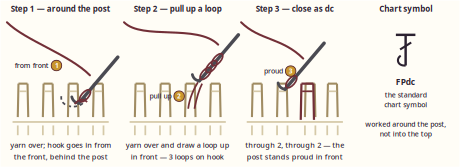 Front Post Double CrochetWaffle's main moving part — the full guide.
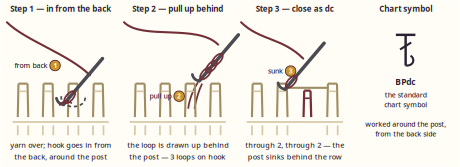 Back Post Double CrochetThe pressing stitch of row 3's repeat.
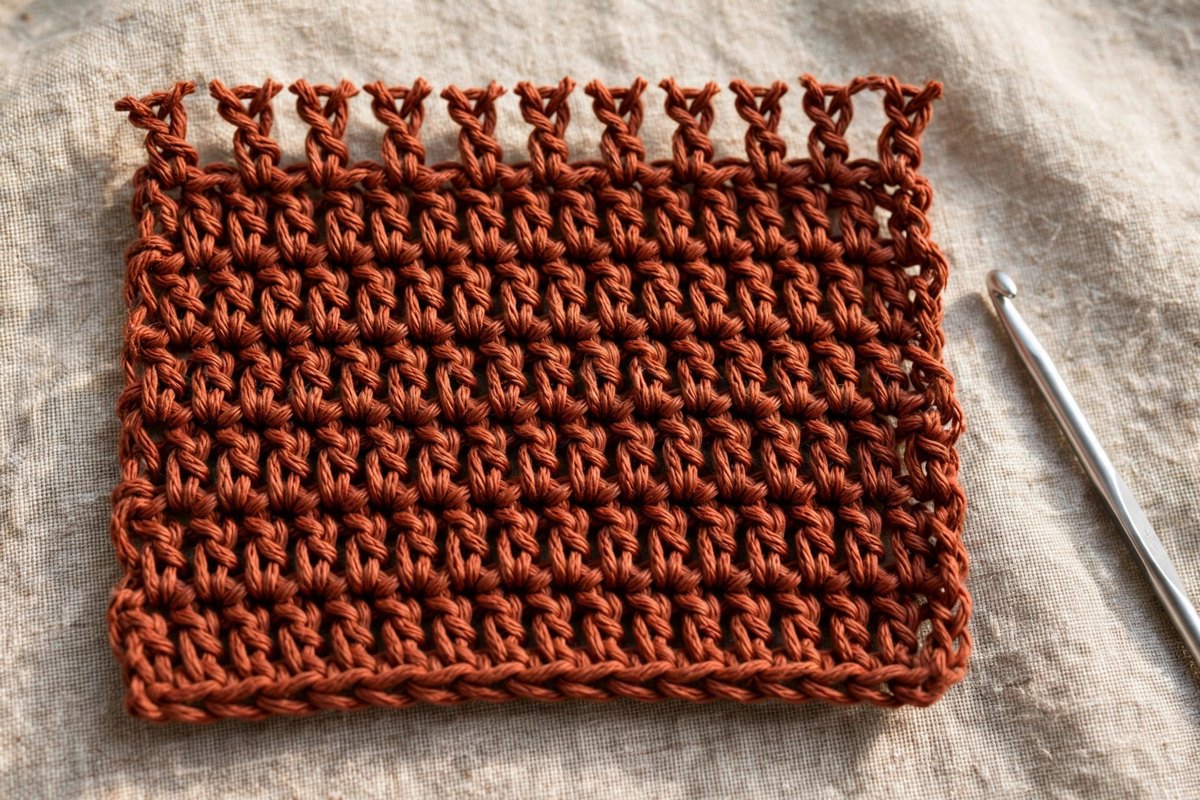 Double CrochetEvery waffle stitch is one of these, relocated — the full guide.
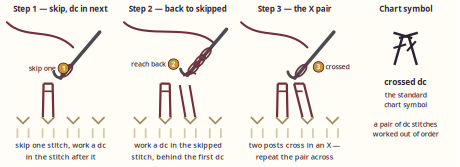 Crossed Double CrochetThe family's other rearrangement of plain stitches.
 Post, Crossed & Long StitchesAll six post and crossed stitches, on the family page.
Common Questions
What is the waffle stitch pattern in crochet?
Chain a multiple of 3, plus 2. Row 1 is plain double crochet across. Row 2 repeats: one front post double crochet, then a plain double crochet in each of the next two stitches. Row 3 repeats: one back post double crochet, then a front post double crochet around each of the next two posts. Repeating rows 2 and 3 frames the raised posts around sunken squares — the waffle grid.
Why does waffle stitch use so much yarn?
Because so much of the fabric stands in relief. Post stitches wrap extra yarn around the posts below, and the alternating rows build thickness rather than flat coverage — expect roughly half again the yarn of plain double crochet for the same area. Secure the full amount in one dye lot.
Is waffle stitch reversible?
No — it is emphatically one-sided. The face carries the crisp grid of raised frames and sunken squares; the back shows the same structure in negative, flatter and less defined. A lining or plain backing panel is the usual answer where both sides will be seen.
How do I keep waffle stitch squares aligned?
Keep the count. A post stitch consumes the stitch whose post it wraps, so working that stitch's top as well gains a stitch, and skipping a plain stitch after a post stitch loses one — either error shifts every later square. Count each row in its groups of three as you work it, total the row at its end, and check the grid visually after the first full repeat of rows 2 and 3.
More to Explore
Search Apparel Search