Crochet Stitches Guide · Post, Crossed & Long Stitches
Front Post Double Crochet (FPdc)
Front post double crochet — abbreviation FPdc, in British patterns front post treble — is an ordinary double crochet worked around the post of the stitch below instead of into its top. The hook passes behind the post from the front, the post is pulled forward, and the stitch stands on the fabric's face as a raised rib — the foundation of crochet ribbing, cables and waffle.
Every stitch in the first two families of this guide is worked into the top of the row below — the hook goes through the little V at a stitch's head, and the new stitch sits where the old one put it. Front post double crochet breaks that habit, and changes what crochet fabric can do. Working around the upright post of the stitch below reaches into the finished fabric and moves it: the post comes forward, stands proud of the surface, and becomes a rib. Columns of ribs make elastic edging; ribs that travel and cross make cables; ribs alternated with plain stitches make the waffle grid.
This guide works the stitch in depth: the formation, the shortness built into it and how to compensate, the ribbing it builds with its back post partner, and — the skill that makes or breaks post work — learning to read a row of post stitches.
How to Work It
Front post double crochet — an original Apparel Search drawing. The hook passes behind the post; the stitch stands proud. Illustration by Apparel Search.
- Yarn over the hook, exactly as for a plain double crochet.
- Insert the hook from the front, behind the post of the next stitch below, and out at the front again.
- Yarn over and draw a loop up in front of the post — three loops on the hook.
- Close as a double crochet — through two loops, twice. Skip the top of the stitch whose post was used.
Around the post, in detail. Name the parts of the stitch below: its top — the two loops at its head, where ordinary stitches are worked — and its post — the upright body below the top. For a front post stitch, yarn over, then pass the hook behind the post from the front: in on one side of the post, out on the other, so the post lies across the hook's shaft. Yarn over, draw the loop up in front of the post, and close exactly as a double crochet — through two, through two. The old post, pulled forward, stands as a raised bar on the fabric's face.
The stitch is shorter — plan for it. A post stitch's head sits at the level of the post it wraps, below the top of its row: a front post double crochet gains less height than a plain one, because part of its length is spent travelling forward around the post. Pure post-stitch fabric grows more slowly, row for row, and a band mixing post and plain stitches pulls in along the post columns. The compensation is in the hands: draw the post stitch's loop up generously, to the full height of the row being built, before closing.
The Fabric It Makes
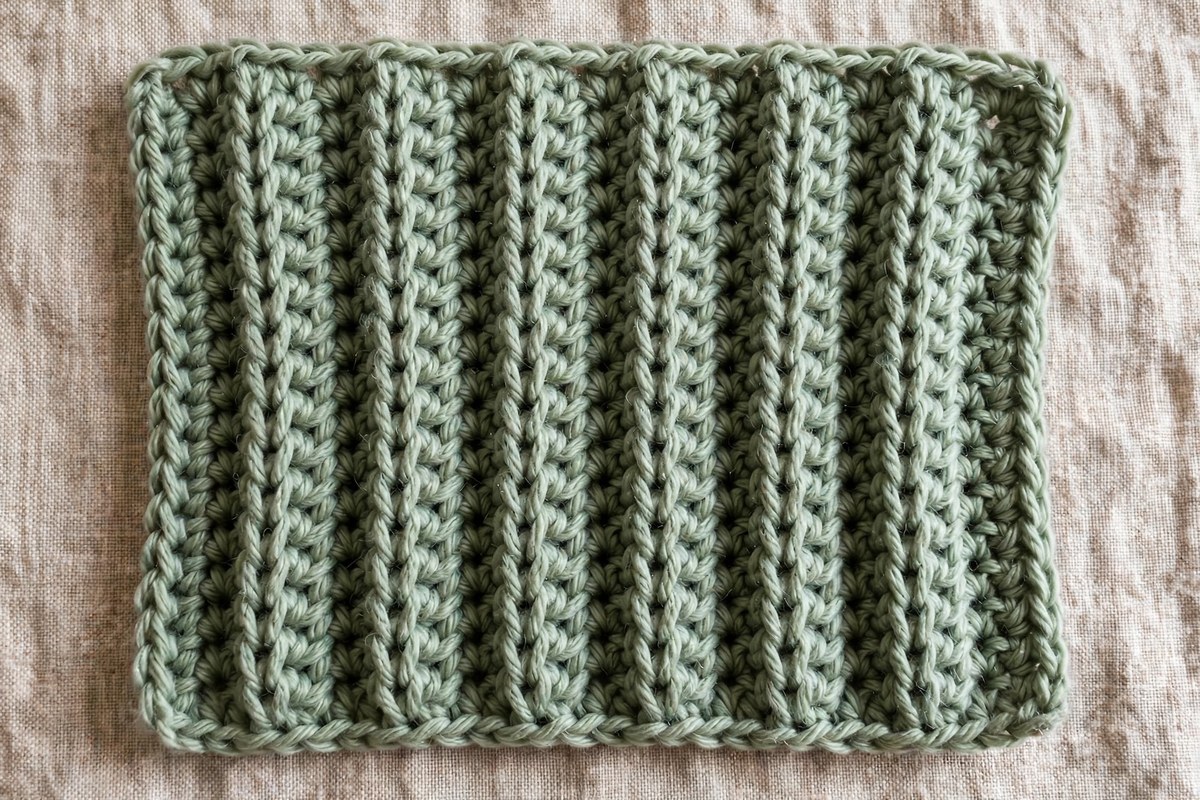
A column of front post stitches is a true rib: a raised, rounded cord running vertically through the fabric, with the recessed work between columns falling into shadowed valleys. Post columns also pull together sideways, so ribbed fabric contracts across its width and stretches back willingly — the closest crochet comes to knitted ribbing's recovery. It will never match knitting's spring, but for cuffs, brims and waistbands it is more than sufficient.
Mixed with plain stitches, the post stitch is a drawing tool. One raised column on a plain ground is a line; two together, a stripe; columns that lean toward and away from each other across rows are the plaits and ropes of crochet cables. In waffle stitch, front post columns frame every square.
Working Notes
The stitch behind — post work's one trap
When a front post stitch wraps a post, that stitch is used: its top must not be worked again in the same row. But the wrapped stitch's top is still visible, sitting in the row of tops, looking like an unworked stitch. It is not — it is spent. Working into it gains a stitch, and because post rows alternate post and plain stitches, the error repeats and the piece flares. Count in pattern groups (post, plain, plain — or post, back post) and trust the count over the eye: in post work, the tops lie.
Reading a post row
To work the next row, learn to see the fabric in posts rather than tops. The raised bars on the face are the front post columns; each marks a stitch whose post the next row may wrap. On a ribbing row the rule is tactile as much as visual: stitches that stand toward you are worked as front post, stitches that recede as back post, and the rib continues itself if you follow the relief.
Turning and edges
Post stitches need a foundation of at least one plain double crochet row — a post needs a post to wrap. At row ends, the edge stitch is usually a plain double crochet worked into the top in the ordinary way, giving a firm selvedge.
Where It Is Used
Ribbing for cuffs, hat brims and waistbands — the stitch's signature job: alternating front and back post columns make a band that hugs and recovers. Hems and neckbands, worked as a post-stitch border after the body is complete. Cables — front post columns crossed over each other are crochet's cable ropes. The waffle stitch, where front post stitches frame every square. Texture stripes and panels — a few raised columns break up plain double crochet without a colour change. Basket and texture stitches across the wider repertoire, nearly all built on this stitch and its back post partner.
Variations
FPdc ribbing — front and back post together
The classic rib alternates the pair — front post around one post (it stands toward you), back post around the next (it recedes) — most often two-and-two: FPdc, FPdc, BPdc, BPdc. On following rows, work each stitch as it presents: front post where the column stands forward, back post where it recedes, and the columns run unbroken up the band.
A first look at cables
A cable is a group of front post stitches whose order is swapped: work the later stitches of a group first, reaching behind, then the skipped stitches in front of them, and the columns cross. Every crochet cable — rope, plait, diamond — is this one idea at different widths and rhythms.
Front post half double and treble
The post treatment applies up and down the ladder: front post half double makes a shallower rib for lighter bands; front post treble makes the long raised stitches of travelling cables. The address is identical; only the stitch changes.
Where It Goes Wrong
The fabric cups or pulls in
Post stitches worked at their natural short height draw the fabric up along their columns. Draw each loop up to the full height of the row before closing — taller than instinct suggests — and check after two rows that the piece lies flat.
The stitch count keeps growing
The top of each wrapped post, still visible in the row, is being worked as if it were a fresh stitch. It is spent — the post stitch consumed it. Skip it, count in pattern groups, and the count holds from the next row onward.
The ribs look uneven
Usually one column is wrapped loosely and its neighbour tightly, or a back post stitch has crept into a front post column. Read the relief before each stitch — forward columns get front post, recessed columns get back post — and keep the drawn-up loops at one height.
Related Stitches
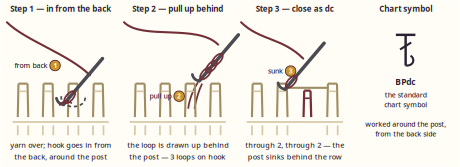 Back Post Double CrochetThe recessed partner that completes the rib.
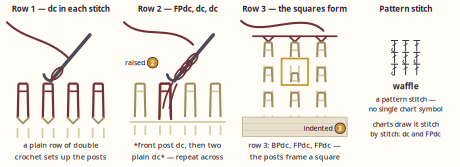 Waffle StitchFront post frames around sunken squares — the full guide.
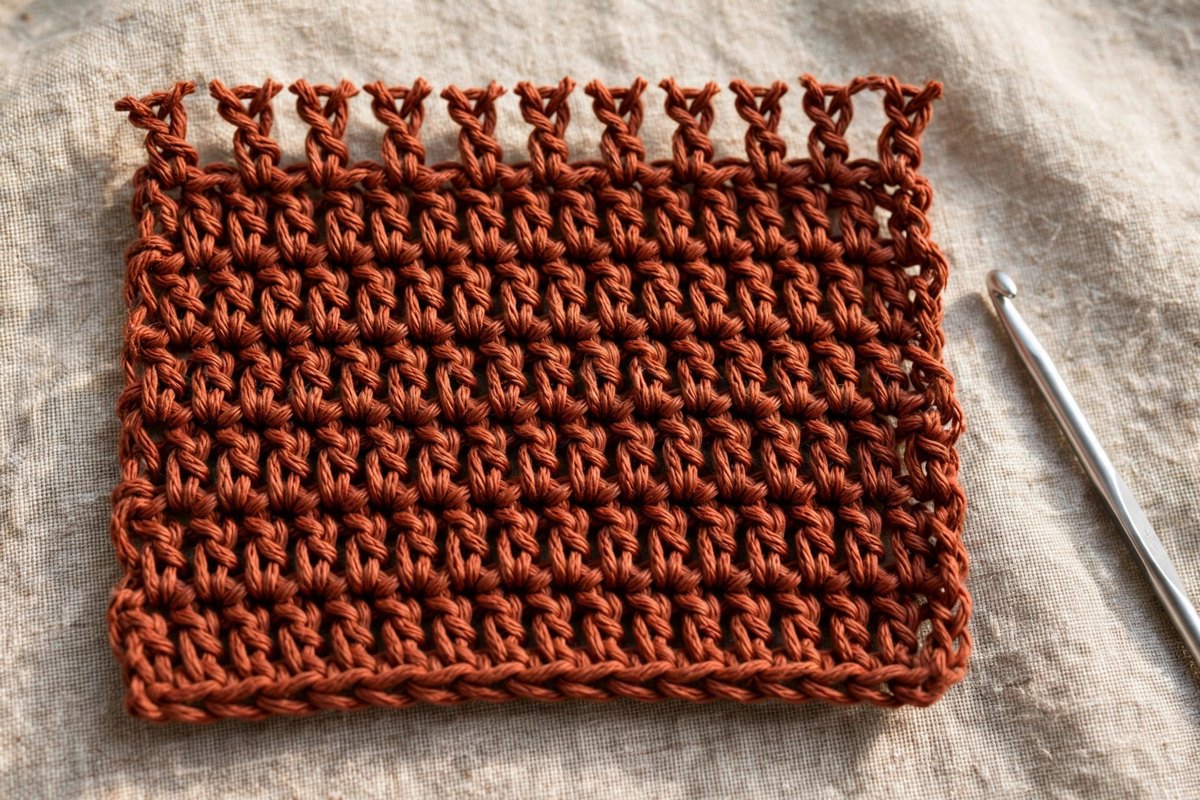 Double CrochetThe same stitch, worked into the top — the full guide.
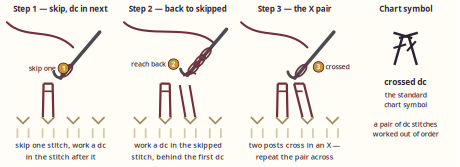 Crossed Double CrochetThe family's other rearrangement: stitches that swap places.
 Post, Crossed & Long StitchesAll six post and crossed stitches, on the family page.
Common Questions
What is the difference between front post and regular double crochet?
Only the address. A regular double crochet is worked into the top of the stitch below; a front post double crochet is worked around that stitch's post — the hook passes behind the post from the front — with the same yarn over and closing by twos. The wrapped post is pulled forward and stands on the face as a raised rib, which is why post stitches build ribbing, cables and waffle.
Why is front post double crochet shorter than double crochet?
Because part of the stitch is spent travelling forward around the post it wraps, so its head sits lower than a plain stitch's head and the row gains less height. Compensate in the working: draw the post stitch's loop up to the full height of the row being built before closing.
How do you make crochet ribbing with post stitches?
Alternate front post and back post double crochet across a band — commonly two of each — so raised and recessed columns alternate. On later rows, work each stitch as it presents: front post where a column stands toward you, back post where it recedes. The columns pull together across the width and stretch back willingly, giving cuffs and brims their hug.
Do you work into the top of a stitch after working around its post?
No — the post stitch consumes that stitch entirely. Its top remains visible in the row and looks unworked, which is the classic post-work trap: working into it as well gains a stitch every time. Trust the row's count over the evidence of the tops, and skip the top of every stitch whose post you have wrapped.
More to Explore
Search Apparel Search