Crochet Stitches Guide · Foundation & Basics
Half Double Crochet (hdc)
Half double crochet — abbreviation hdc, and in British patterns half treble — is the middle stitch of the basic family. One yarn over, a loop drawn up, and then all three loops on the hook closed in a single motion. Taller and faster than single crochet, denser and warmer than double crochet, it is the compromise the craft reaches for first.
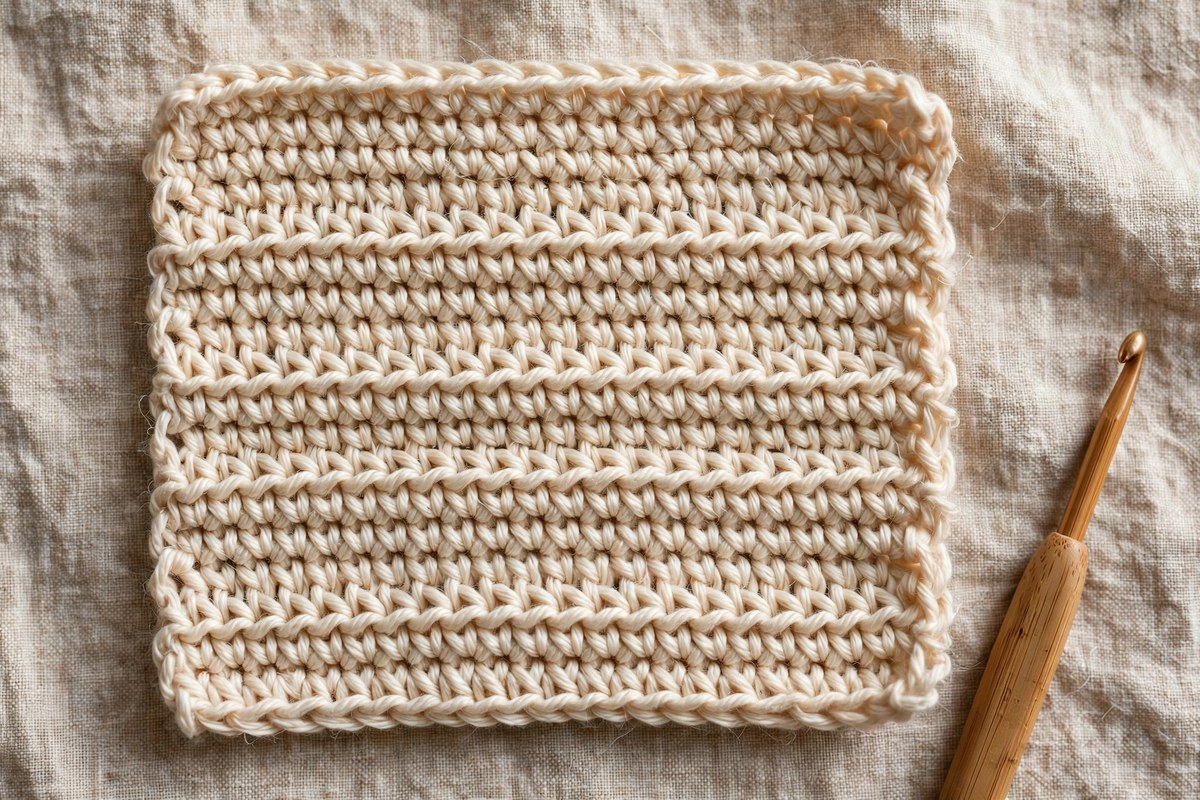
Every family has a middle member who does the quiet work, and in the basic stitches that is half double crochet. It rarely gets the beginner's first lesson and it is not the stitch of lace or drama. What it offers instead is balance: a fabric with real warmth and body that still drapes, rows that grow at a satisfying pace without turning lacy, and a face with just enough texture, from the extra strand each stitch carries, to keep plain yarn interesting. Beginner blankets default to it; experienced crocheters return to it for garments that must be warm without being heavy.
This guide works the stitch completely: the all-at-once closing that defines it, the third strand that closing leaves on the fabric's face, its turning chain, and the third-loop variation — the camel stitch — that turns this plain stitch into a knitted look-alike.
How to Work It
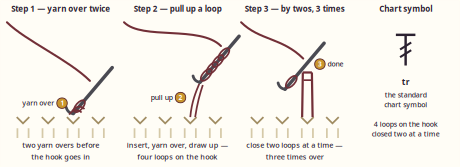
Half double crochet — an original Apparel Search drawing. Three loops on the hook, closed in one motion. Illustration by Apparel Search.
- Yarn over the hook — before the hook goes into the work.
- Insert the hook into the next stitch, yarn over again and draw through — three loops on the hook.
- Yarn over once more and draw through all three loops in a single motion.
The closing is the stitch. Double crochet, which starts identically — one yarn over, three loops on the hook — closes its loops two at a time and stands tall. Half double crochet refuses that second stage: one yarn over pulls through all three loops at once. That decision makes the stitch shorter, packs its yarn into a tighter head, and leaves a souvenir — the yarn over's strand lying horizontally across the front of the finished stitch, below its top loops. Crocheters call it the third strand (or third loop): the stitch's identifying mark when reading fabric, and a working loop in its own right — the entry point of the camel stitch below.
The first row. Into a foundation chain, the first half double crochet goes into the third chain from the hook; the two skipped chains are the turning allowance.
The turning chain. At each row's end, chain two and turn. In standard US practice those two chains do not count as a stitch — they are only a step up to the new row's height. The row's first half double crochet therefore goes into the very first stitch of the row below, the one at the turning chain's base, and the row's last stitch goes into the last stitch of the row below — never into the turning chain itself. Some patterns do count the chain two, and say so; when a pattern is silent, treat it as a non-stitch and the count will hold.
The Fabric It Makes
Half double crochet fabric sits exactly where its formation promises: between its neighbours. It is softer and more pliable than single crochet, with rows that show as neat horizontal bands rather than tight knots, yet it keeps a density double crochet cannot match — hold a swatch to the light and the openings are small, slanting slits rather than windows. It is warm for its weight, folds well, and has a gentle sideways give that suits garments. The third strand gives the face a subtle nubbly grain, most visible in smooth yarns and plain colours: the fabric itself supplies the texture.
The two faces differ slightly — the front shows the third strands as fine horizontal lines, the back is smoother. It does not curl or lean, and it forgives: of the three middle basics, its tension faults show least.
Working Notes
The last stitch is the trap
Half double crochet's loose, single-motion closing leaves each stitch's head less defined than double crochet's, and the last stitch of a row — sitting low against the edge, half hidden by the turning chain — is the easiest stitch in the basic family to skip. One skipped stitch per row narrows a blanket almost invisibly until the slant is undeniable. Count at every row's end while the piece is young, and mark the last stitch until placing the hook there is automatic.
Pull through three, cleanly
The all-at-once closing works best in one confident motion: yarn over, and draw through all three loops without pausing halfway. A hesitant pull snags on the middle loop. If the closing regularly resists, the drawn-up loop is too small — let it rise to the hook shaft's full thickness before closing.
Reading the third strand
Turn a finished swatch to the light and each stitch shows three horizontal elements: the two top loops, and below them the third strand running across the post. Finding it on your own work — rather than in a diagram — is the moment the stitch becomes fully legible.
Where It Is Used
Blankets and afghans — the classic beginner piece: warm, quick enough to finish, dense enough to use. Garments — sweaters, cardigans and vests where double crochet would be too open and single crochet too stiff. Hats and cowls, especially in the round or in the third loop for a ribbed brim. Baby pieces — no large holes for small fingers, a soft face, a fabric that washes well. Scarves in plain yarns, where the third strand's grain replaces patterning. A teaching stitch — the first yarn-over stitch most beginners meet, because its single closing is the simplest of the wrapped stitches.
Variations
Half double crochet in the third loop — the camel stitch
Instead of working under the top loops, insert the hook into the third strand — the horizontal bar on the stitch's face, below the top. The top loops are pushed to the back, where they form a neat braided ridge on the face, and the fabric takes on a knitted look with a ribbed elasticity no other basic variation gives. Worked in turned rows it is the standard camel stitch of hats and brims; in the round, the ridge spirals. The same stitch with a different address — proof that where the hook goes matters as much as what it does.
Back loop and front loop only
As with single crochet, working under one top strand only leaves a ridge and adds stretch — back-loop rows make a soft ribbing for cuffs and hems.
Herringbone half double
The drawn-up loop is pulled through one loop on the hook before the all-at-once closing, slanting each stitch slightly and giving plain fabric a subtle diagonal grain — a quiet texture for garments in smooth yarn.
Where It Goes Wrong
The piece is narrowing
Almost certainly the missed last stitch: the row's final half double crochet sits low beside the turning chain and gets skipped, or the turning chain is being worked into as if it were a stitch while the real first stitch is skipped — the two errors together hold the count while slanting the edge. Count one row slowly, stitch by stitch, mark both end stitches, and work the first stitch into the stitch at the chain's base and the last into the row's true last stitch.
The fabric feels loose and holey
The single-motion closing leaves a naturally looser head than a two-stage stitch, and a hook a size too large exaggerates it into gaps. Drop one hook size before changing anything else — half double crochet tightens up beautifully — and check that each drawn-up loop is not being pulled taller than its neighbours.
Rows of different heights
Usually a closing problem: some stitches closed in the true all-at-once motion, others hesitated into an accidental two-stage close, which makes them taller. Settle the rhythm — yarn over, through three, done — and the row heights even out.
Related Stitches
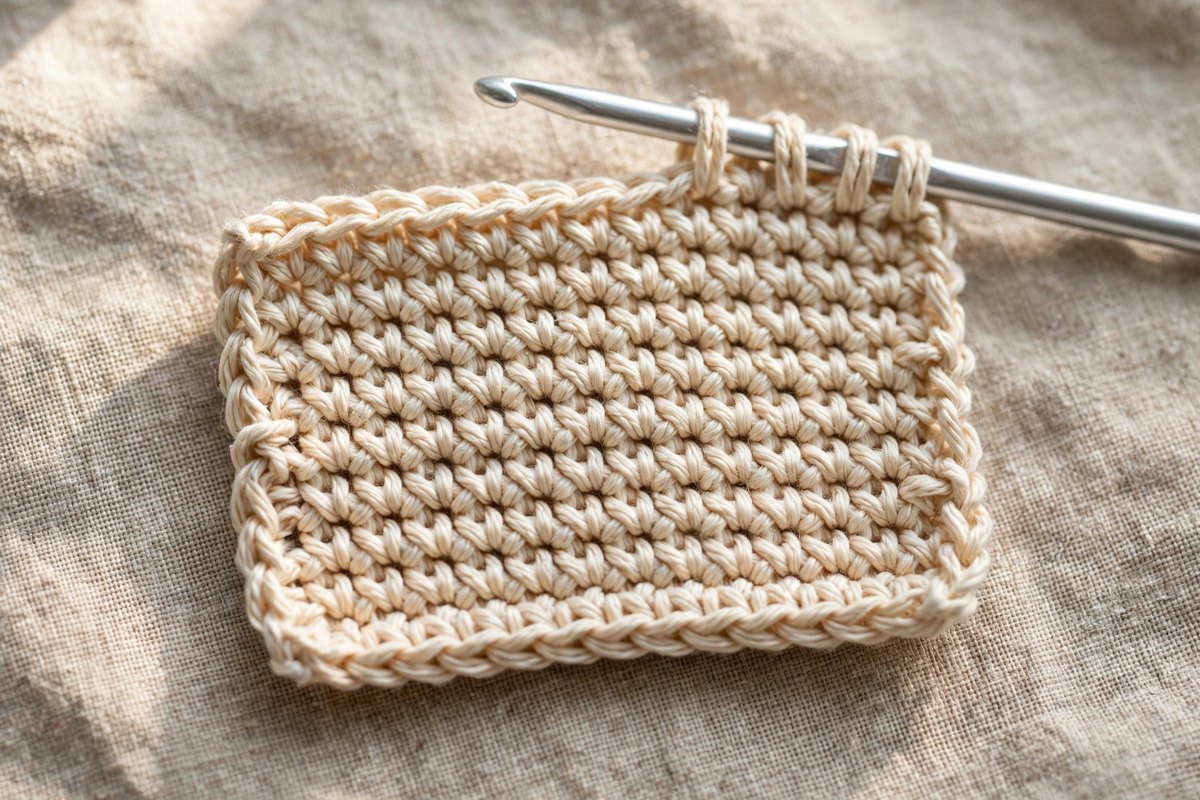 Single CrochetThe denser neighbour below — the full guide.
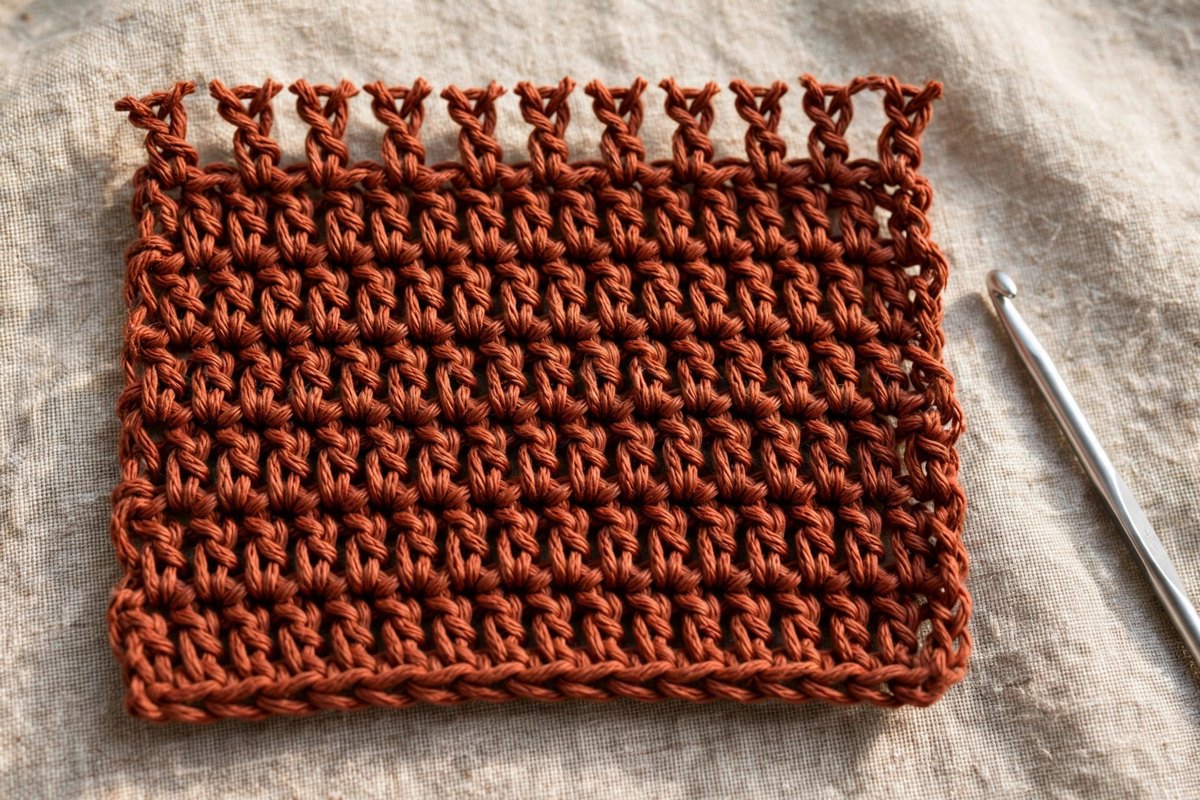 Double CrochetThe same start, closed by twos — the full guide.
 Treble CrochetTwo rungs up the ladder: tall and open — the full guide.
 Slip StitchThe flat joining stitch that finishes half double pieces.
 Foundation & BasicsAll seven basic stitches with diagrams, on the family page.
Common Questions
Does the chain-two turning chain count as a stitch in half double crochet?
Usually not. In standard US practice the chain two is only a step up to the new row's height: the first half double crochet goes into the first stitch of the row below, and the last into the last stitch, never into the turning chain. Some patterns count it and say so — when a pattern is silent, the non-counting convention is the safe reading.
What is the third loop in half double crochet?
The strand left lying across the front of the stitch by its all-at-once closing, below the two top loops. It is the stitch's identifying mark, and it can be worked into directly: half double crochet in the third loop is the camel stitch, whose pushed-back top loops form a knitted-looking braided ridge.
Why does my half double crochet keep getting narrower?
The last stitch of the row is being missed. Half double crochet's loose closing leaves that stitch low and inconspicuous beside the turning chain, and one loss per row narrows a piece gradually and evenly. Count stitches at each row's end and mark the last stitch until working into it is automatic.
Is half double crochet the same as British half treble?
Yes — American half double crochet (hdc) is British half treble (htr): one yarn over, three loops on the hook, all closed at once. It is the middle rung of the ladder in both terminologies, sitting between single crochet (British double) and double crochet (British treble).
More to Explore
Search Apparel Search