Crochet Stitches Guide · Shells, Clusters & Texture
Shell Stitch
The shell stitch — a fan of double crochets, classically five, worked into a single stitch or space until they burst open like a scallop shell — is crochet's oldest decorative stitch. Nothing is gathered or altered: each double crochet is ordinary and complete, and the texture comes purely from crowding. Rows of shells make the scalloped fabric of baby blankets, edgings and shawls.
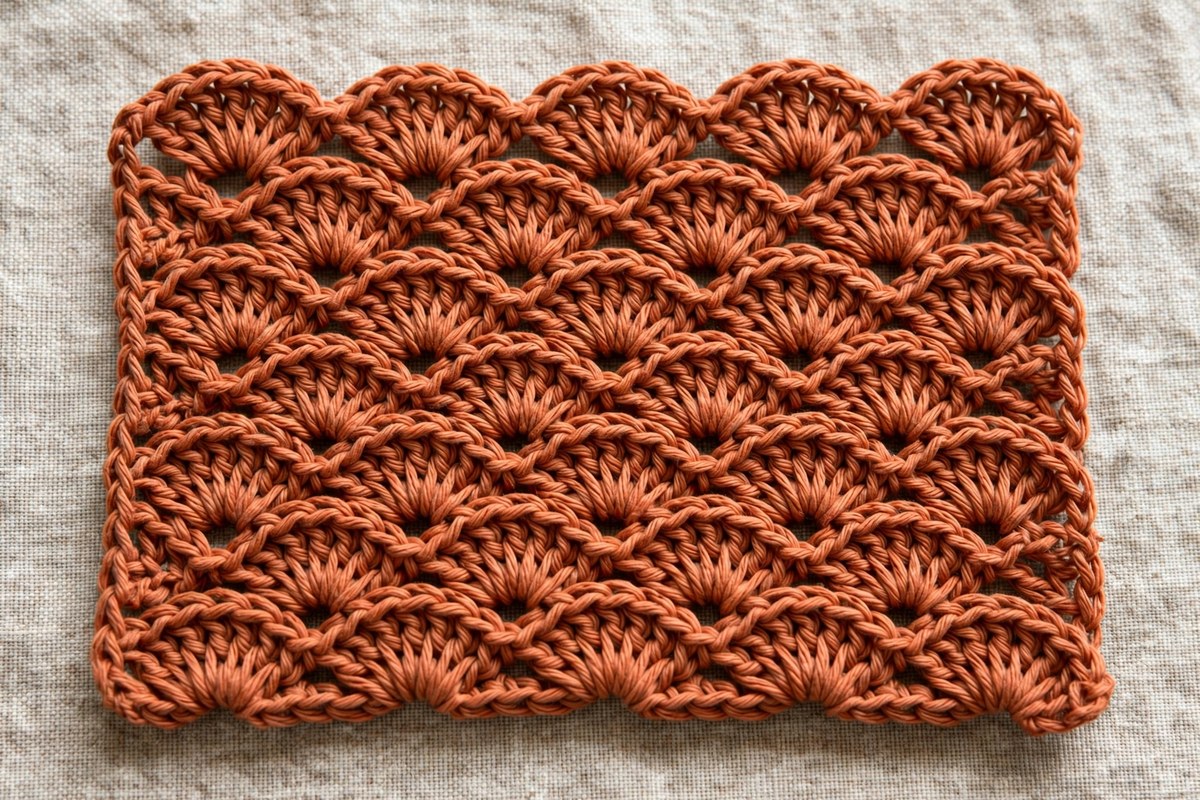
If one stitch owns crochet's decorative tradition, it is this one. The shell needs no new skill beyond the double crochet a beginner already owns — it simply asks for several of them in the same place — and repays that arithmetic with the most recognisable fabric in the craft: row on row of scallops, each fan curving against its neighbours like scales or roof tiles. It edged Victorian table linen, it blankets babies by the million, and it is still the first texture stitch most crocheters choose when a plain fabric wants to become a present.
This guide covers the shell in its standard and variant sizes, the two homes a shell can live in — a stitch or a space — the classic shell row with its skipped stitches and single-crochet anchors, and the turning and edging that keep scalloped fabric square.
How to Work It
Shell stitch — an original Apparel Search drawing. Five double crochets fanned from one stitch. Illustration by Apparel Search.
- Work to the shell's stitch. Patterns space shells with skipped stitches and single-crochet anchors.
- Yarn over, insert into that stitch and work a double crochet.
- Work four more double crochets into the SAME stitch — five in total — each leaning a little further out so the five fan open.
- Skip exactly the stitches the pattern states, then anchor or work the next shell — the skips give the fan room.
The standard shell row. The arrangement nearly every pattern starts from runs: shell in one stitch, skip 2 stitches, single crochet in the next stitch, skip 2 — and repeat. The single crochet is not decoration; it is the anchor that pins the fan's spread down, and the skipped stitches are the room the fan needs to open. Each repeat consumes six stitches of the row below and returns a fan where one stitch stood, so a foundation for plain shell rows is a multiple of 6, plus 1 in most published versions — but patterns vary their anchors and skips, and the pattern in hand always wins.
Shells into stitches, shells into spaces. A shell worked into a stitch is anchored to a single point and fans symmetrically — the classic look. A shell worked into a chain space (the shell rows of many shawls) sits looser, can hold more stitches, and slides slightly, which suits draping work. The two are not interchangeable mid-piece: a row designed for spaces has its spacing built into the chains, and forcing its shells into stitches crowds the fabric into ripples.
Turning and the row above. In stacked rows each shell sits directly above the shell below, anchored into its centre stitch, giving columns of scallops. In offset rows — the commoner arrangement — each shell is worked into the single-crochet anchor of the row below, so every fan nests into the hollow between two fans beneath it, and the scallops stagger like brickwork. The turning chain is whatever the pattern's first stitch needs: commonly chain 3, standing as the first double crochet of a half shell at the row's edge, since a shell cut in half is how scalloped rows begin and end square.
The Fabric It Makes
Shell fabric is a study in controlled fullness. Each fan holds five stitches' worth of yarn in one stitch's footprint, so the cloth is thicker and warmer than plain double crochet, with a surface that moves in waves: the fans stand forward, the anchors dip back, and the fabric ripples gently and regularly. The scalloped edge a shell row makes is its signature — many pieces are designed so the shells themselves form the finished edge, needing no border at all.
Two honest notes: the back shows the fans flattened — still attractive, but plainer — and the stitch uses noticeably more yarn than flat double crochet. Its wave also means it measures differently relaxed and stretched, so gauge swatches must be worked in the pattern, over at least two full repeats, or the sizing will lie.
Working Notes
Let the fan lean
A shell fans because its stitches lean: the first double crochet tilts one way, the centre stands upright, the last tilts the other way. Crocheters who force every stitch upright get a bunch, not a fan. Draw each loop up to the same height and let the crowding do the leaning.
Count the skips, not the shells
Shell rows go wrong in the spaces, not the fans. A skip count that drifts by one stitch moves every shell in the row half a place, and the error only shows when the next row will not nest. Count the anchor pattern — skip 2, anchor, skip 2 — aloud for the first rows until the rhythm sets.
Edges and half shells
Square pieces begin and end each shell row with a half shell or a plain double crochet at the edge, as the pattern directs. Improvising full shells at both ends adds a fan's width every row and the piece grows horns. Keep a pattern's edge treatment exactly; change only the repeat count in the middle.
Where It Is Used
Blankets and baby blankets — the stitch's home: soft scallops, no holes large enough to catch small fingers at a firm gauge, pretty in a single colour. Edgings — a single shell row, often over a steadying row of single crochet, finishes cloths, cuffs, hems and necklines with a ready-made scallop. Shawls and scarves, especially shells into spaces for drape. Baby pieces of every kind. Vintage-style bedspreads and throws, the shell's heirloom role. Garment yokes and borders, where a shell row or two finishes a plain double-crochet body.
Variations
Three and seven double crochet shells
The five-stitch shell is the standard, not the law. A three-double-crochet shell makes a smaller, tighter scallop for fine yarns and narrow edgings; a seven-double-crochet shell fans wider and more dramatically, for bold afghans and shawl borders. The spacing must change with the size — wider shells need more skipped stitches — which is why shell size and row geometry are always specified together.
Half double and treble shells
Shells can be built from any tall stitch. Half double shells sit flatter and denser, a quiet texture for garments; treble shells open into long, lacy fans for summer shawls. The formation never changes — only the stitch being crowded.
Shells in the round
Worked in rounds, shells build the classic round ripple and many motif borders: each round's shells sit in the anchors of the round below, and increases hide inside the fans — which is why shell rounds can grow a flat circle while looking purely decorative.
Where It Goes Wrong
The fabric ripples or cups
Too much fullness for the spacing: shells too wide for their skips, or shells worked into stitches where the pattern intends spaces. Check the row geometry against the pattern's repeat before blaming tension — in shell work, arithmetic ripples and tension ripples look alike, but only one of them is fixed by counting.
The shells will not nest
On offset rows, each shell belongs in the anchor single crochet of the row below. If the fans are landing on fan centres, the rows are stacking instead — usually because an anchor was skipped or a skip count drifted. Rip back to the last row that nested cleanly; shell errors compound row over row and never heal upward.
One shell looks pinched
A single stitch in the fan was worked into the neighbouring stitch instead of the shared base, or one loop was drawn up short. Every stitch of a shell must enter the same hole.
Related Stitches
 Double CrochetThe stitch every shell is built from — the full guide.
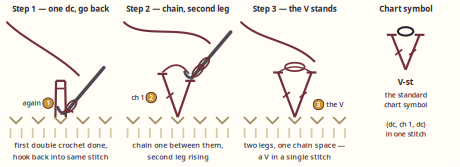 V-StitchTwo stitches, one place: the shell's minimalist cousin.
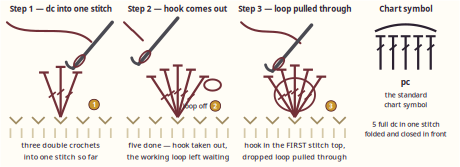 Popcorn StitchThe fan folded into a ball — the full guide.
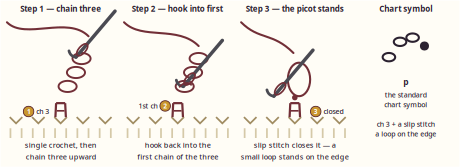 PicotThe tiny looped point that finishes shell edgings.
 Shells, Clusters & TextureAll eight texture stitches with diagrams, on the family page.
Common Questions
How many double crochets are in a shell stitch?
Five in the standard shell — five complete double crochets worked into the same stitch or space so they fan open. Three-stitch shells make a smaller scallop for fine work and edgings, and seven-stitch shells a wider, bolder fan; the pattern's stated size and its skip spacing are designed together, so they should not be swapped mid-piece.
What is the standard shell stitch row pattern?
The classic arrangement is: work a shell in one stitch, skip 2 stitches, work a single crochet in the next stitch to anchor the fan, skip 2 stitches, and repeat. The anchors pin the fans down and the skips give them room to open. Most plain shell patterns build their foundation chain as a multiple of 6 plus 1 to fit this repeat.
Should shells be worked into stitches or into spaces?
Both are standard, and the pattern decides. Shells into stitches are anchored to a point and fan symmetrically — the classic blanket and edging look. Shells into chain spaces sit looser and drape more, the usual choice for shawls and lacy shell patterns. The spacing of each design assumes its own method, so the two should not be interchanged within a piece.
Do shell rows stack or offset?
Either, by design. In stacked rows each shell sits directly over the shell below, in its centre stitch, forming columns. In offset rows — the commoner arrangement — each shell is worked into the single-crochet anchor of the row below, so the fans nest into each other's hollows and stagger like brickwork. The anchor placement in the pattern tells you which you are working.
More to Explore
Search Apparel Search