Online Fashion Trade Shows
Virtual trade shows and online exhibits — the fashion industry's always-open show floor, and the pioneering experiment that tried to build it
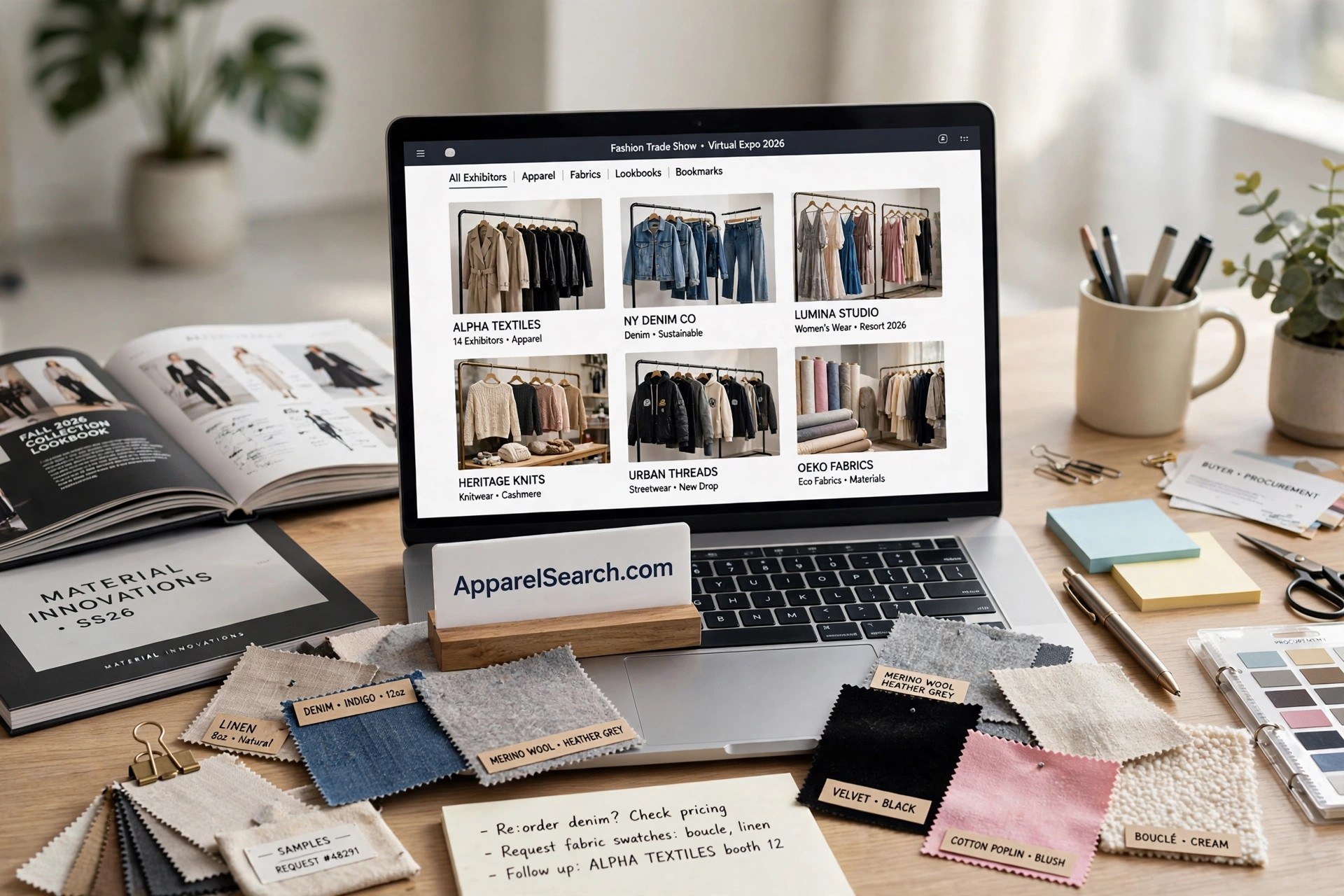
An online fashion trade show moves the exhibit hall onto the internet: instead of a booth in a convention center for three days, an exhibitor keeps a digital booth that wholesale buyers can visit at any hour, view collections in, and place orders through. This category page explains how virtual trade shows work, what they can and cannot do, and records the best-documented early attempt to build one for the fashion industry, Z Global Mart.
The appeal is arithmetic. Attending one physical market costs an exhibitor booth fees, samples, freight and travel, and the selling ends when the show closes; a virtual booth stays open around the clock, all year, to buyers anywhere in the world, at a fraction of that cost. The limits are just as real — no screen lets a buyer feel a fabric, check a fit or build the trust that a face-to-face market builds — which is why online shows developed as a complement to in-person markets rather than a replacement for them.
Trade Show Directories
Z Global Mart: The Fashion Industry's Virtual Trade Show
Z Global Mart, LLC launched in August 2009, in partnership with Ashley O'Rourke, a fashion industry veteran. Its billing was direct: "The Fashion Industry's Virtual Trade Show." The platform was created for exhibitors, designers, manufacturers, sourcing companies and service companies across apparel, shoes, bags, accessories and home accessories — the full exhibitor mix of a physical fashion market, rebuilt online.
Each exhibitor received a booth that stayed open 24 hours a day, 7 days a week, 365 days a year, on a worldwide basis. In it, a company could display its designs and write sale orders — both for existing inventory and for inventory to be delivered — directly with attendee wholesale buyers from all over the world. The pitch to exhibitors was worldwide exposure at a fraction of the cost of attending just one trade show. The site was strictly business-to-business: consumers were not allowed in.
The borderless floor drew borderless interest. Exhibitors and attendees signed on or enquired from Canada, the USA, Mexico, Brasil, the United Kingdom, the Netherlands, Belgium, Portugal, Spain, France, Italy, Turkey, Egypt, Russia, India, Bangladesh and China — a list that demonstrates the draw of a show floor with no airfare attached.
Z Global Mart, LLC was based at 1135 N. Topanga Canyon Blvd., Topanga, CA 90290, with telephone 818-453-1759 and fax 818-999-4225. Carmine Alex Egidio was the company's chief executive, and enquiries went to aegidio@socal.rr.com.
The experiment was short-lived. On March 11, 2010, the company announced that Z Global Mart had officially been taken off the internet because of partnership issues and undercapitalization, and that the system — with its domain names and trademarks — was open to offers from a purchaser or a joint-venture partner. The website no longer operates. The two announcements in References & Further Reading below bookend the attempt: the November 2009 opening to exhibitors, and the closing notice four months later.
How a Virtual Trade Show Works
The exhibitor's side of a virtual show mirrors a physical booth, translated to a screen. A company builds its booth from collection photography, line information and terms, organizes its offer by category so buyers can find it, and keeps the booth current as styles sell through or new deliveries land. Because the floor never closes, the work shifts from a frantic market week to steady maintenance: the booth is always one update away from showing what can actually be ordered.
The buyer's side starts with trade registration — virtual fashion shows are wholesale floors, not public shopping sites. A registered buyer browses exhibitors by product category, opens booths, reviews collections and places orders for stock on hand or for future delivery. Discovery works differently from a physical aisle: search and category browsing replace walking the floor, which makes an exhibitor's photography, descriptions and search terms do the work that a well-placed booth and a good salesperson do in person.
Online Shows and In-Person Markets, Compared
A virtual show wins on reach, cost and time. It admits a buyer in another hemisphere at midnight, it lets a small label exhibit without freight and travel, and it keeps selling between the physical market dates — the reorder in month four is business a three-day show cannot capture. Z Global Mart's international exhibitor interest showed how many companies wanted exactly that: a presence at a fashion trade show they could not afford to fly to.
An in-person market wins on the senses and on trust. Buyers handle fabrics, judge construction, see how a garment moves and negotiate across a rail of samples; relationships formed over seasons of markets carry the phone calls and the problem orders. That is why the industry's physical infrastructure — the shows in the directories above and the permanent showrooms of the merchandise marts — kept its place while online experiments came and went, and why the lasting role of the virtual show is to extend a market's reach and season, not to empty its halls.
More Ways to Find Fashion Trade Shows
Most fashion trade shows are still found the established ways: the trade show by category list groups markets by the merchandise they sell — the Maternity Trade Shows page in this category is one example — and fashion trade show news follows the market calendar as editions are announced and reported. Fashion Week coverage covers the runway side of the same seasons.
Working the shows is also a career. The Fashion Job Search pages and the wider Fashion Jobs section cover employment at shows, showrooms and brands, and Fashion Schools list the training routes into the trade.
More Trade Show Guides
Common Questions
What is an online fashion trade show?
A virtual exhibit hall for the fashion trade: exhibitors keep digital booths that registered wholesale buyers can visit at any time to view collections and place orders for existing or future inventory. Unlike a physical market's few days in one city, an online show stays open around the clock, all year, to buyers worldwide — but it is business-to-business, not open to consumers.
What was Z Global Mart?
Z Global Mart, LLC's 'Fashion Industry's Virtual Trade Show,' launched in August 2009 in partnership with fashion industry veteran Ashley O'Rourke. Exhibitors in apparel, shoes, bags, accessories and home accessories received booths open 24/7, 365 days a year. On March 11, 2010 the company announced the site had been taken off the internet because of partnership issues and undercapitalization.
Do online trade shows replace in-person markets?
No — they complement them. A virtual booth wins on cost, reach and always-open reordering, but buyers cannot feel fabric, judge fit or build face-to-face trust through a screen. The industry's pattern is physical markets and merchandise mart showrooms for launching and evaluating lines, with online exhibits extending a market's reach between its dates.