Apparel Search · Fashion Show Production
Backstage at a Fashion Show
Rails, dressers, look boards and a voice on a headset: how the hidden half of a fashion show keeps forty looks moving in the right order, at the right second, without the audience ever seeing a seam.
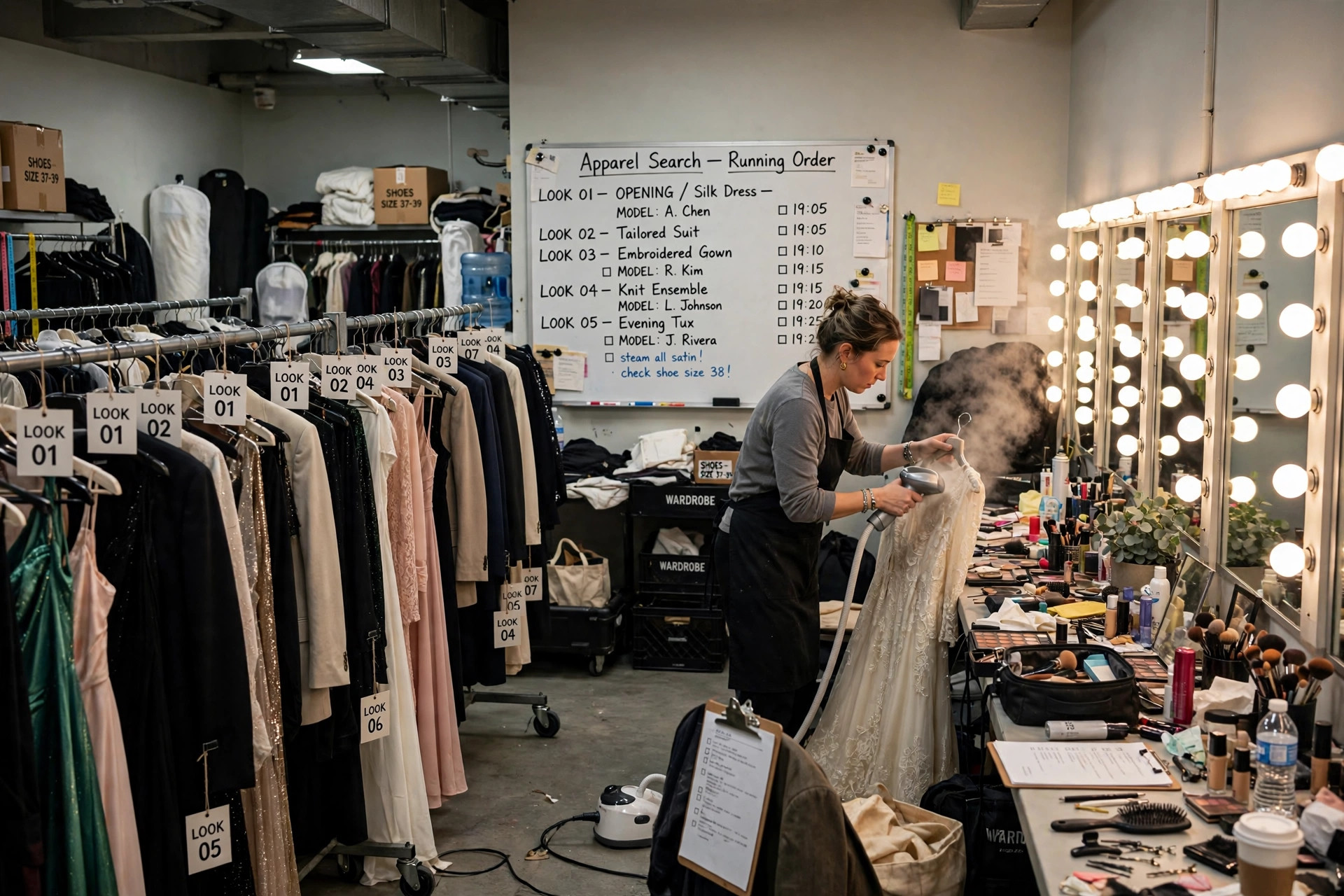
From the seats, a fashion show is serenity itself. Backstage, as this guide in the Fashion Show & Runway Production Guide explains, the same fifteen minutes are a controlled sprint: models cycling through hair, makeup and wardrobe, dressers executing changes timed in seconds, and a caller’s voice on a headset knitting it all together. Backstage is not chaos that happens to work. It is a system — and once you know the system, you can see it working in every well-run show.
The Layout: Everything Has an Address
Backstage space is organized so that nothing has to be searched for during the show. Garments hang on rails arranged in running order, each look tagged with its number, its model’s name and its look board photograph. Each model has an assigned position — their station — where their shoes, accessories and changes live, and an assigned dresser who owns that station. Hair and makeup occupy their own lit area with mirrors and chairs, running on a separate schedule that starts hours before the show: the first models into the chairs are the ones whose looks open the show. A lineup area near the runway entrance is where dressed models queue, in order, for the caller’s cue. Steaming and pressing happen early; a repair kit — needles, thread, safety pins, hooks, tape, spare buttons and a handheld steamer — sits where the backstage manager can reach it in seconds.
The Running Order Runs Everything
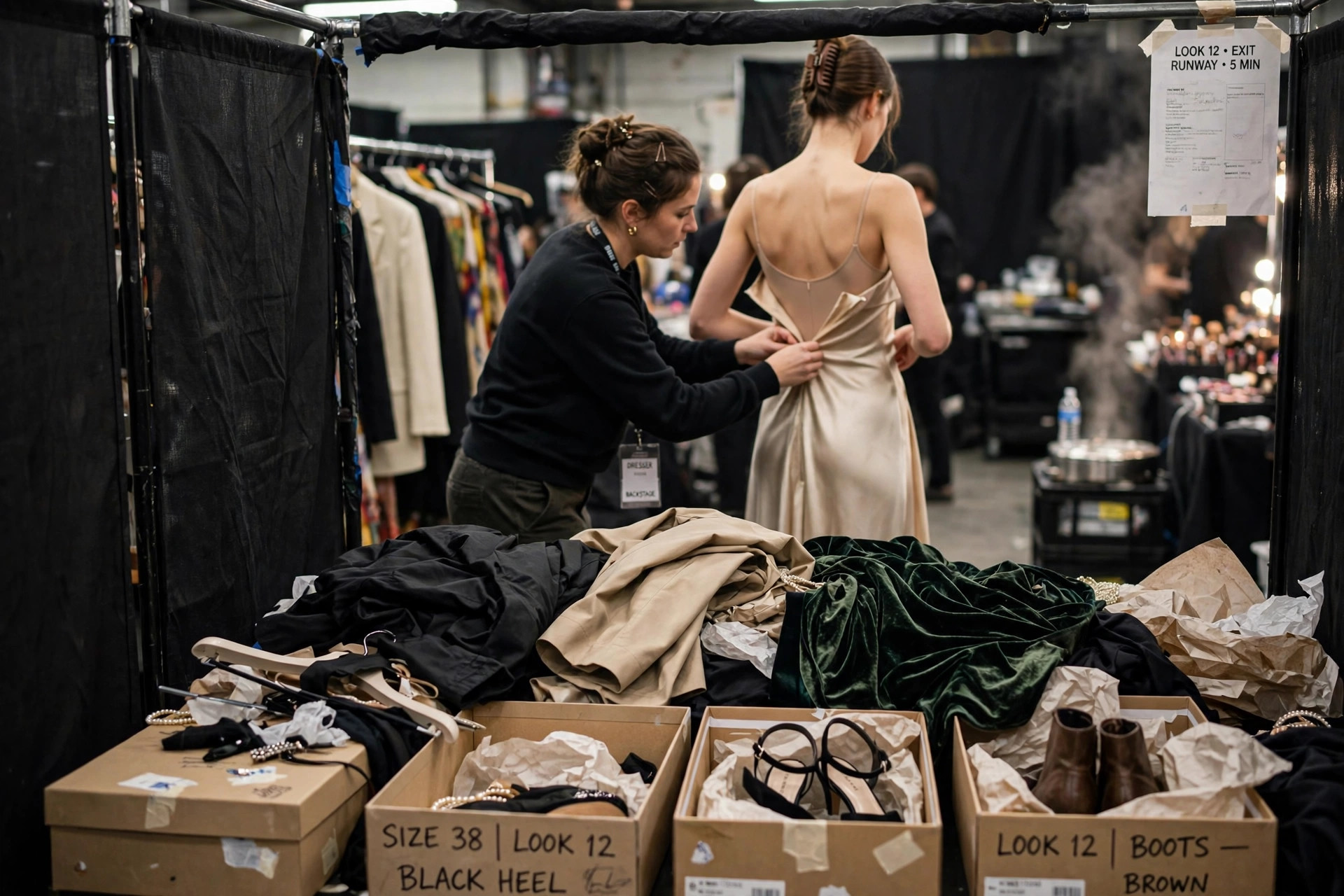
The running order is the numbered sequence of looks, and backstage it is treated like a railway timetable. Each model’s changes are calculated against it: if a model wears look 4 and look 19, the team knows exactly how many looks — how many minutes — they have to accomplish the change. The backstage manager tracks the board as the show runs, marking looks off as they leave for the runway and confirming returns. When the designer makes a late change — a look pulled, two looks swapped — the board, the rails and every dresser’s sheets are updated together, because the one unforgivable backstage error is two versions of the order in circulation. This is the same document our production guide calls the single source of truth for the whole show.
Communication: Quiet Voices, Closed Loops
Backstage runs on headsets and whispers. The show caller talks to the dressers’ lead, the lineup coordinator and the technical operators on one channel; cues are given as warnings (“stand by, look 12”) and executions (“look 12 — go”), and every cue is acknowledged. Voices stay low because the audience is often only a curtain away, and music from the house leaks in as the backstage clock: experienced dressers can tell where the show is from the track playing. When something goes wrong — a broken zipper, a missing shoe — the fix is chosen from preparations made earlier: a substitute shoe in the same size range, a look re-pinned, a model’s later look swapped with a simpler one. Improvisation exists, but it improvises from a kit and a plan, never from nothing.
The Rule of the Rail
Every garment returns to its exact place on its rail, every time, in running order — even mid-show, even in a hurry. The rail is the backstage filing system, and a garment hung one position off can cost a look its turn. New dressers learn this rule before any other: your hands can hurry, but the system cannot be allowed to blur.
Common Questions
What does a dresser do at a fashion show?
A dresser is responsible for a specific set of models and their changes. Before the show they prepare their rail — garments steamed, shoes and accessories laid out in running order, look boards checked. During the show they help their models out of one look and into the next in as little as a minute, then send them to the lineup. Good dressers are prized crew: fast, calm, discreet, and exact about details like which belt notch and which earring.
How do quick changes work?
A quick change is rehearsed, not improvised. The next outfit is laid out in the order it goes on, fasteners are pre-set (zippers down, buttons open, shoes unbuckled), and the model steps into a screened area where one or two dressers work in silence against the clock. Anything that cannot be changed in the available gap is restyled in advance — the production changes the outfit's styling, never hopes for more time.
What is a look board?
A look board is the photograph taken at the fitting showing exactly how one outfit is worn: which pieces, which accessories, how it is styled. A printed board hangs with each look on the rail backstage, so dressers can reproduce the fitting's styling precisely under time pressure, without the stylist needing to be in six places at once.
Who is the show caller?
The show caller (or show director) runs the performance itself from the production desk, wearing a headset connected to backstage, lighting, sound and the runway entrance. Working from the running order and the music, the caller cues each model's entrance, every lighting state and every sound cue. Their voice is the one thread tying the front of house and backstage together during the show.
More in the Fashion Show & Runway Production Guide
Back to the Fashion Show & Runway Production Guide
The Fashion Show & Runway Production Guide hub explains the whole production — planning, casting, backstage, staging, fashion week and the guest list — with a map of every guide in this cluster.