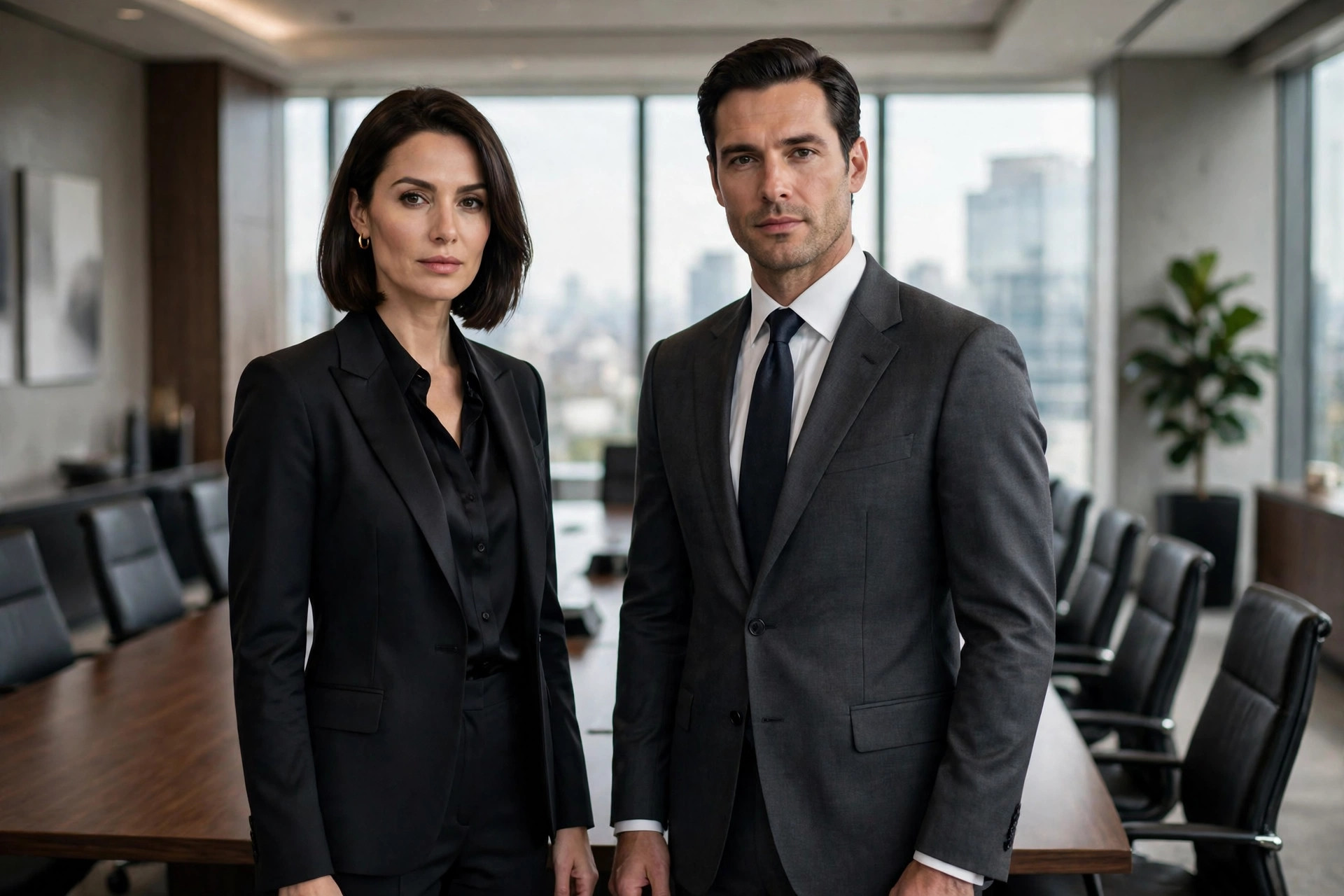
Business formal, also called business professional, is the traditional dress standard of boardrooms, courtrooms, client presentations, and formal business events. Its centre is the matched suit: jacket and trousers — or jacket and skirt — cut from the same cloth, worn with a formal shirt and, for men, a tie. It is the workplace counterpart of the upper rungs of the formality ladder, and it exists for a practical reason: it removes individual guesswork and presents a uniform front of competence. This guide sets out the standard for men and women, and draws the line that separates business formal from its relaxed neighbour, business casual — with smart casual one step below that.
Business Formal for Men
The suit is a two-piece (three-piece in traditional settings) in a dark, sober colour: navy and charcoal do nearly all the work, with black reserved for the most formal occasions and lighter greys acceptable in summer at the standard's relaxed edge. The shirt is white or pale blue, with a proper collar and long sleeves fastened with buttons or cufflinks — never short sleeves under a suit jacket. The tie is not decoration here but uniform: silk, in a solid, small pattern, or classic stripe, knotted neatly to the belt line. Shoes are black or dark brown leather oxfords or Derby shoes, polished, with dark socks that cover the calf. A belt that matches the shoes, a restrained watch, and nothing else by way of jewellery completes a code whose entire point is that nothing about it asks for attention.
Business Formal for Women
The women's standard mirrors the men's in intent: a tailored suit — trousers or a skirt cut to the knee or just below — in navy, charcoal, black, or another deep neutral, worn with a blouse or formal top in a light, plain fabric. A tailored sheath or shift dress with a matching or coordinating jacket meets the same standard and is a common modern choice. Shoes are closed-toe pumps or flats in leather, with a moderate heel; hosiery remains the traditional expectation in the most conservative settings such as courtrooms and traditional finance. Jewellery is small and singular — studs or a modest necklace, a watch — makeup and hair are neat and understated, and the bag is structured and large enough for documents rather than an evening clutch. As with the men's version, fit is the substance of the code: a suit that is tailored to the wearer reads formal at any price, and one that is not reads careless at any price.
The Business Formal Outfit Checklist
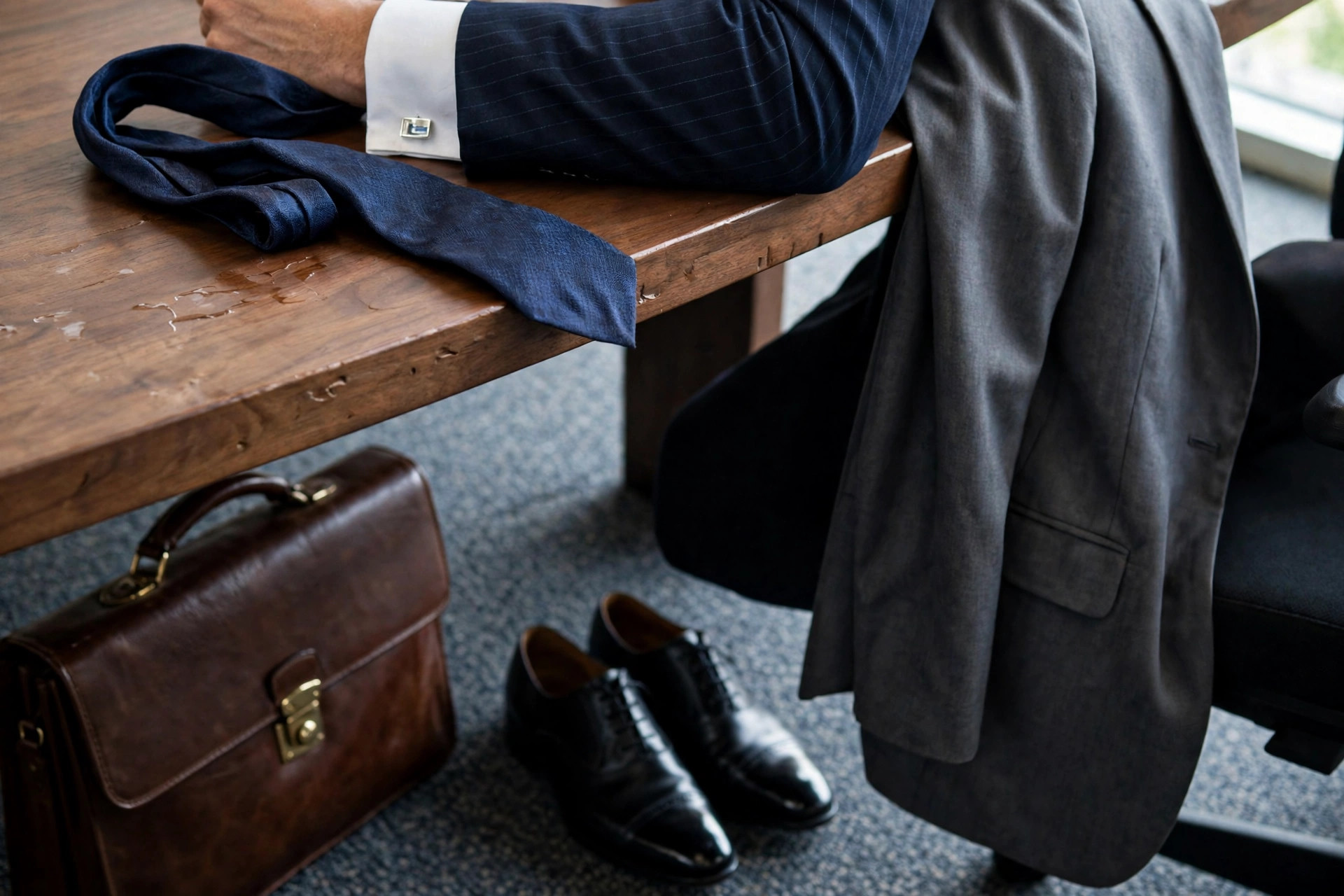
Business formal is the matched suit worn as a uniform. If the outfit would pass in a boardroom or a courtroom, it passes this list.
For Women
- A tailored suit — trouser or skirt — in navy, charcoal or black
- Or a tailored sheath dress worn with a jacket
- A blouse or fine shell top, nothing low-cut or casual
- Closed-toe pumps or polished flats
- Conservative jewellery and a structured work bag
- Hosiery where the workplace is traditional
For Men
- A matched suit in navy or charcoal — jacket and trousers from the same cloth
- A white or pale blue dress shirt
- A conservative tie, knotted properly and reaching the belt
- A belt that matches the shoes
- Polished black or dark brown Oxford dress shoes
- A briefcase or document bag — never a backpack in formal settings
How Business Formal Differs from Business Casual
Business casual was created by relaxing business formal piece by piece, and listing the relaxations is the clearest way to see both codes. Business formal requires the matched suit; business casual allows separates. Business formal requires the tie; business casual drops it. Business formal shirts are white or pale and plain; business casual admits colour, pattern, and eventually knitwear. Business formal shoes are polished oxfords or pumps; business casual walks down through loafers to, in some offices, clean trainers. Nothing about jeans, shorts, or sportswear changes between the two — both codes exclude them — which is why confusing the codes is costly in one direction only: arriving business casual at a business formal occasion is a visible error, while arriving business formal at a business casual office merely reads as a big day, which it may well be.
When Business Formal Applies
Expect the standard wherever the institution's formality is part of its credibility: law, traditional banking and finance, government, board and shareholder meetings, court appearances, and senior client-facing work in conservative industries. It also governs specific occasions inside otherwise casual companies — job interviews at formal firms, major presentations, negotiations, award ceremonies, and formal business dinners. Industry and region shift the baseline considerably, and many technology and creative workplaces never ask for it at all. The working rule is to dress to the most formal plausible reading of the occasion when the relationship is new, and to let the code relax only as the room itself shows you that it has. For evening business events that shade into social territory, the neighbouring guides on this site — cocktail attire for receptions and our festive guide for holiday parties — take over from this one.
Common Questions
- Is business formal the same as business professional?
- Yes — the two terms name the same standard: a matched dark suit, a formal shirt, and a tie for men; a tailored suit or dress with a jacket for women. Business professional is the term used more often in North American workplace dress codes and interview advice.
- Do you always need a tie for business formal?
- For men, yes. The tie is a defining element of the business formal standard, not an accessory. The occasions that relax it — a summer event, a creative-industry meeting — have usually also relaxed the rest of the code toward business casual.
- Are jeans ever business formal?
- Never. Denim is excluded from both business formal and business casual. The most relaxed garment with any place in business formal is a tailored dress trouser; jeans belong to smart casual and below.
- What colour suit is best for business formal?
- Navy and charcoal are the working standards — appropriate in every season, industry, and level of formality the code covers. Black is more formal still and suits evening or ceremonial occasions. Brown, tan, and strongly patterned suits fall below the business formal line.
Dress Codes Decoded
This page is part of the Apparel Search Dress Codes Decoded series — every invitation and workplace code explained on its own page, from white tie at the top of the ladder to smart casual at the everyday end. Browse the full series below.
More to Explore on Apparel Search
- Consumer Fashion Guide — fashion guidance for shoppers, from fit and fabrics to dressing well for every occasion.
- Shopping Directory — shop for clothing, shoes, and accessories by category, style, and store.
- Retail Clothing Stores — the Apparel Search directory and guide to clothing retailers, from boutiques to department stores.