The Short Answer
What Business Casual Means in 2026
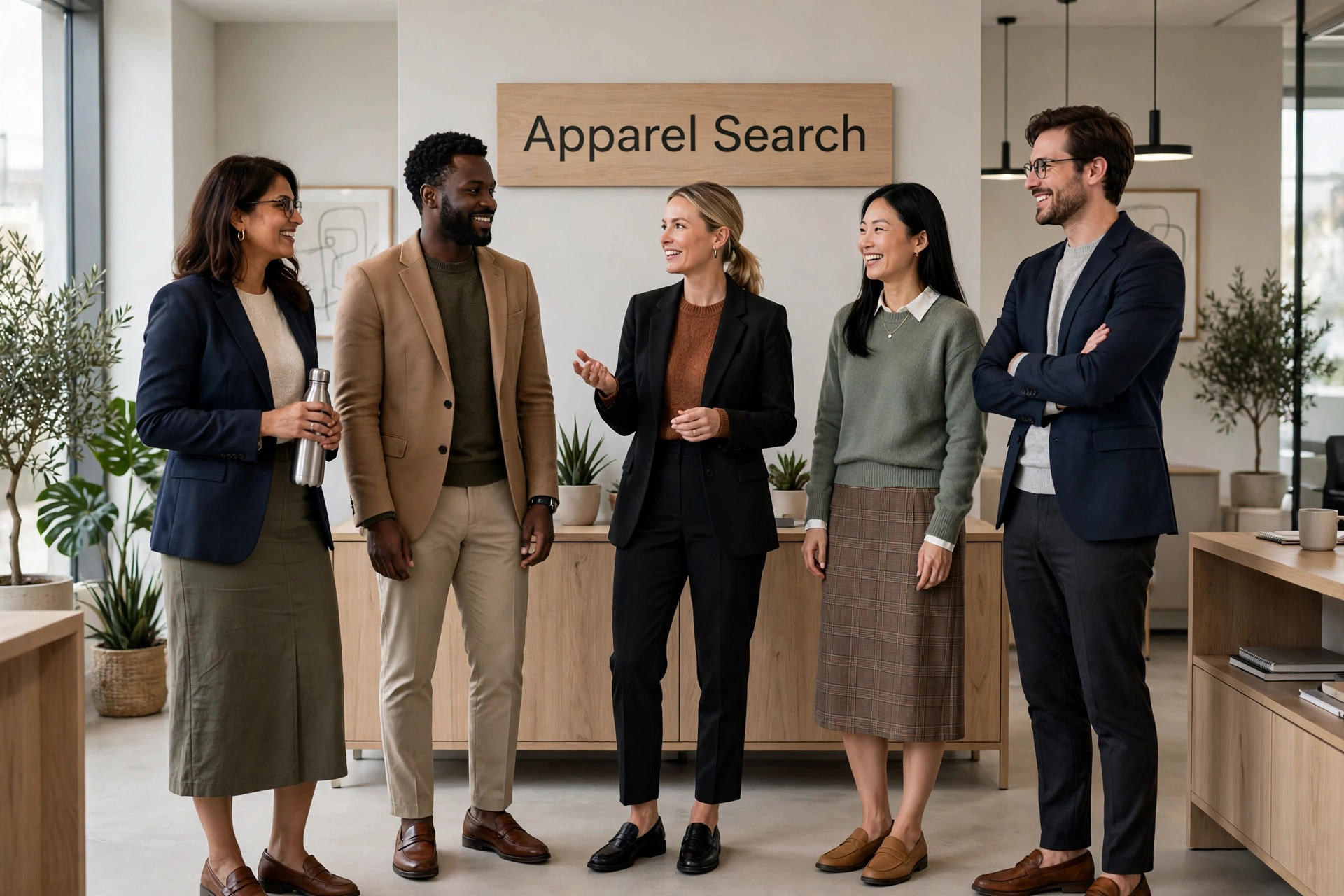
Business casual is the middle register of office dress: cleaner and more deliberate than everyday casual clothes, but freed from the matching suit, the tie and the formality of traditional business dress. In 2026 it is the default code in most offices — and still the one people most often get wrong, because it is defined by judgement rather than by a uniform.
The working definition is simple. Take the building blocks of classic workwear — tailored trousers, chinos, skirts, buttoned shirts, knitwear, unstructured jackets, clean leather shoes — and combine them so the result looks intentional. Nothing is ripped, faded, slouchy or beach-ready; nothing needs a dry-cleaner’s press to survive the day either. The business casual definition in the Apparel Search glossary gives the formal wording; this hub turns that wording into outfits.
Two forces shape the code today. Hybrid work means many people dress for a screen as much as a room, which rewards pieces that read well from the waist up. And offices have quietly split into two camps — a dressier business casual in law, finance and client-facing roles, and a relaxed version in tech and creative work. Knowing which camp your workplace belongs to matters more than any single rule.
Search Apparel Search
The Spectrum
From Business Professional to Casual Friday
Dress codes form a ladder, and business casual is the rung most people stand on. At the top, business professional means a matching suit, a dress shirt or blouse, closed leather shoes and conservative grooming — the courtroom and boardroom standard. One step down, business casual separates the suit: trousers or a skirt with a shirt, knit or soft jacket, no tie required. Below that, smart casual admits dark, clean denim and more personal styling, a code covered on its own page, smart casual. At the bottom, casual is ordinary off-duty clothing, which in most offices appears only on designated days, if at all.
The full side-by-side breakdown — what changes at each level, for tops, bottoms, shoes and accessories — is on Dress Codes Compared. The practical rule when you are unsure: dress one rung above what you expect. It is always easier to remove a jacket than to wish you had worn one.
The Guides
The Outfit Guides in This Family
This hub gathers the whole family in one place. Women’s Business Casual Outfits works through outfit formulas built on trousers, skirts, dresses, knitwear and blazers, season by season. Men’s Business Casual Outfits covers chinos and khakis, oxford shirts, polos and knit polos, unstructured blazers and the shoe choices that make or break the look. Business Casual Dresses & Skirts goes deep on the one-piece and skirt side: lengths, necklines, sleeves, fabrics and seasonal dressing.
Two older guides belong to the family too. The women’s business casual pants guide is the detailed trouser reference — cuts, fabrics and fits — and the dress code definition explains where all of these terms came from. Together they cover the code from a one-line definition to a week of outfits.
The Ground Rules
Five Rules That Hold in Almost Every Office
Fit beats formality. A well-fitting knit polo outranks a baggy dress shirt every time; business casual punishes sloppy fit more than it punishes relaxed garments. Shoes set the floor. Clean leather shoes, loafers or immaculate minimal trainers anchor the outfit — scuffed shoes drag everything above them down. Denim is a local decision. Dark, unripped jeans pass in many offices and fail in others; watch what senior colleagues wear before assuming. Logos and slogans stay home. Branded sportswear, graphic tees and gym kit sit below the line in nearly every workplace. When a client, court or ceremony appears, step up. Business casual is the everyday setting, not a ceiling — important days call for the rung above.
Beyond the Everyday
Related Work-Dressing Guides
Some workdays are not everyday. A first impression calls for more polish than a normal Tuesday: job interview outfits explains how to pitch your look for the interview itself, where dressing half a step formal is the safe play. Classroom dress has its own logic — movement, practicality and washable fabrics — covered in the teacher outfits guide. Both sit beside this family rather than inside it, and both borrow the same foundation pieces: the trousers, knits and jackets in the guides above, adjusted for a higher-stakes or harder-working day.
Start where your question lives: the definitions if the wording of a policy puzzles you, the comparisons if an invitation uses a code you do not recognise, and the outfit guides when the wardrobe itself needs building.
Questions
Common Questions
What does business casual mean in 2026?
Business casual in 2026 means tailored, tidy clothing that stops short of a full suit: trousers, chinos or skirts with shirts, blouses, knitwear or an unstructured jacket, finished with clean shoes. It excludes ripped or faded denim in most offices, gym clothing, graphic tees, shorts and flip-flops — but exact expectations vary by workplace, so senior colleagues are the best guide.
Are jeans business casual?
Sometimes. Dark, unripped, well-fitting jeans are accepted as business casual in many modern offices, especially paired with a blazer or smart knit. In traditional workplaces — law, finance, client-facing roles — they still fall below the line. Check the written policy and what managers wear before relying on denim.
What is the difference between business casual and smart casual?
Business casual is built from office clothing worn less formally — trousers, shirts, knitwear, soft tailoring. Smart casual is built from casual clothing worn more carefully — dark denim, polos, neat trainers, unstructured pieces. The two overlap in the middle, but business casual starts from the suit and relaxes it, while smart casual starts from the weekend and tidies it.
Working From Home
Business Casual, Home Edition
Business casual assumed an office. For the days worked from home, our work from home outfits guide adapts the same code to the desk at home — camera-up, comfort-down dressing, a five-day rotation and hybrid days — and the companion video call outfits guide covers what the webcam actually sees: necklines, colours and the patterns to avoid.
Starting a New Job
Business Casual on Your Very First Day
Business casual is also the setting most new starters are aiming at. Our first day of work outfits guide applies this code to day one of a new job — decoding the office’s real level before you arrive, erring one notch smarter without overdressing, and turning the same pieces into a first-week rotation.