Apparel Search Consumer Guides
Teacher Outfits
Classroom dressing is its own branch of workwear: hours on your feet, floors to sit on, chalk and paint to survive, and a layer for the room that is never the temperature it was promised to be. The working system, piece by piece.

Teaching is physical work performed in front of an audience, and classroom dressing is its own branch of workwear because the conditions are unlike any office. You stand and move for most of the day. You may sit on the floor, kneel beside a desk, or perch on a stool built for someone half your size. You work within arm’s reach of chalk dust, dry-erase markers, paint, glue and thirty lunches. And whatever you wear goes home and into the wash tonight — tomorrow needs it ready again, not back from a cleaner next week. This guide works through those demands in order: the postures, the staff dress code, the washable fabrics, the pockets, the shoes, and the layer.
Two companion guides do the planning. The teacher outfit formulas by season turn this page’s principles into a rotating wardrobe, term by term. The guide to what teachers wear in the first week covers the school year’s set pieces — first impressions, picture day, field trips and evening events.
Search Apparel Search
One Job, Two Postures
Down at student level. Elementary teachers spend real parts of the day on the floor, on small chairs, and kneeling at desk height. That argues for trousers and longer skirts that stay dignified in a squat, hems that clear the floor, tops that do not gap when you lean across a table, and fabrics with enough recovery to kneel in at 9 a.m. and still look pressed at 3. Dresses join the rotation when they pass the same test: sit on the floor in it at home, cross-legged, before it earns a school day.
Up in front of the room. Secondary and university teachers present: writing at the top of a board, reaching a projector screen, gesturing through an explanation. Sleeves must allow a full overhead reach without pulling a hem up with them, and anything that needs adjusting between classes will get adjusted thirty times a day — send it back to the closet. Both postures share one rule: the outfit is finished when it can be forgotten until the final bell.
The Staff Dress Code Is Real — and It Varies
Most schools hold staff to a standard somewhere around business casual, but the range is wide and honestly reported here: some districts publish detailed rules (no denim except Fridays, no athletic shoes, no leggings as trousers), some private and charter schools are more formal, and some schools ask little beyond neat and covered. Department matters too — the art room, the gym and the science lab each bend the code toward what the work allows. None of that variation is a problem to solve; it is a fact to read first. Your handbook and your building’s customs outrank this guide, and the wardrobe below is built to fit inside the common middle of school codes.
Read Your Own Handbook First
Staff dress codes differ by district, by school and sometimes by department, and they change. If your handbook bans a fabric, a shoe or a silhouette, the ban wins over anything on this page. Treat this guide as the pattern that fits most schools, adjusted to the letter of yours.
Washable, Durable, Forgiving: The Fabric Rules
The classroom is hard on cloth in specific ways. Chalk and dry-erase dust show worst on black and navy in smooth weaves; they brush off mid-tones and small patterns almost invisibly — one reason experienced teachers drift toward heathered greys, prints and textured knits for daily wear. Markers, paint and glue argue the same way, and for pieces that can be machine-washed at home without a thought. The working rule is simple: if a garment needs dry cleaning, ironing gymnastics, or luck, it is not a school-day garment. Cotton blends, washable wool blends, ponte and good knits carry the year; our laundry guide covers the wash rhythms a five-day rotation demands, and the stain removal guide handles the marker incidents.
Pockets Are Equipment
A teacher’s pockets do a job: keys, a hall pass, a phone, stickers, a pen that works, the small change of a school day. Outfits without real pockets push all of that into hands that are already full. When you shop, test pockets with your own hand — many women’s trousers and dresses still offer decorative ones. Cardigans with patch pockets, trousers with full front pockets and the occasional dress with pockets sewn into the side seams are the rotation’s heavy lifters, and a lanyard or badge clip keeps the one credential every school requires off the pocket budget entirely.
The Layer, and the Shoes That Stand
Classrooms are famously unreliable about temperature: hot at the windows in September, cold by the door in January, and set by a thermostat in another wing at all times. The answer is a layer that lives at school — a cardigan or unstructured blazer that goes with everything in the rotation, added and shed as the room demands. The reasoning is the same one our dressing for the climate guide applies outdoors, moved inside.
Shoes are graded by the standing day more honestly than by any other test. Cushioned flats, loafers, low block heels and ankle boots do the work; thin soles, high heels and shoes that pinch by noon do not. Fit them the way our shoe fit guide prescribes — room in front of the toes, a heel that holds, a try-on late in the day when feet are at their largest — and keep two or three pairs rotating so no pair works five days straight.
The Two Companion Guides
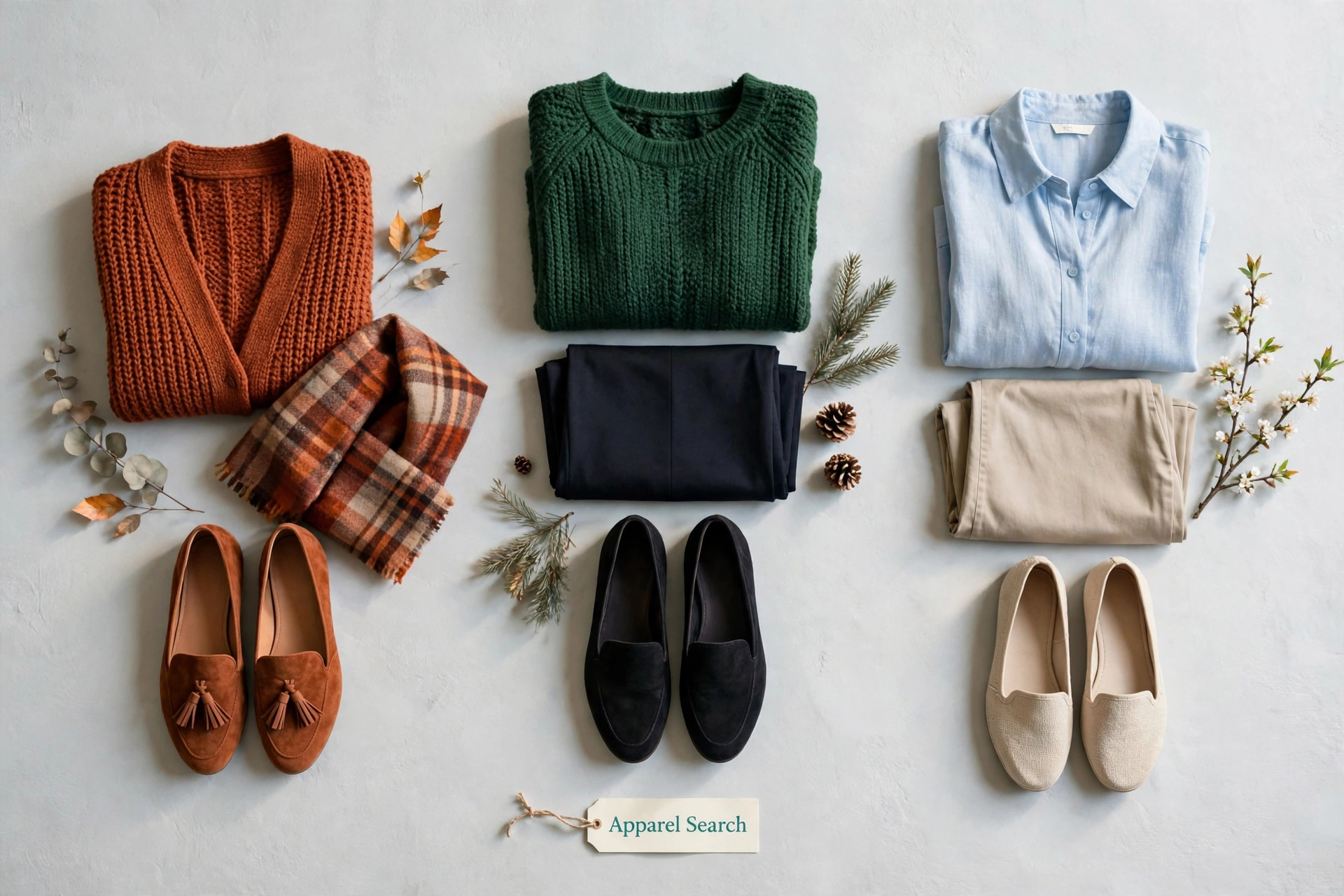 Teacher Outfit Formulas by SeasonOne wardrobe, three terms: the stock list, the fall, winter and spring formulas, the wash-night rhythm, and the step-up for conferences and parent nights.
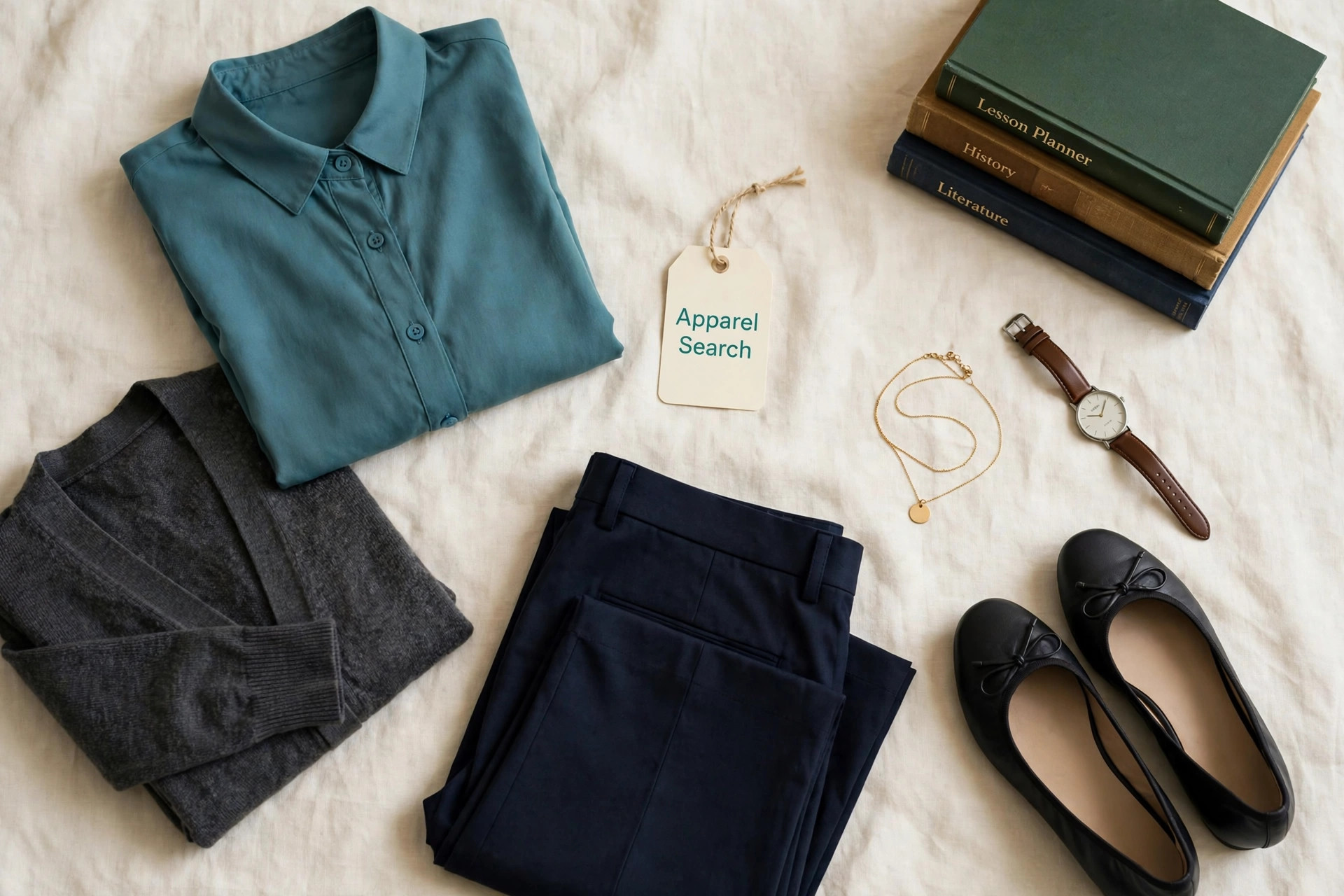 What Teachers Wear: First Week & EventsThe year’s set pieces dressed one by one: the first week, picture day, field trips on foot and evening events — plus the weekend-before checklist.
Shop Teacher Workwear on Amazon
Cardigans, washable trousers, knit tops and cushioned flats and loafers — the pieces of the classroom rotation — are all stocked on Amazon.
Shop Clothing on AmazonThis link opens the Apparel Search shopping guide for Amazon, where the product links are kept in one place.
Common Questions
What should a teacher wear to school?
A business-casual core built for movement: washable trousers or a skirt that survives bending and floor work, a top that stays put while you reach for the top of the board, a layer for the room’s temperature swings, and cushioned shoes chosen for standing, not sitting. The exact standard is set by your school’s staff dress code, which always outranks any general guide.
Can teachers wear jeans?
It depends entirely on the school. Many schools allow jeans on Fridays, on dress-down days, or all week when they are dark, undamaged and styled like trousers; others prohibit denim for staff outright. Your employee handbook is the authority — and when in doubt, the washable trouser is the safer version of the same comfort.
What shoes do teachers wear for standing all day?
Cushioned flats, loafers and low, stable heels or ankle boots — shoes fitted with room in front of the toes and a heel that holds, because feet swell across a standing day. Most teachers keep two or three pairs in rotation: no single pair should work five days straight, and no pair should make its debut on a school morning.
How many work outfits does a teacher need?
About two weeks’ worth of mix-and-match pieces — typically twelve to fifteen core items: three or four bottoms, six to eight tops, two or three layers and two or three pairs of shoes. Built on one palette, that rotation covers the school year, re-layered by term; the formulas page in this guide lays out the stock list.