What a Provider Actually Decides for You
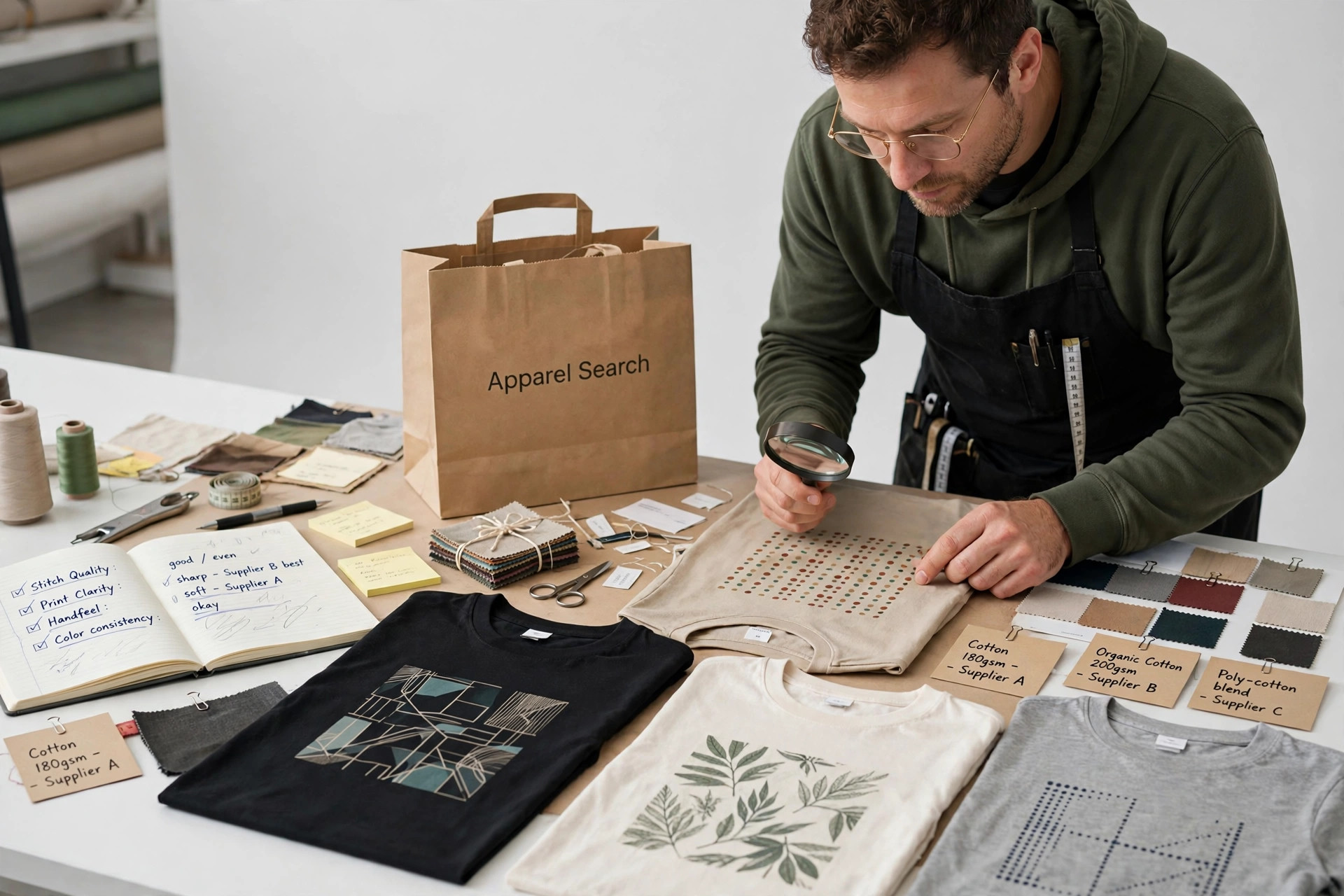
A print-on-demand provider is not a neutral pipe between your store and your customer. It decides which garments you can sell, how they are printed, how long customers wait, what a defect looks like when it arrives, and what happens when something goes wrong. Well-known providers include Printful, which runs its own production facilities, Printify, which routes orders through a network of independent print shops, and Gelato, which produces through local partners in many countries. Those are different structures — own facilities versus networks — not a ranking: a network offers more locations and catalog breadth, while a single operator can be more consistent. Other providers, from large marketplaces' own services to small regional shops, fill out the market. Names change less often than terms do, so evaluate any provider against the checks below rather than reputation alone.
The Checks, in the Order to Run Them
Catalog and print methods
Start with the blanks: the garments, fabrics, colors and sizes your brand actually needs, the print methods offered on each (DTG, DTF, sublimation, embroidery), and the printable area per garment. A wide catalog is worthless if your core product is a heavyweight hoodie the provider stocks only in a thin one. Check size range too — a catalog that stops early excludes customers you may not know you are losing.
Samples of your own products
Order your best-selling design on your main blank, at your own expense, before customers see it. Wash it several times. Check print placement, color against your file, hand feel and blank quality. This single step, skipped by most beginners, is the only direct evidence about what your customers will receive — how print on demand works explains why facility variation makes it necessary.
Production locations and delivery times
Where a provider produces decides shipping cost and speed to your actual customers. A provider with a facility on your customers' continent will usually beat a cheaper base price shipped across an ocean. Ask for production-plus-shipping times by region, and how times change in the holiday peak, when POD queues lengthen across the industry.
Integrations and workflow
The provider must connect cleanly to your store platform so orders, stock status and tracking pass automatically. Test the connection with a real order. Also check what happens when a blank goes out of stock: does the provider warn you, substitute, or quietly delay?
Branding options and their limits
Packing slips, labels and pack-ins vary widely, and some branding touches cost extra per order. Inside-neck prints are offered by some providers and not others. List the branding your brand genuinely needs now — most young brands need a correct packing slip and nothing more — and do not pay per-order fees for the rest.
Returns, defects and support
Read the defect policy precisely: what counts as a defect, what evidence is required, who pays return shipping, and how size exchanges are handled (usually: not handled, as the brand's cost). Then test support with a real question before you need it urgently. When a customer's parcel is wrong at Christmas, this policy — not the feature list — is your provider.
Total cost, not headline cost
Compare the full charge for the same garment shipped to the same address: base price, print surcharges for extra placements, branding fees, shipping and any monthly subscription that unlocks lower prices. Subscription tiers change the arithmetic only at volume, which is part of print on demand pricing and margins.
One Provider or Two?
Running two providers is common once a brand grows: one for a product the other stocks poorly, or one per sales region. It costs consistency — the same design printed two ways — and doubles the sample checking. For a starting brand, one provider, properly sampled, is almost always the right answer; add a second only for a named reason. And re-run the sample check periodically whichever you choose: blanks get substituted, facilities change, and the provider you vetted last year is not automatically the one shipping today.
Common Questions
What is the difference between providers like Printful and Printify?
The structural difference is who prints. Printful produces mainly in its own facilities, which tends to make output more consistent. Printify routes orders to a network of independent print providers, which offers a wider catalog and more production locations, with quality that varies between shops. Gelato follows a local-production network model across many countries. None of this makes one universally better — it makes the sample check more or less critical.
Should I order samples before selling print-on-demand products?
Yes — at least one sample of each core product, printed with your own artwork. It is the only way to see the actual blank, print placement, color and hand feel your customers will receive. Wash the sample several times as a basic durability check before the design goes on sale.
Does it matter where a print-on-demand provider produces?
Yes, because production location sets shipping cost, delivery time and customs exposure for your customers. A provider that produces on the same continent as most of your buyers will usually deliver faster and cheaper than one shipping internationally, even if its base garment price is slightly higher.
Can a provider put my own labels in the garments?
Some can and some cannot, and the options differ: printed inside-neck designs, branded packing slips and pack-in inserts are the common offerings, sometimes at a per-order fee. Sewn-in private labels are generally not a print-on-demand service — that level of branding belongs to private label or cut-and-sew production.
More to Explore
Search Apparel Search