What Print on Demand Is
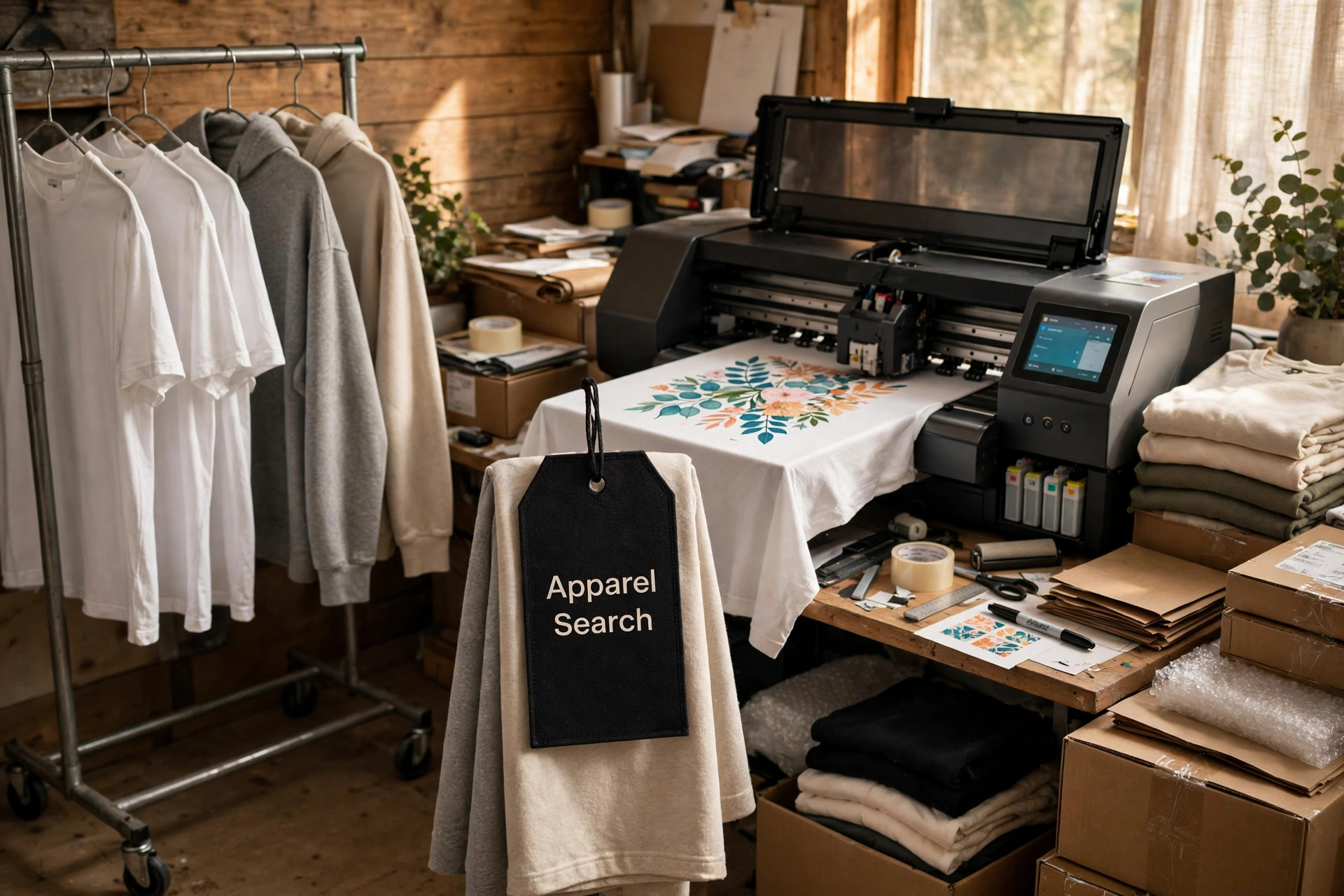
Print on demand (POD) is a production model in which a garment is printed only after a customer has ordered it. The brand supplies the artwork and sells through its own store; a POD provider holds the blank garments, prints each order one at a time — usually by direct-to-garment, direct-to-film or sublimation printing — and ships it to the customer, often under the brand's name. Because nothing is made in advance, there is no inventory to buy, store or mark down, and no minimum order quantity. Industry estimates put the global print-on-demand market at roughly $13 billion in 2026, and clothing is its largest product category.
The trade is equally clear. The provider's per-unit price must cover the blank, the print and the packing labor, so unit costs are far higher than bulk production, and the brand can only sell the blank garments, colors, sizes and print placements the provider stocks. Print on demand is therefore best understood as a way to test designs and run a graphic-led brand without inventory risk — not as a cheaper version of owning production. It sits alongside private label and cut-and-sew in the comparison of clothing business models, and this guide works through it in the order a founder meets it.
Search Apparel Search
The Model, in Five Steps
Publish the design
You prepare print-ready artwork, choose a blank garment from the provider's catalog, place the design in a mockup generator and list the product in your store at your price. How print on demand works follows this sequence in full detail.
The customer orders
The order, payment and shipping address flow from your store to the provider automatically. You never touch the garment.
The provider prints one unit
The blank is picked, printed, cured and checked, then packed — typically within a few working days, though times vary by provider and season.
The provider ships
The parcel goes to your customer with your branding on the label or packing slip where the provider allows it. The provider charges you the base cost plus shipping; the difference from your retail price is your gross margin, worked through in print on demand pricing and margins.
You handle the customer
Questions, size exchanges and complaints about print quality all arrive at your store, not the provider's — customer service and returns policy remain the brand's job even though fulfillment does not.
What It Suits — and Where It Stops
POD suits graphic-led products: t-shirts, hoodies, sweatshirts and tote bags where the artwork is the product and the garment is a standard blank. It suits testing — a design that sells can be kept, one that does not can be withdrawn at no cost — and it suits personalization, since every unit can differ. It is a poor fit for fitted, constructed or fabric-led clothing: the provider's catalog, not your pattern, decides the garment. Quality is also shared control. You choose the provider and the blank, but a different facility may print the same design next month, which is why choosing a print on demand provider — and ordering samples of your own products — matters more than any feature list.
The sharpest comparison is against the traditional alternative: print on demand vs screen printing sets the two side by side on run length, color, cost and hand feel, and the screen printing guide covers the batch method itself. And POD is often a stage rather than a destination: when to move beyond print on demand lists the signals — proven sellers, volume, quality or branding needs — that say a design has earned bulk production.
The honest summary: print on demand trades margin and control for zero inventory risk. That is a good trade while demand is unproven, and an expensive one once it is not.
Common Questions
What is print on demand in clothing?
Print on demand is a production model where a garment is printed only after a customer orders it. A provider holds blank garments, prints each order individually using methods such as direct-to-garment or direct-to-film printing, and ships it to the customer. The brand supplies the artwork and runs the store, and never holds inventory.
Do you need money to start a print-on-demand brand?
Very little goes to inventory, because there is none. The real startup costs are design time or artwork, product samples you order to check quality, your store platform fees, and marketing. That low entry cost is the model's main attraction — but per-unit costs are high, so a brand still needs prices that leave a margin after the provider's base cost and shipping.
Can you choose your own garments with print on demand?
Only within the provider's catalog. Each provider stocks a set of blank garments in particular colors and sizes, and your designs must fit those blanks and their print areas. If your brand depends on a specific fabric, cut or construction, print on demand cannot supply it — that requires private label or cut-and-sew production.
Is print on demand good quality?
It varies by provider, blank and print method, which is why ordering samples of your own products is essential. A well-made DTG or DTF print on a decent blank is durable and retail-acceptable; a cheap blank or a poorly cured print is not. Quality control sits with the provider, so the brand's quality tool is choosing — and periodically re-checking — the provider.