Before Any Order: Files, Blanks and Listings
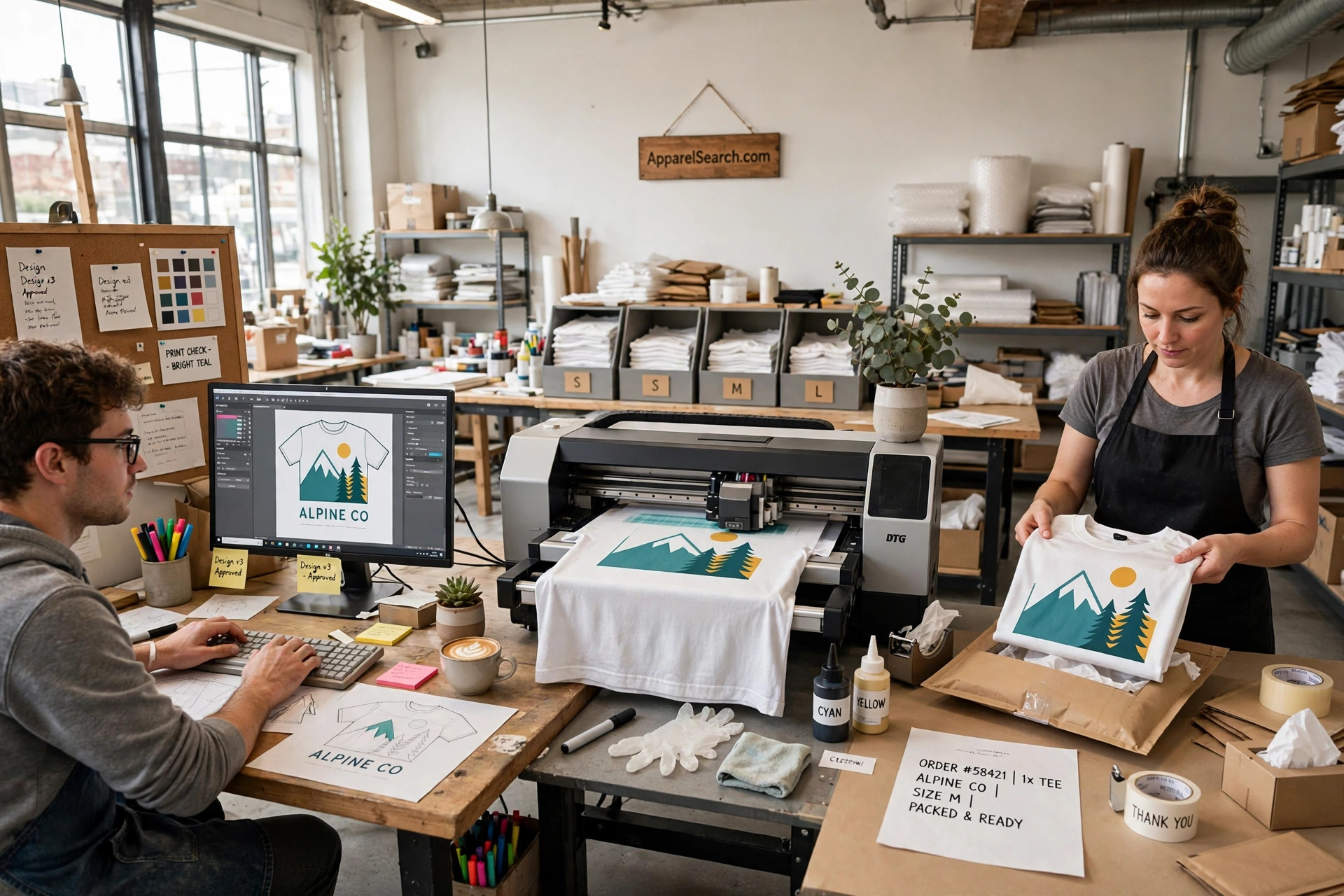
Every print-on-demand product begins as a digital file. Artwork is prepared at the size it will print, usually as a transparent-background PNG at 300 dpi, because the file — not a screen or a plate — is the master the printer works from. The brand then chooses a blank garment from the provider's catalog, places the artwork within that garment's printable area in the provider's mockup tool, picks colors and sizes, and sets a retail price. Publishing pushes the listing to the brand's store with generated mockup photos. Nothing physical exists yet: no stock, no printed sample unless the brand orders one — which it should, because the mockup is a rendering, not a promise about ink on cloth.
The print method is decided at this stage too, and it constrains the artwork. Direct-to-garment (DTG) printing sprays water-based ink directly into cotton fabric and handles photographs and gradients well. Direct-to-film (DTF) printing prints the design onto film and heat-presses it as a transfer, which works on more fabrics and gives strong color on dark garments. Sublimation dyes polyester itself and is used for all-over prints. Each provider offers a subset, on a subset of blanks.
After the Order: The Six Steps You Never See
The order triggers production
Your store sends the provider the design file, garment, size, color and shipping address, and pays the provider's base cost. Production queues at the facility nearest the customer that stocks the blank — which is why the same design can be printed in different places on different days.
The blank is printed
The garment is picked from the provider's blank stock, printed by the chosen method, and cured or pressed so the print sets. A single unit gets the full process; there is no batch to spread setup across, which is the mechanical reason POD unit costs stay high.
Quality check and packing
The printed garment is inspected — alignment, obvious print defects, correct size and design — folded and packed, with the brand's packing slip or label where the service tier includes it. Checks are visual and brief; they catch misprints, not subtle color drift, which is why sample orders remain the brand's own quality tool.
Shipping and tracking
The provider buys the label, hands the parcel to a carrier and returns a tracking number, which your store emails to the customer. Total delivery time is production time plus transit time, and both vary — a fact to state plainly on your product pages rather than discover through complaints.
Delivery — under your brand
The customer receives a parcel from a company they have never heard of, branded as yours. From their side of the transaction, you printed and shipped the shirt.
Problems come back to you
A misprint or a lost parcel is usually reprinted or refunded by the provider under its policy, but the customer contacts you, and you claim from the provider. A size exchange is harder: most providers do not accept returns of correctly printed items, so the brand's returns policy — priced in print on demand pricing and margins — decides who pays for a replacement.
Where the Chain Breaks
Knowing the steps shows where POD orders go wrong. Files break first: low-resolution artwork, colors specified for screen that print duller on cloth, and designs placed outside the printable area all pass silently until a customer complains. Blank stock breaks second — a popular blank in a popular size can go out of stock at a facility, adding days or switching production to another site. Shipping breaks third, because production and transit are run by two different organizations and the brand controls neither. The practical defenses are unglamorous: order a sample of every product, keep artwork inside the provider's templates, publish honest delivery estimates, and choose providers using the checks in choosing a print on demand provider before your customers test them for you.
Common Questions
How long does print on demand take from order to delivery?
Production typically takes a few working days and shipping adds several more, so many POD orders arrive within one to two weeks — but both stages vary by provider, facility, product and season. Because the brand controls neither stage, honest practice is to publish a range on the product page and update it when a provider's times slip.
What file do I need for print on demand?
Usually a transparent-background PNG at the exact print size and 300 dpi, prepared inside the provider's template for that garment. Vector sources are ideal for creating the file, but the printer works from the raster file you upload. Low-resolution files are the most common cause of blurry prints.
Who ships a print-on-demand order?
The provider ships it, normally from the production facility closest to the customer that stocks the blank, using a label and packing slip that carry your brand where the service allows. Your store receives the tracking number and passes it to the customer.
What happens if a print-on-demand order is wrong?
Misprints, defects and lost parcels are normally reprinted or refunded by the provider under its policy, but the customer contacts your store first and you make the claim. Correctly printed items in the wrong size are usually not returnable to the provider, so most brands cover exchanges themselves and build that cost into their prices.
More to Explore
Search Apparel Search