Children's Umbrellas Guide
A children's umbrella is the one U topic that is an accessory rather than a garment: a folding canopy on a shaft, sized down so a child can hold it centred over their own head and shoulders. Be honest about rain - yes, it is fun to sometimes play in the rain, but it is also important to sometimes stay dry, and in general it is best to stay out of the rain if possible. This guide covers the umbrella as a product: canopy sizes, opening mechanisms, safety points, fabrics and the rain kit it belongs to.
Shop Children's Umbrellas Now
Shop Children's Umbrellas on Amazon Shop Children's Umbrellas on eBayThe Amazon and eBay links on this page are affiliate links. If you make a purchase through them, Apparel Search may earn a commission.
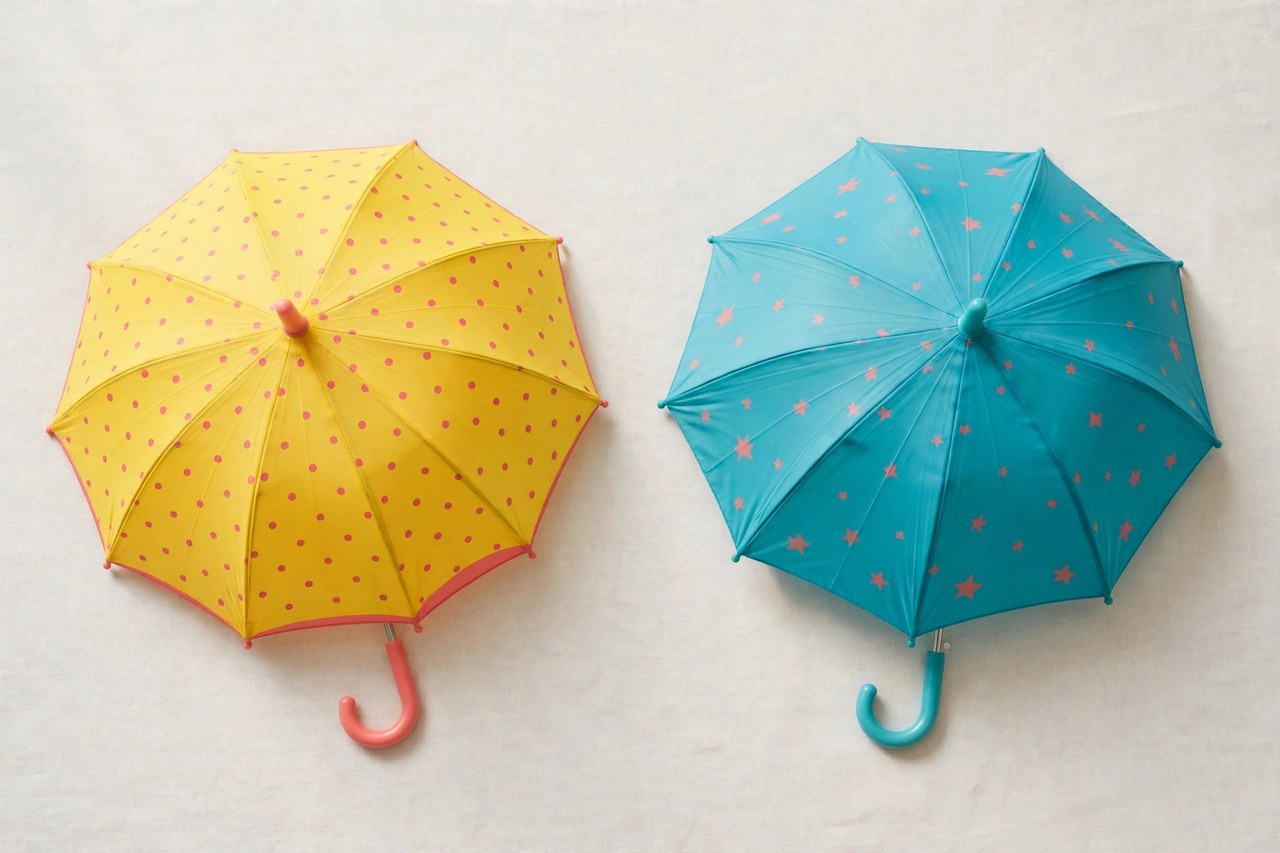
A children's umbrella is the one U topic that is an accessory rather than a garment: a folding canopy on a shaft, sized down so a child can hold it centred over their own head and shoulders. Be honest about rain - yes, it is fun to sometimes play in the rain, but it is also important to sometimes stay dry, and in general it is best to stay out of the rain if possible. This guide covers the umbrella as a product: canopy sizes, opening mechanisms, safety points, fabrics and the rain kit it belongs to.
An umbrella earns its place in the school bag only if the child can actually use it alone: open it, hold it against a gust, close it and stow it wet without soaking everything else. Those four actions - not the print on the canopy - are what separates a good children's umbrella from a toy, and they organise every section of this guide.
Canopy Size, Shape and Coverage
Children's canopies typically run from about 60 to 85 centimetres across when open. The test is coverage with margin: the canopy should overhang the child's shoulders on both sides when held at a natural height, because rain rarely falls straight down and a walking child tilts the umbrella into the wind. Dome or bubble canopies curve lower at the edges and protect better in wind-driven rain, at the cost of slightly reduced visibility; classic flatter canopies give a wider view and are easier for a child to see past. Bright colours and reflective trims are genuine safety features on a grey school-run morning, making a small pedestrian easier for drivers to see.
Construction starts at the ribs. Fibreglass ribs flex in a gust and spring back where thin steel ribs bend permanently or snap, and on a child's umbrella they are the single best predictor of survival past the first storm. The canopy fabric is usually polyester or pongee with a water-repellent finish; water should bead and shake off rather than soaking through, and seams should be bound so drips do not track down inside. Check the ferrule - the cap at the top - and every rib tip: on children's models these should be rounded or covered, with no sharp points anywhere at eye level, the child's own or a classmate's.
Opening Mechanisms, Handles and Safety
Manual open-and-close is the right mechanism for most children: simple, repairable and under the child's control. Spring-loaded auto-open buttons launch the canopy with a jolt that startles young children and can catch fingers and faces, so if a design has one, the child must be taught to point it away and hold it at arm's length. Pinch-proof runners - the sliding part the hand pushes up the shaft - are a real feature worth looking for, because the runner is where small fingers get caught on cheap umbrellas.
Handles are sized for small hands: a classic crook (J) handle hangs over a wrist or a hook by the door and is easy to grip with gloves, while straight handles with a wrist loop suit older children. The closing strap should be wide enough for the child to manage with cold fingers, and a name label on the strap or handle is the cheapest insurance there is - umbrellas are among the most-lost items of the entire school wardrobe, and the lost-property box is full of identical unmarked ones.
The Rain Kit and Care
The umbrella belongs in the wider rain system - children's rainwear, raincoats and rain boots - rather than replacing it. An umbrella covers the head and the school bag; it does nothing for legs, feet or a child cycling or scooting, which is what the coat and boots are for. For the walk to school in real rain, the working combination is all three, with the umbrella chosen to fit inside or clip onto the bag it will travel with.
Care is mostly drying discipline. An umbrella put away wet mildews, smells and corrodes its frame; teach the habit of leaving it open or loosely unfurled until dry, then closing and strapping it. Shake it outdoors before bringing it in, wipe the shaft dry, and store it where it will not be crushed - bent ribs from being sat on in a car footwell end more umbrellas than storms do. Bought with fibreglass ribs, rounded tips, a pinch-proof runner and a canopy that truly covers the child's shoulders, a children's umbrella should survive years of school runs rather than a single season of them.
Common Questions
What size umbrella should a child have?
One whose open canopy - usually 60 to 85 cm across on children's models - overhangs the child's shoulders on both sides when held at a natural height. Rain falls at an angle and a walking child tilts into the wind, so exact head-width coverage is not enough.
What is distinctive about umbrella advice for children?
Its balance about rain itself: playing in the rain is fun, but staying dry matters, and in general it is best to stay out of the rain if possible. The umbrella is one part of the wider rain kit, alongside rainwear, raincoats and rain boots.
What safety points matter on a children's umbrella?
Rounded or covered rib tips and ferrule with no sharp points at eye level, a pinch-proof runner so fingers are not caught, fibreglass ribs that flex rather than snap, and - on spring-loaded auto-open designs - teaching the child to point the canopy away when opening.
More in Children's Clothes Guide U
The U letter hub and related U guides:
More to Explore on Apparel Search
Looking for Children's Clothing Stores?
This guide helps you choose children's umbrellas. To browse where to buy, visit our children's clothing store directory, where you can find retailers that carry them.