The System
Staying Dry Is a Fit Problem First
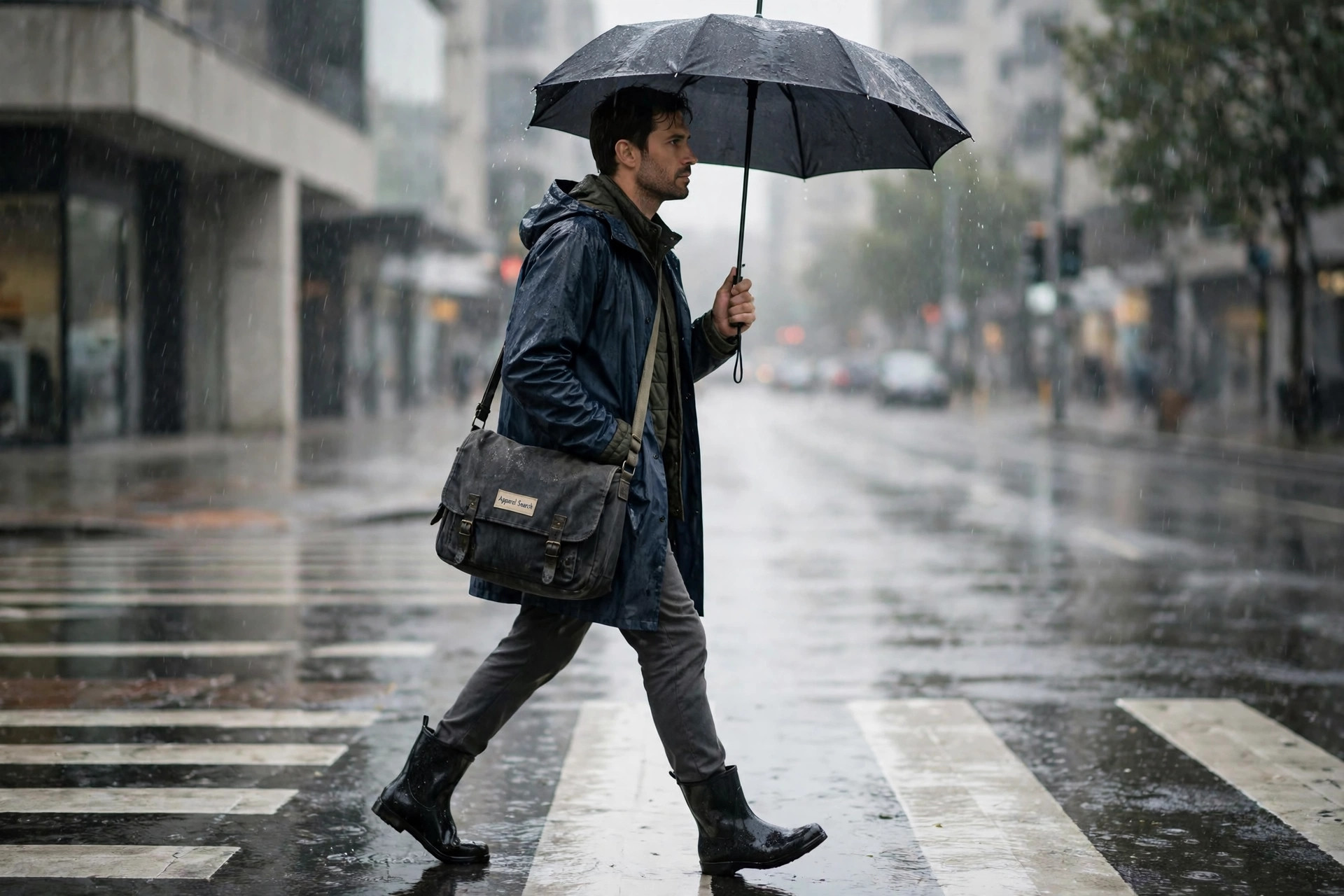
Men’s rainy day dressing fails in predictable places: a coat that cannot close over a jacket, trouser hems dragging through puddles, leather shoes soaked by nine o’clock. The system that prevents all three is simple — a genuinely waterproof coat with working length, footwear that seals, and trousers kept clear of wet ground — and this guide works through each piece.
The component guides go deeper: the men’s raincoats guide on coats, the men’s rain boots guide on footwear, and the men’s rainwear guide on the full wardrobe. Here, the subject is how they combine on an actual wet day.
Coats
Trench, Mackintosh or Shell — Pick by Route
Over tailoring, the trench and the single-breasted raincoat are the standards: long enough to cover a jacket, structured enough for the office, waterproof in weather-built versions — the men’s trench coats guide covers fit over suits. The mackintosh tradition offers heavier, fully rubberised protection. For casual and outdoor routes, a technical shell with sealed seams and a proper hood is lighter and drier than either, and layers over knitwear without ceremony. Whichever you choose, the checks are the same: it closes fully over your bulkiest layer, sleeves cover wrists with arms forward, and the hem reaches at least mid-thigh so trouser tops stay dry.
Footwear
Boots for the Street, Shoes for the Office
Street footwear in rain needs a rubber sole with real tread and an upper that water cannot enter: Wellington-style boots for heavy weather and mud, waterproof Chelsea or lace-up boots for city wear. Smooth leather soles are the worst choice wet pavement offers. The durable routine is the commute swap — boots outside, office shoes kept at the desk — which protects good leather and keeps feet dry all day. If boots are new to you, the men’s rain boots guide covers heights, calf fit and why rubber never breaks in, so sizing has to be right on day one.
Trousers
Keep the Hem Out of the Water
Trouser hems wick water upward with embarrassing efficiency. Tapered and cropped cuts, a shorter break on rainy days, and darker wool-blend or synthetic fabrics all reduce the damage; wide, pooling hems in cotton are the worst combination available. Cyclists and long-distance walkers should skip the compromises and add packable waterproof over-trousers, which live in a bag and deploy in a minute. Jeans deserve a warning: denim absorbs heavily, dries slowly and stays cold, making it a light-shower fabric only.
Scenario — The Commute
Platform, Train, Office: One System
A worked commute: shell or trench closed over a jacket, tapered trousers, waterproof boots, messenger bag worn under the coat’s shelter or a backpack with a rain cover, compact umbrella for the platform and a hood for the windy street. On arrival, hang the coat to drip, swap the boots for desk shoes, and the day starts dry. The trail version of the same logic — shell, layers, sealed boots — is covered in the men’s hiking outfits guide, which treats rain as the default condition rather than the exception.
Two accessories complete the commute. A compact umbrella covers the platform, but choose a vented frame if your route crosses open, windy ground, and shake it into a bin on arrival rather than across the office floor. The bag should be coated or synthetic with a fully closing zip — a leather briefcase in heavy rain needs a rain cover or a sealed laptop sleeve inside it — and a spare pair of socks in the desk drawer quietly rescues the days when a puddle wins anyway.
By Temperature
Adjust the Layer, Keep the Shell
Cold rain calls for insulation under the shell — a liner, a mid-weight knit, taller boots and gloves — because wet cold drains heat fast. Warm rain calls for ventilation: unlined shells, open two-way zips when the rain eases, and quick-drying fabrics underneath. The what to wear by temperature hub gives the layering ranges; the rain rule on top of them is constant — change what goes under the waterproof layer, not the layer itself.
Questions
Common Questions
What coat should a man wear over a suit in the rain?
A waterproof trench or a single-breasted raincoat cut long enough to cover the suit jacket and roomy enough to close over it without pulling. Try it on over the bulkiest jacket you wear; the coat only works if it closes fully, because a closure under strain opens gaps exactly where rain gets in.
Can leather shoes survive a rainy commute?
Occasionally, with rubber soles and a prompt dry — stuffed with paper, away from direct heat. Regularly, no: repeated soaking stains and cracks leather. Commute in waterproof boots or overshoes and change into office shoes at your desk; it is the standard system for a reason.
Are waterproof trousers worth it for men?
For cycling, long walks and outdoor work, yes — packable over-trousers turn a soaking into a non-event. For a short platform-to-door commute, no: cropped or tapered trousers with a hem clear of the ground, worn with boots, handle ordinary rain without extra kit.
More to Explore
Search Apparel Search