Men's Silk Socks Guide
Men's silk socks are fine-knit dress socks made wholly or chiefly from silk - thin, smooth socks with a natural sheen, made to disappear inside a dress shoe and glide under a tailored trouser. Silk is the oldest luxury sock fiber: it insulates in both directions, absorbs moisture respectably for so fine a yarn, and knits into the thinnest sock that still behaves like one. Pure silk socks are delicate; the modern standard blends silk with nylon or a little elastane so the sock survives the shoe it was made for.
Shop Men's Silk Socks Now
Shop Men's Silk Socks on Amazon Shop Men's Silk Socks on eBayThe Amazon and eBay links on this page are affiliate links. If you make a purchase through them, Apparel Search may earn a commission.
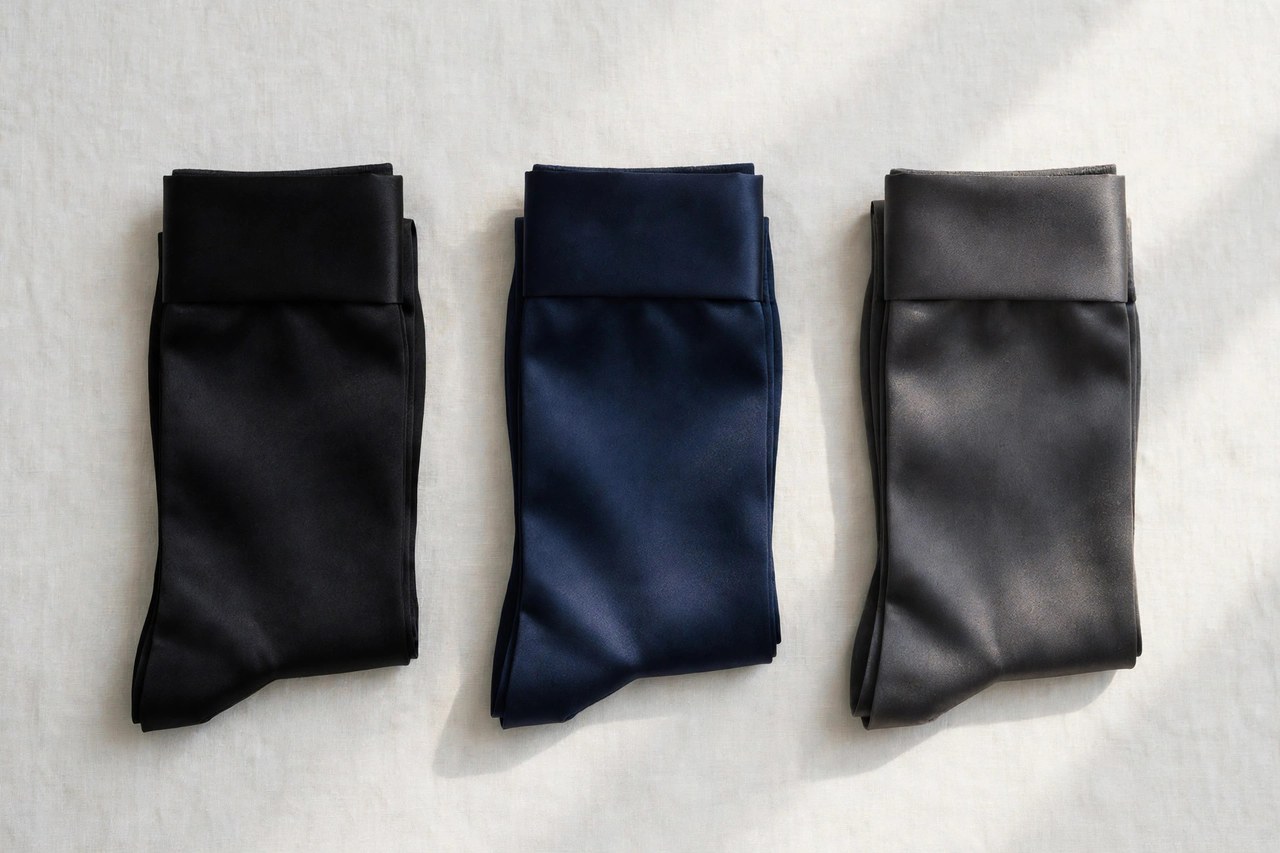
Men's silk socks are fine-knit dress socks made wholly or chiefly from silk - thin, smooth socks with a natural sheen, made to disappear inside a dress shoe and glide under a tailored trouser. Silk is the oldest luxury sock fiber: it insulates in both directions, absorbs moisture respectably for so fine a yarn, and knits into the thinnest sock that still behaves like one. Pure silk socks are delicate; the modern standard blends silk with nylon or a little elastane so the sock survives the shoe it was made for. This guide is built around the questions buyers actually ask: which style, which size, which fabric, and what will it look like after a year of real use - answered in order, with the trade-offs stated plainly.
Blends, Knits and the Toe Seam
Judge silk socks by blend and knit. A silk-nylon blend (roughly 60-80 percent silk) keeps the hand and sheen while roughly doubling working life; a few percent elastane holds the leg up without a garter's hardware. The knit should be fine and even - silk shows irregularities honestly - with a hand-linked or smooth toe seam that cannot ridge against dress-shoe interiors, and a ribbed top that grips by knit tension rather than by a tight elastic band. Over-the-calf lengths stay up by architecture and suit tailoring best; mid-calf is the easier daily length. Silk's gleam is subtle in black, navy and charcoal - the three colors that carry a business wardrobe - and louder in dress colors for evening.
The durable buying order is job, specification, budget - in that sequence. Decide what the garment must do, translate that into fiber, weight, construction and size numbers, and only then shop price. Read labels as specifications, inspect the garment inside out where finishing is unposed, and prefer the maker who publishes measurements to the one who publishes adjectives. A garment that matches your measurements, climate and laundry will be worn; one that misses any of the three becomes expensive storage.
Fit and Sizing
Sock sizing follows shoe size, and silk blends have less forgiveness than cotton - a sock at the top of its size range will wear at the heel fastest, so size up when between ranges. The heel pocket should land on your heel, not under it, and the toe should lie smooth without tension pulling the fabric thin. Over-the-calf silk should reach just below the knee without a tourniquet at the top band; if it needs constant rescuing, the length or the size is wrong, not your calf.
Measure yourself once a year and keep the numbers - chest, waist, inseam, foot, head - because bodies drift gradually while size habits never do. Shop from measurements, try garments under real conditions (over layers, in your own shoes, late in the day for footwear), and be honest about alterations: lengths and small waist changes tailor beautifully; shoulders, rises and patterns are the garment you bought forever.
Wearing and Care
Silk socks are the one sock that should never meet a hot wash: cool water, gentle cycle in a mesh bag or a hand wash, and air drying flat - the dryer is where silk socks go to become smaller, duller silk socks. Store them folded in pairs, away from rough drawer neighbors that snag fine knits. Rotated and washed gently, a silk-blend dress sock earns its price in the one place it is seen: the elegant inch between trouser hem and shoe.
Five minutes when a garment comes off - shake it out, hang or fold it correctly, note the stain and the loose button - prevents most of the damage later blamed on quality. Keep a small kit where the clothes live: brush, lint roller, conditioner suited to your leathers, black, navy and grey thread. Clothing rarely dies at once; it fades by small neglects, and small attentions reverse the process at the same pace.
Common Questions
Are silk socks worth it for everyday wear?
For dress shoes and tailored trousers, yes - nothing else is as thin, smooth or quietly lustrous, and the temperature regulation is real in both boardroom and summer wedding. For trainers, boots and athletic shoes, no: silk is not built for abrasion or volume, and cotton, wool and synthetic socks do those jobs better and cheaper. Silk socks are a specialist tool; used in their specialty, they are unmatched.
Pure silk or silk blend socks?
Blend, for almost every buyer. Pure silk socks are beautiful, fragile and priced like it; a silk-nylon blend keeps most of the sheen and hand while adding the abrasion resistance a shoe's interior demands, and a touch of elastane keeps the sock up. Reserve pure silk for rare formal wear where the sock will be pampered as deliberately as the shoes.
Why do silk socks fall down?
Usually the wrong length or a tired knit, not a silk failing. Mid-calf socks slip as the calf flexes; over-the-calf lengths stay up by geometry, which is why tailoring tradition prefers them. A ribbed knit that has lost its recovery - often dryer damage - slips at any length. Choose over-the-calf, fit the size range honestly, and air-dry to keep the knit alive.
More in Men's Clothes Guide S
A Short History of Socks
A sock is an item of clothing worn on the feet, often covering the ankle and some part of the calf, with some type of shoe or boot typically worn over it; in ancient times socks were made from leather or matted animal hair; in the late sixteenth century machine-knit socks were first produced; and before nylon in 1938, socks were commonly made from silk, cotton or wool. The materials catalogue runs from cotton, wool, nylon, acrylic, polyester, olefins and spandex to the softness upgrades - silk, bamboo, linen, cashmere and mohair.
Looking for Men's Clothing Stores?
This guide explains men's silk socks. To browse where to buy, visit our men's clothing store directory, where you can find retailers that carry them.