Women's Business Pants Guide
Straight, wide and tapered suiting trousers — fabrics, office fit and the tailoring details that read as executive.
Shop Women's Business Pants Now
Shop Women's Business Pants on Amazon Shop Women's Business Pants on eBayThe Amazon and eBay links on this page are affiliate links. If you make a purchase through them, Apparel Search may earn a commission.
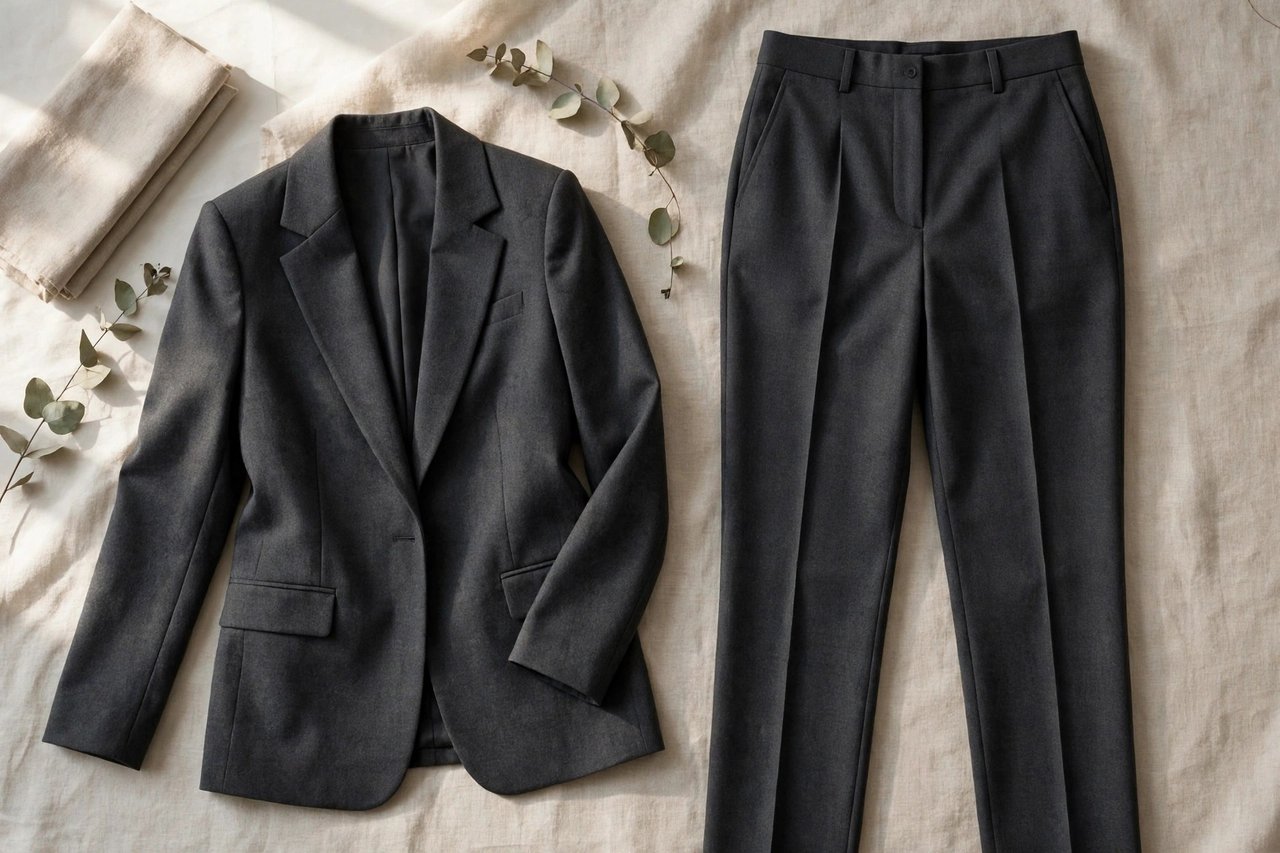
Business pants are the formal foundation of a working wardrobe: tailored trousers in suiting fabrics, cut to sit cleanly through the waist and hip and fall in an unbroken line to the shoe. They are the trousers you wear when the meeting matters — with a blazer they form a suit, with a fine knit or silk blouse they carry a professional day on their own, and in either case they signal that you dressed on purpose. Because offices judge polish in details, business pants reward attention to fabric, cut and tailoring more than almost any other garment. This guide explains the main cuts, the suiting fabrics behind them, and the fit standards that separate executive-looking trousers from merely long pants.
The category is narrower than casual trousers by design. True business pants exclude denim, casual chinos, leggings and anything with cargo pockets or drawstrings, however expensive. What remains is a refined family — mostly wool and high-quality blended suiting in black, navy, charcoal and other deep neutrals — whose variety comes from cut and proportion rather than decoration. Learning those proportions lets you choose the silhouette that flatters your body and matches your workplace, from a traditional corporate floor to a modern office that still expects tailoring.
Cuts: Straight, Wide, Tapered and More
The straight-leg trouser is the timeless standard: the leg falls in a consistent width from hip to hem, suiting nearly every body and every office, and pairing equally well with heels and flats when hemmed correctly for each. Wide-leg and palazzo business trousers add drama and comfort, especially in fluid fabrics, and balance fitted tops and blazers beautifully on taller frames; the waist must fit perfectly, because the volume below forgives nothing up top. Tapered trousers narrow toward the ankle for a modern, streamlined finish that shows the shoe and suits cropped lengths. Bootcut business trousers, with a slight flare over the shoe, lengthen the leg and remain a quiet favorite with heeled pumps.
Rise and length complete the cut. A mid to high rise that sits at or near the natural waist is the professional standard, keeping shirts tucked and silhouettes smooth. Cropped business trousers ending above the ankle are now accepted in many offices for warmer months, provided the fabric and finish stay formal. Full-length trousers should break once, lightly, over the shoe — pooling fabric reads as careless and shortens the leg. Pleats are a personal and body-dependent choice: a single forward pleat adds room and a classic suiting note on straighter figures, while flat fronts give the cleanest line on most wearers and dominate modern collections.
Suiting Fabrics and Construction
Wool suiting remains the benchmark: it drapes without clinging, resists wrinkles better than most fibers, breathes across seasons in tropical weights, and takes a crease that lasts the day. Wool blends with polyester add durability and lower the price and the dry-cleaning bill, while a touch of elastane gives the slight give that makes a close waistband comfortable through long seated meetings. Crepe and triacetate blends produce fluid wide-leg trousers that move elegantly. Summer brings linen blends in the most relaxed formal offices, accepted with their natural softness rather than a hard crease. Whatever the fabric, the surface should be smooth and matte; shine, slubs and casual textures pull a trouser out of the formal category.
Construction details mark the quality tier. Look for a contoured waistband with an interior button and hook closure that lies perfectly flat, lined fronts on lighter fabrics to prevent show-through and knee bagging, and clean, flat pockets that do not flare open when you sit. Belt loops should be neatly stitched and sized for a standard belt. The crease should be pressed through the hem, and the hem itself finished invisibly. Inside finishing — bound or neatly overlocked seams — predicts how the trousers will survive years of cleaning. Trousers that pass these checks in the fitting room almost always justify their price in cost per wear.
Office Fit and Tailoring Standards
Fit business trousers to a stricter standard than casual pants. The waistband should close comfortably without a belt and without gaping at the back when you sit. The front should lie smooth: horizontal stress lines across the hip mean the size or cut is wrong, and pocket flare says the same. Through the seat and thigh, the fabric should skim — formal trousers are never tight, and ease is part of their elegance. You should be able to pinch about an inch of fabric at the thigh on a classic cut. Length is tailored to the shoe you will wear most, with cropped and full-length versions treated as separate purchases rather than one trouser asked to do both.
Budget for tailoring as part of the purchase, because off-the-rack trousers are made to be finished. Hemming is almost always needed, taking in a waistband is routine, and tapering a leg slightly is a modest alteration that can make a good pair look made for you. Choose your tailor before you need one urgently, bring the exact shoes, and judge alterations standing naturally rather than posed. A useful wardrobe strategy is to buy the best fabric and construction you can afford in a near fit, then spend a little more to perfect it — the result routinely outperforms a more expensive pair worn straight off the rack.
Styling Formal Trousers at Work
The classic partnership is the matching blazer, and buying trousers and blazer together as a suit guarantees fabric and color harmony that separates can only approximate. When wearing trousers as separates, pair black with jewel tones, white and grey; navy with white, pale blue and burgundy; charcoal with almost everything, including black in modern styling. Silk blouses, fine-gauge knits and tailored shirts are the standard tops, tucked in with a slim leather belt to complete the waist. Shoes follow the hem: pointed pumps and loafers for full-length cuts, loafers and sleek flats for cropped, with hosiery or a clean ankle as the office expects.
Small choices keep the look current rather than dated. Keep patterns in the trouser itself minimal — a fine pinstripe or subtle check is as far as formal usually goes — and let blouses and accessories carry any personality. Jewelry should be deliberate and quiet during the workday, bags structured, and grooming neat, because tailored clothing amplifies every other detail. For business travel, wool-blend trousers in a dark neutral are the professional's trick: they emerge from a suitcase nearly uncreased, coordinate with every top packed, and move from a flight to a meeting with only a shoe change.
Care and the Suiting Rotation
Suiting lasts longest on a rotation: rest wool trousers at least a day between wears, hanging them by the waistband on clip or clamp hangers so the crease hangs straight and wrinkles fall out in the air. Brush after wear to remove surface dust, steam to refresh rather than washing frequently, and dry clean wool styles only a few times a season unless they are soiled — over-cleaning dulls fibers and fades deep colors. Blends designed to be washable should be washed cold, inside out, and pressed with a cloth to protect the surface. Store off-season trousers clean, since stains set and moths find wool that was put away worn.
One extra tip for anyone building a formal wardrobe from scratch: buy in the order of black straight-leg, navy in your favorite cut, then charcoal wide or tapered as your silhouette of choice, all in the best suiting you can manage. Those three trousers, rotated with a blazer in at least one matching fabric, cover interviews, presentations, ordinary office weeks and most formal daytime events without repetition fatigue. Formal business pants are not exciting to shop for, and that is precisely their virtue — chosen well and tailored once, they quietly make everything worn with them look more competent for years.
Related Women's Guides
More to Explore
Photos

Looking for Women's Clothing Stores?
This guide helps you choose women's business pants by cut and suiting fabric. To browse where to buy, visit our women's clothing store directory, where you can find retailers that carry them.