Women's Cotton Camisole Guide
The camisole as a classic garment — traditional construction, lace-trim heritage, and cotton lawn and jersey versions.
Shop Women's Cotton Camisoles Now
Shop Women's Cotton Camisoles on Amazon Shop Women's Cotton Camisoles on eBayThe Amazon and eBay links on this page are affiliate links. If you make a purchase through them, Apparel Search may earn a commission.
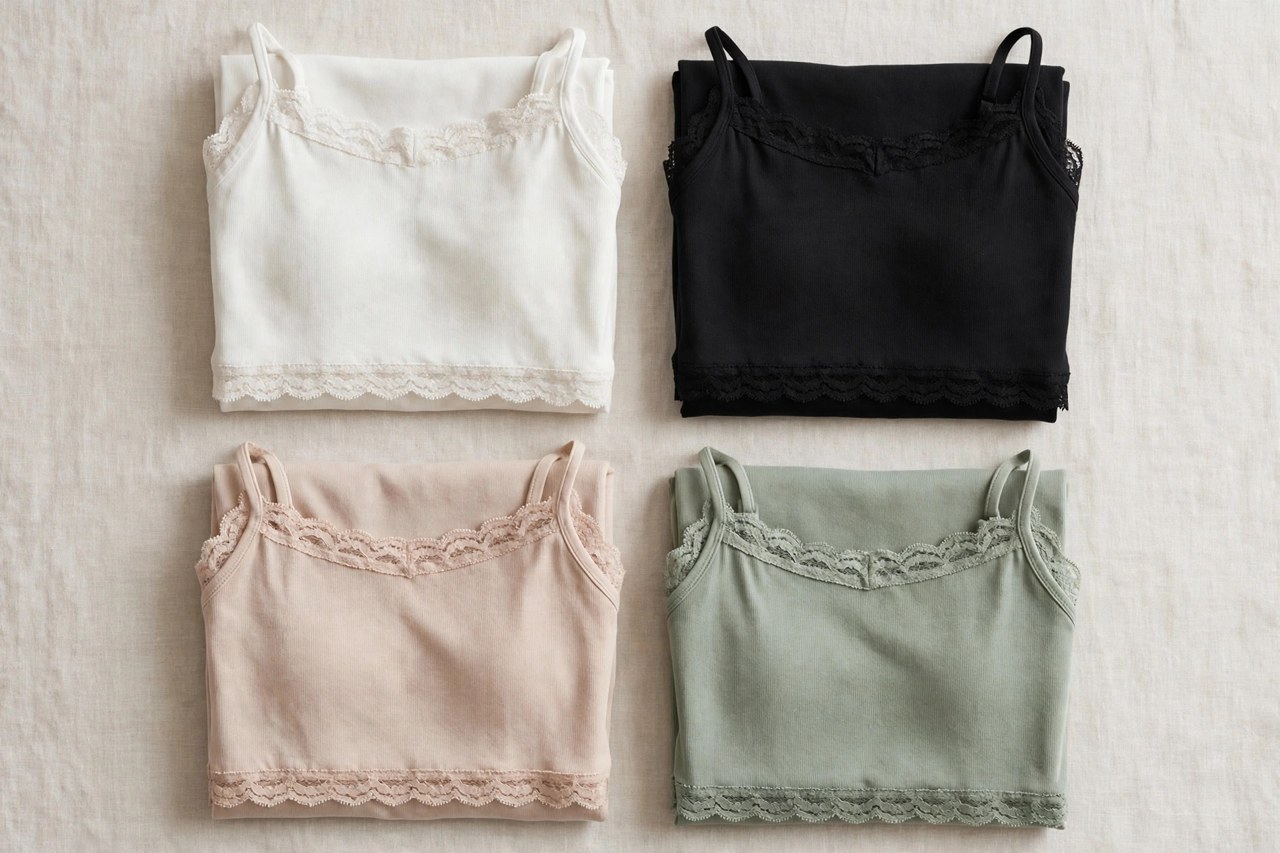
The camisole is a classic garment with a long history, and this page treats it that way: as a traditional piece of clothing with its own construction, finishing standards, and place in the wardrobe. It is the fuller, more formally made relative of the modern cami, which is covered separately as a contemporary layering tool. A classic camisole is a sleeveless undergarment or light top with narrow shoulder straps, a defined bodice, and traditionally a degree of fine finishing — lace edging, careful seams, sometimes buttons or a drawstring neckline inherited from its history. In cotton, it appears most authentically in lawn, voile, and fine jersey, fabrics that suit its role as a comfortable, breathable layer worn close to the skin and, in its dressier forms, as a graceful top in its own right. Everything here is about the garment itself: how it is made, where it came from, and how to judge and keep a good one.
Heritage: From Undergarment to Wardrobe Classic
The camisole descends from the loose under-bodices women wore for centuries as the washable layer between skin and outer dress. By the nineteenth century it had taken its recognisable form: a waist-length or hip-length sleeveless top, fastened or tied, often trimmed with lace or embroidery at the neckline because that edge might show at a dress's open neck. Cotton transformed the garment's history. Fine cotton lawn and cambric made camisoles cool, washable, and affordable beyond silk versions, and the white cotton camisole with broderie anglaise or lace trim became a standard of the trousseau and the summer wardrobe alike. That continuity is why the classic camisole still signals care and finish in a way simpler modern layers deliberately do not.
Classic Construction: Bodice, Straps, and Fastenings
A traditional camisole is built, not just cut. The bodice may be shaped with darts, soft gathering into a yoke, or a drawstring channel at the neckline that lets the wearer adjust fullness, a feature inherited directly from historical undergarments. Better examples use French seams or bound edges inside, so no raw fabric touches the skin and the garment survives frequent washing without fraying. Straps on a classic are often ribbon or self-fabric rather than elastic, sometimes adjustable with small sliders, sometimes made to a fixed traditional length, and they are stitched through reinforced points because a strap failure ends the garment. The hem may be straight, scalloped, or trimmed to match the neckline. None of this construction is visible at a glance, which is precisely the point: the classic camisole's quality is in its finishing.
Lace Trim and Fine Finishing
Trim is the camisole's signature, and it divides into honest categories. Cotton lace, including broderie anglaise with its punched and embroidered eyelets, is the traditional partner for a cotton body, washes with the garment, and ages gracefully. Cluny and torchon-style cotton laces give a slightly heavier, handcrafted character suited to lawn camisoles. Fine net laces look delicate but are usually synthetic, feel different against the skin, and can age at a different rate than the cotton they trim. Application matters as much as material: lace inset into the fabric, with the cotton cut away behind it, lies flat and lasts; lace simply stitched on top can curl and catch. Embroidery at the neckline, small pintucks down the front, and hand-rolled or narrowly hemmed edges are the other classic finishes to look for. A well-finished camisole is smooth inside and out, because a garment worn against the skin for centuries was refined until nothing rubbed, snagged, or showed through an outer dress.
Cotton Lawn Versus Jersey Versions
The two modern cotton forms serve different loyalties. A woven lawn or voile camisole is the heritage version: crisp, cool, and exceptionally breathable, holding the trims and pintucks described above, with no stretch and a fit that must be chosen accurately. It is the coolest option in hot climates and the most formal in character, and it irons to a freshness knits cannot match. A fine cotton jersey camisole is the comfort version: it keeps the classic shape and often the lace-trimmed neckline, but gains stretch, softness, and pull-on ease, suiting daily wear and sleep-adjacent comfort while sacrificing some crispness and structure. Rib jersey versions sit between the two, textured and close-fitting. Shrinkage behaviour differs as well: woven lawn shrinks evenly and predictably, while jersey can twist slightly if poorly cut, so check that a jersey camisole's side seams hang straight. Choose lawn for tradition and heat, jersey for softness and ease, and judge both by their finishing rather than their fibre alone.
Wearing and Keeping a Classic
The classic camisole is worn today in the roles its history prepared it for: as a fine layer under sheer blouses and low necklines where its trimmed edge is meant to be glimpsed, as a cool top with skirts and trousers in summer, and as part of traditional sleepwear and lounging sets in cotton lawn. Wash cotton camisoles gently and cool, in a mesh bag to protect lace and straps, and dry them on a line away from harsh sun that yellows white cotton over time. Iron lawn versions lightly for their intended crispness, pressing lace from the wrong side over a soft cloth. Store folded with trim smoothed flat, not crushed under heavier clothes. A classic cotton camisole made and kept this way lasts for years, and its appeal is exactly that durability of both cloth and idea: a simple garment, finished properly, that has never needed reinventing.
More to Explore on Apparel Search
Photos

Looking for Women's Clothing Stores?
This guide helps you choose women's cotton camisoles by fabric, trim and construction. To browse where to buy, visit our women's clothing store directory, where you can find retailers that carry them.