Women's Cotton Clothing Guide
How cotton cloth becomes clothing — cutting, seams, pre-shrinking, and garment dyeing, and the quality markers that reveal good making.
Shop Women's Cotton Clothing Now
Shop Women's Cotton Clothing on Amazon Shop Women's Cotton Clothing on eBayThe Amazon and eBay links on this page are affiliate links. If you make a purchase through them, Apparel Search may earn a commission.
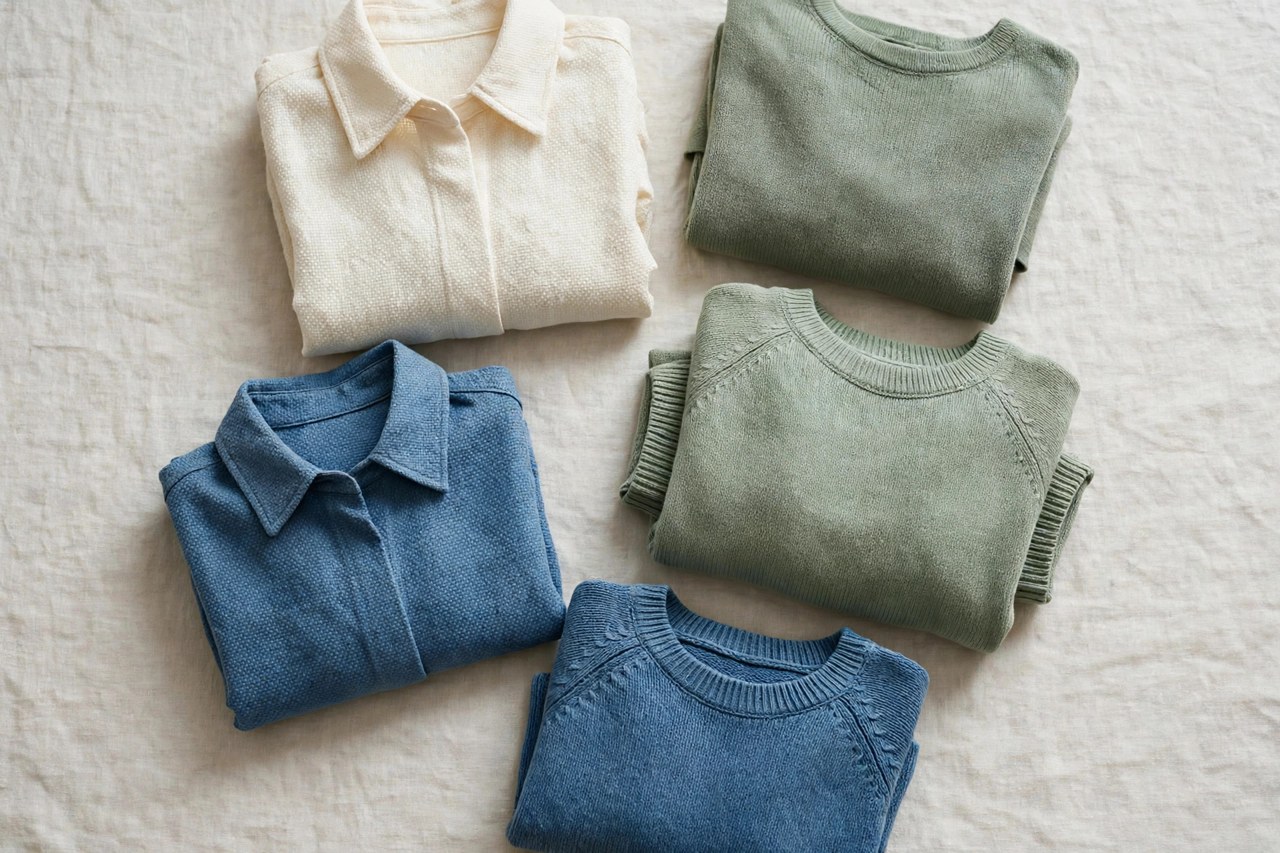
Cotton clothing begins long before a garment is sewn. By the time a women's cotton shirt, dress, or pair of pants reaches a rail, the cotton has been grown, ginned, spun into yarn, woven or knitted into cloth, dyed or printed, finished, cut, and sewn — and decisions at every stage are visible in the finished piece if you know where to look. This guide follows that fabric-to-garment path. It is deliberately different from the companion Cotton Clothes guide, which takes the wardrobe view of pieces already owned; here the subject is manufacture itself: how cloth is cut and seamed, why pre-shrinking and garment dyeing change a garment's character, and which construction markers reliably separate well-made cotton clothing from clothing that will twist, fade, and fail early.
From Yarn to Cloth: Weaving and Knitting
Cotton yarn becomes clothing cloth by two routes. Weaving interlaces warp and weft yarns at right angles to make the stable, structured fabrics of shirting and trousers — plain-weave poplin and lawn, diagonal twill, basket-weave oxford — whose behavior is set by weave pattern and yarn fineness. Knitting loops yarn into the stretchy, fluid fabrics of t-shirts, leggings, and underwear, principally single jersey, interlock, and rib knits, whose behavior is set by gauge and loop structure. Fiber preparation feeds both routes: longer-staple, combed cotton spins into smoother, stronger yarn that weaves and knits into cloth with less pilling and a cleaner surface, while short-staple yarn makes cheaper, fuzzier cloth regardless of how it is constructed. Finishing then tunes the cloth — singeing, mercerizing, sanforizing — so two garments in the same weave can differ markedly in hand and lifespan.
Cutting: Grain, Pattern, and Why Garments Twist
Cloth must be cut on its grain — lengthwise threads running straight down the garment — or the finished piece will twist around the body and its seams will spiral after washing. Careful makers lay patterns with grain lines aligned, match checks and stripes across seams, and cut knits with their wales vertical; hurried production saves cloth by nudging pieces off-grain, a fault invisible on the hanger and obvious by the third wash. Cutting also sets economy and fit: pattern pieces are nested to minimize waste, sizes are graded from a base pattern, and seam allowances are allocated for later stitching strength. Signs of careful cutting in a finished garment include side seams that hang vertically, prints that sit level, collars that mirror each other, and legs that fall straight rather than corkscrewing. When trying on cotton clothing, walk a few steps and glance down: a garment cut true stays composed in motion, while an off-grain piece begins its slow rotation immediately.
Seams and Stitching: The Skeleton of a Garment
Seams carry every stress a garment meets, and cotton clothing uses a small vocabulary of them worth recognizing. Flat-felled seams, folded and double-stitched like the inseam of jeans, are the strongest and cleanest for twill and denim. French seams enclose raw edges inside a second stitching line and suit fine lawns and voiles where fraying would show. Overlocked seams, trimmed and bound in thread, are the fast industry standard for knits and for woven linings, serviceable when stitch density is high. Stitch quality is readable at a glance: more stitches per centimetre, even tension with no loops or puckering, and bar-tacked reinforcement at pocket corners, fly bases, and strap joins all signal a maker investing in durability. These details, not styling, predict whether cotton clothing survives fifty washes intact.
Pre-Shrinking and Garment Dyeing
Two finishing processes reshape a garment after, or just before, it is sewn. Pre-shrinking — by sanforizing the cloth, garment washing the finished piece, or both — removes most of cotton's natural three-to-five percent wash shrinkage at the factory instead of in the customer's first laundry, so the size bought is the size kept. Garment dyeing takes the opposite creative approach: the garment is sewn from undyed or lightly prepared cloth and dyed whole, producing the soft, slightly varied color, puckered seams, and broken-in hand familiar from casual cotton clothing. Piece dyeing, by contrast, colors the cloth before cutting and gives the even, controlled shades of dress shirts and trousers. Each route has honest trade-offs. Garment-dyed pieces feel wonderful immediately but vary subtly between batches; piece-dyed clothing is consistent but starts crisper and needs washes to soften. Labels that state the process plainly are themselves a quality signal worth rewarding.
Quality Markers Worth Paying For
Well-made cotton clothing announces itself through a cluster of small consistencies. The fabric surface is even and smooth for its type, with no thin streaks, slubs where none belong, or fuzz on a cloth meant to be crisp. Color is level across panels, including under arms and inside facings. Seams lie flat, stitching is dense and even, stress points are reinforced, and spare buttons are provided on better pieces. Inside, the garment looks considered: seam allowances are finished rather than raw and shedding, linings and facings are cut from appropriate cloth, and labels state fiber content and the cotton's preparation honestly. None of these markers requires luxury pricing; they require a maker who controls spinning, weaving, cutting, and sewing as one chain. Cotton clothing bought by these markers repays its price in years of wash-and-wear service.
More to Explore on Apparel Search
- benefits of cotton clothing
- Clothes
- Clothing Retail Stores
- Cotton
- Cotton Definition
- Cotton News
- cotton prices
- hand of the fabric
- natural fibers
- Organic Cotton
- Women's Clothes
- Women's Clothing Stores
- Women's Clothing Wholesalers
- Women's Cotton Clothing
- Women's Cotton Clothing Pg. 2
- Women's Cotton Clothing Pg. 3
- Women's Cotton Clothing Pg. 4
- Women's Cotton Clothing Pg. 5
- Women's Cotton Clothing Pg. 6
Photos

Looking for Women's Clothing Stores?
This guide helps you choose women's cotton clothing by manufacture, construction and quality. To browse where to buy, visit our women's clothing store directory, where you can find retailers that carry them.