Women's Cotton Hosiery Guide
The winter warmth story — cotton-rich tights and sock-weight knits that trade sheer elegance for real insulation.
Shop Women's Cotton Hosiery Now
Shop Women's Cotton Hosiery on Amazon Shop Women's Cotton Hosiery on eBayThe Amazon and eBay links on this page are affiliate links. If you make a purchase through them, Apparel Search may earn a commission.
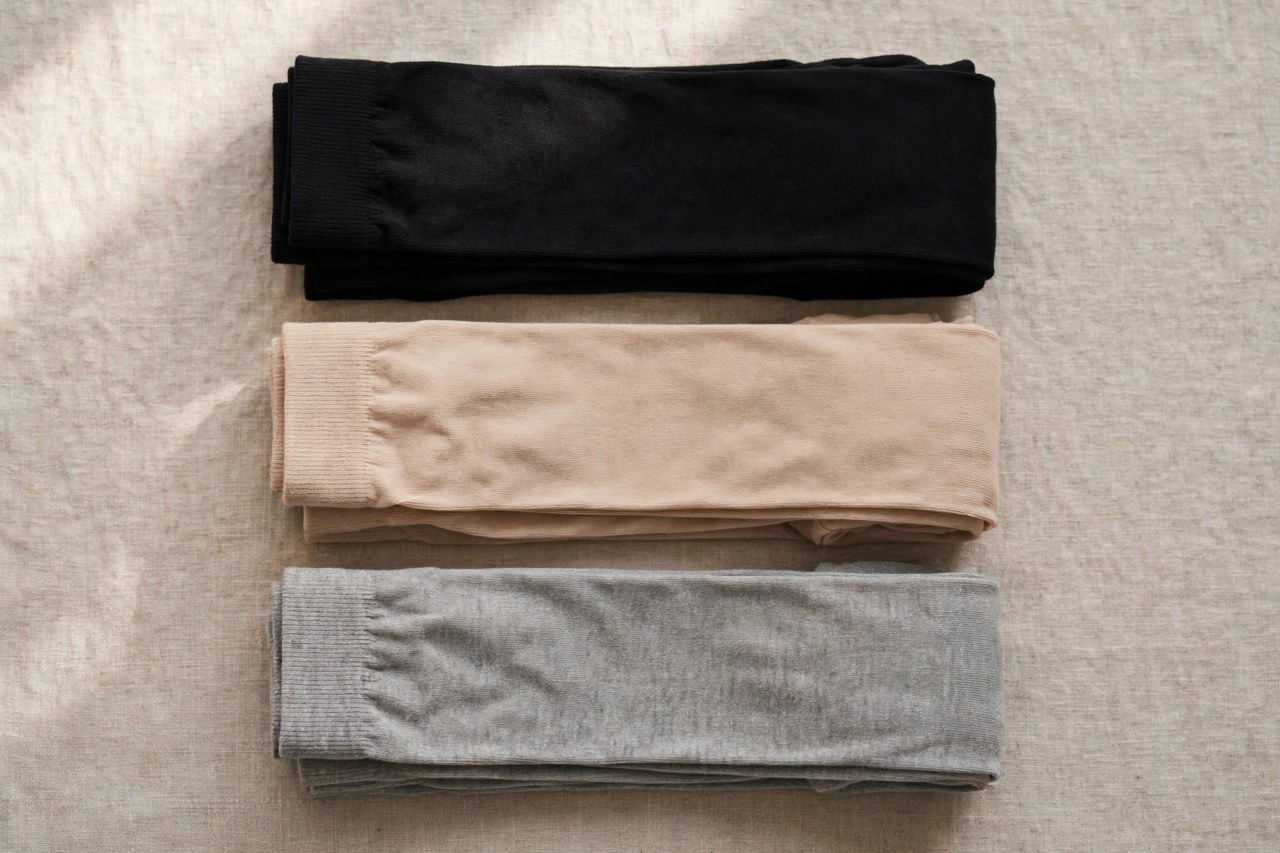
Cotton hosiery is the practical, cold-weather branch of the hosiery family: cotton-rich tights, footless tights that read as leggings, and heavy sock-knit hosiery made for warmth under skirts, dresses, and boots. It exists because standard sheer hosiery, knitted from fine nylon yarn, offers almost no insulation and feels cold and clammy against the skin in winter. A cotton-rich tight, typically 50 to 80 percent cotton blended with nylon for strength and elastane for stretch, feels softer, warmer, and more forgiving to wear all day. The trade is appearance: cotton hosiery is opaque and matte, with a knitted texture closer to a fine sweater than to a sheer stocking. This guide covers how these tights are knitted, how to read their weights, how sizing differs from nylon hosiery, and how to wash a cotton-rich knit so it does not shrink out of its size.
How Cotton-Rich Tights Are Knitted
Tights are knitted in a tube on circular machines, then sewn at the toe and joined with a center seam or a gusseted panel. In cotton-rich versions, a plated construction is common: the cotton yarn feeds to the inside face, against the leg, while a finer nylon yarn forms the outer face, adding abrasion resistance where boots and shoes rub. Elastane threads knitted in at intervals give the tight its stretch and recovery, without which a mostly cotton tube would bag at the knee and ankle within an hour. Better tights add a knitted comfort waistband that distributes pressure instead of a single cutting elastic. Feel the fabric between finger and thumb: a good cotton tight is dense and even, with the cotton softness clearly present on the inside.
Weights, Denier, and Reading Warmth
Nylon hosiery is sold by denier, a yarn-thickness number where 10 to 20 denier is sheer and 40-plus is opaque. Cotton tights borrow the vocabulary loosely, but weight is the more honest guide: light cotton-rich tights suit autumn days, midweight sweater tights are the winter standard under dresses, and the heaviest cable or ribbed cotton tights approach legging territory. Texture signals warmth as well: a flat jersey knit is the baseline, ribbed tights trap a little more air and stretch more forgivingly over the calf, and cable knits are the warmest and most casual, pairing naturally with boots and heavier skirts. For most wardrobes, one midweight flat-knit pair in black or charcoal and one textured pair cover the season; variety matters less than having the right weight on the coldest mornings.
Cotton Hosiery Versus Leggings and Sheers
Shoppers often hesitate among three similar garments. Sheer nylon tights are for polish and bare-leg illusion; they contribute nothing to warmth. Cotton leggings are a heavier, footless knit worn as a visible garment layer; they are thicker than any tight and show every seam under a dress. Cotton hosiery sits between: footed, finer than a legging, opaque enough for modesty and warmth, and smooth enough to slide under a fitted skirt without bunching. Choose by the outfit's need: if the layer must disappear under clothing while keeping you warm, it is hosiery; if it is part of the visible outfit, it is a legging. Owning the distinction prevents the common mistake of expecting a delicate tight to survive being worn as pants, or a legging to lie flat under a pencil skirt.
Sizing: Height Charts and the Cotton Shrink Factor
Hosiery sizing runs on height and hip charts rather than dress sizes, because leg length decides whether the tight reaches comfortably or pulls down all day. Cotton-rich tights are less stretchy than pure nylon ones, so the charts are less forgiving: if you sit between sizes or are tall, choose the larger size, since a cotton tight worn at its stretch limit feels tight everywhere and wears out faster at the toe and heel. A correctly sized pair should pull up fully with the gusset in place, the waistband at the waist rather than dragged low, and no downward creep after walking around the room. Cotton also shrinks slightly in the wash, mostly in length, which compounds a borderline fit after the first laundering. Tall ranges and plus ranges in cotton hosiery are worth seeking out rather than squeezing into the standard chart; the category rewards accuracy more than most garments because it is one piece from waist to toe with nowhere for a poor fit to hide.
Washing Cotton Hosiery Without Shrinking It
Wash cotton-rich tights inside out in cool water, ideally in a mesh bag that keeps them from twisting around other garments, which stretches the knit unevenly. Warm water is the main shrinkage risk, and a hot dryer is worse, so air dry flat or draped over a rail; cotton tights dry slowly, so wash them with a day to spare. Avoid snagging hazards in the wash, since the cotton face can pill where it rubs against zippers and hooks, even though it will never ladder and run the way a sheer nylon does. That durability is a quiet advantage: a small hole usually stays small and can be darned invisibly on the inside. Store tights loosely rolled rather than knotted. Treated gently, a good pair lasts several winters.
Related Women's Cotton Guides
More to Explore on Apparel Search
Photos

Looking for Women's Clothing Stores?
This guide helps you choose women's cotton hosiery by weight, knit and warmth. To browse where to buy, visit our women's clothing store directory, where you can find retailers that carry them.