Women's Red Jeans Guide
Colored denim with confidence — and the tops you already own are the styling answer
Shop Red Women's Jeans Now
Shop Red Women's Jeans on Amazon Shop Red Women's Jeans on eBayThe Amazon and eBay links on this page are affiliate links. If you make a purchase through them, Apparel Search may earn a commission.
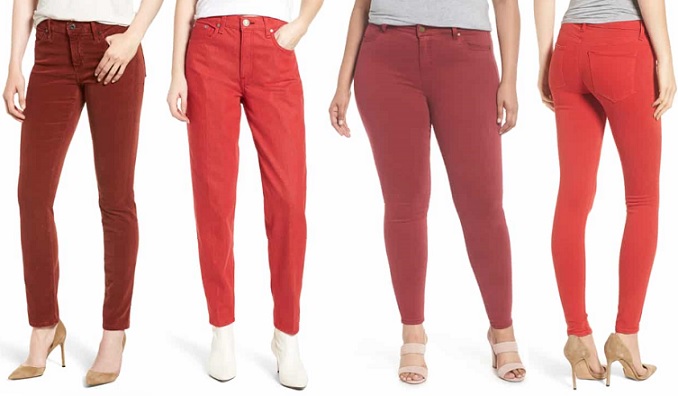
Red jeans are the friendliest way to wear bold color on the lower half, because denim's familiar texture takes the formality — and the fear — out of the shade. A pair of red jeans with a white t-shirt is not a fashion statement so much as a good outfit, and burgundy denim goes further still, functioning in autumn almost like a neutral. Colored denim cycles in and out of trend headlines, but the women who own a good red pair tend to keep wearing it regardless, because it solves the plain-jeans rut instantly.
This guide covers the reds used for denim, from bright true red to deep wine, the fits and fabric blends that hold color best, what to wear on top (the short answer: the neutrals already in your closet), and the wash routine that keeps colored denim from fading unevenly at the knees and seat.
Shades of Red for Jeans
Burgundy, wine and oxblood denim is the enduring end of the range. These deep reds pair with black, grey, navy, cream and olive tops, work from autumn through spring, and fade gracefully toward a softer wine rather than toward pink. They are the red jeans most likely to be worn weekly, and in a slim or straight cut they can pass in casual workplaces where bright denim would not.
True red and scarlet jeans are the high-energy version: unmistakably colored denim that wants simple partners — white, black, navy, stripes, chambray — and rewards them by making an ordinary top half look styled. Brick and rust reds, often garment-dyed for a slightly weathered finish, suit relaxed fits and warm-toned wardrobes. A note on matching: red jeans should be the outfit's only red, in almost every case. A red top above red jeans creates a one-piece effect that flatters very few outfits; let the denim carry the color alone.
Fits and Fabrics in Colored Denim
Colored denim is usually a lighter-weight twill than blue jeans, sometimes a true denim and sometimes a cotton-elastane blend woven to look like it. A small amount of elastane, around one to two percent, helps slim red jeans keep their shape; high-stretch versions bag faster and can fade at stress points sooner. Mid-weight fabric holds dye most evenly and looks most like proper jeans rather than leggings, which matters when the color is already drawing attention. Blue jeans were invented by Jacob W. Davis with Levi Strauss & Co. in 1871 and dyed with indigo; red denim uses other dyes, since cotton can now be dyed any color. See the jeans definition for the terminology.
Fit follows the same logic as blue denim, with one adjustment: strong color reads best in clean, classic cuts. Skinny and slim red jeans are the proven combination, straight legs are the current easy option, and cropped or ankle lengths show the color off against shoes. Very wide or heavily distressed styles in bright red can look costume-like; in burgundy, more relaxed fits stay grounded. Check the inside before buying — garment-dyed reds that are lighter inside will fade toward that inner tone, so you can preview the jeans' future at the turn-up.
Styling Red Jeans
Start with the tops you wear with blue jeans; most of them work. White tees and shirts make red jeans look fresh, black sweaters make them look sharp, and grey marl is the quiet middle option. Navy is the classic partner — a navy blazer over a white top with burgundy jeans is a complete smart-casual outfit — and a chambray or light-blue denim shirt gives a deliberate double-denim variation that works because the blues are clearly different from the red.
Striped Breton tops are red jeans' signature partner, the navy-and-white pattern bridging the color into something almost nautical. Camel and tan knitwear warm red denim up for autumn, especially the burgundy shades. Shoes stay simple: white sneakers for bright reds, black ankle boots for deep reds, loafers or ballet flats for a polished take. Keep bags neutral and skip red accessories near the jeans; the single-color-block approach is exactly what makes red denim look confident instead of busy. More denim reading: jeans, ripped jeans, designer jeans, mom jeans, jean shorts, denim skirts and denim jackets.
Caring for Red Jeans
Colored denim fades by design in blue; in red, uneven fading just looks tired, so wash red jeans less often and more carefully. Turn them inside out, wash cold on a gentle cycle with similar dark or red colors only, and use a detergent for colored fabrics. The first wash matters most: red dye release is heaviest then, so a solo wash, or one with an old dark towel and a dye-catcher sheet, protects the rest of your laundry.
Skip the tumble dryer, which fades and shrinks unevenly, and dry inside out in shade — red denim on a sunny line can lighten on the exposed side in an afternoon. Between washes, spot-clean marks and air the jeans to stretch the interval. If fading does arrive, it tends to suit burgundy pairs, which soften into a vintage wine; bright scarlet pairs that fade toward pink are harder to love, which is one more argument for cold, rare, inside-out washing from day one.
More Red Clothing Guides
Looking for Women's Clothing Stores?
This guide helps you choose your red jeans, in the fit and shade that suit your wardrobe. To browse where to buy, visit our women's clothing store directory, where you can find retailers that carry them.