Women's Petite Down Jackets Guide
Petite down jackets pack serious insulation into a shorter body and sleeves, with baffles, hoods and hems scaled so warmth does not come with a duvet's worth of extra volume.
Shop Women's Petite Down Jackets Now
Shop Women's Petite Down Jackets on Amazon Shop Women's Petite Down Jackets on eBayThe Amazon and eBay links on this page are affiliate links. If you make a purchase through them, Apparel Search may earn a commission.
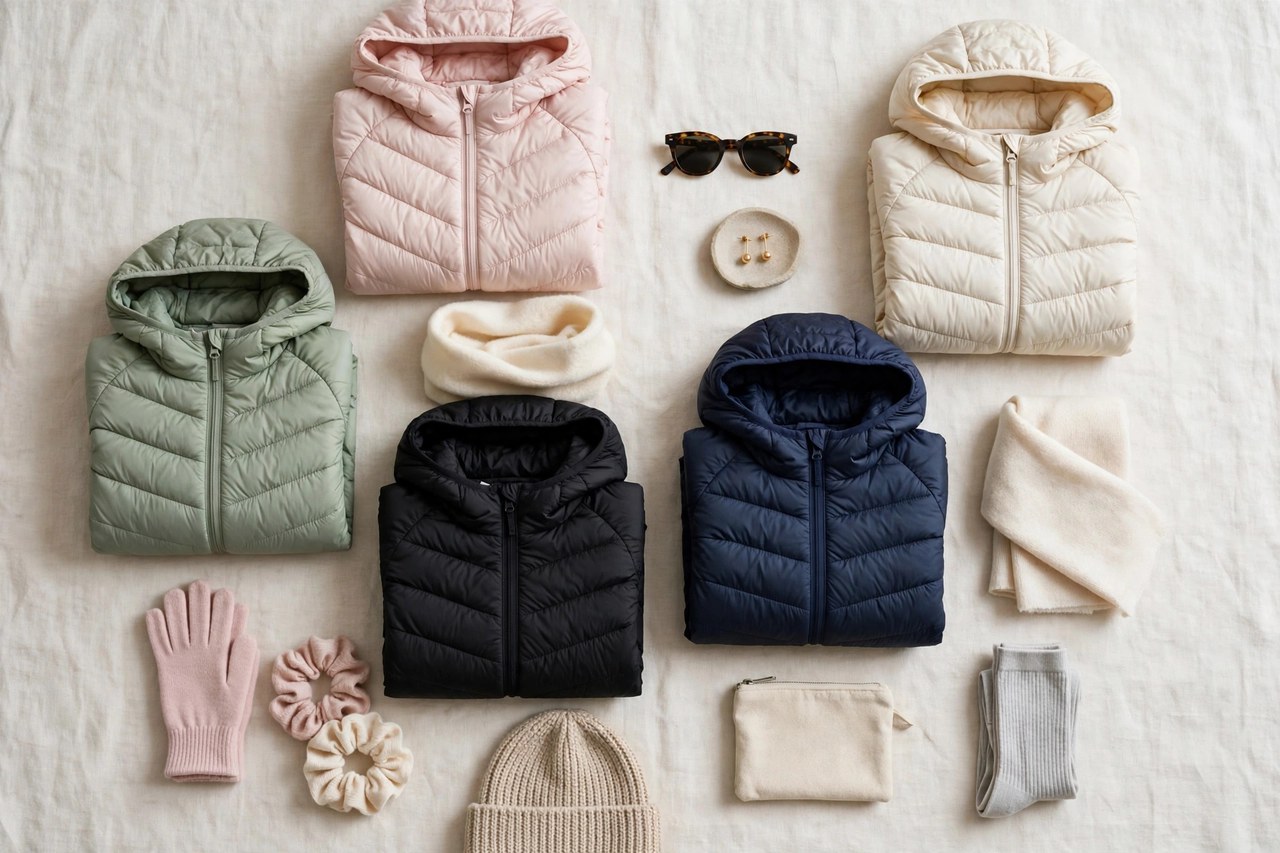
A down jacket is insulated with down — the soft, cluster-shaped under-feathers of geese or ducks that trap warm air in thousands of tiny pockets. It is the warmest insulation for its weight ever put in a garment, which is why petite down jackets matter: a woman 5'4" and under needs that warmth in a jacket whose body is shorter, whose sleeves end at her wrist, whose baffles are scaled to her torso and whose hem does not descend to mid-thigh when it was designed to sit at the hip. Regular puffers on petite frames add bulk in exactly the wrong places.
This guide is specifically about insulated jackets — down and its synthetic alternatives — as distinct from the broader petite coats category of wool, trench and dress styles. It explains fill power and fill weight in plain terms, how baffle size and jacket length change in petite cutting, what to check about hoods, cuffs and hems at small scale, and how to size a jacket that must work over winter layers without simply buying a size up and losing the petite fit entirely.
Down, Fill Power and Synthetic Alternatives
Fill power measures down's loft: how many cubic inches one ounce of down occupies when fully expanded. Higher numbers, roughly 550 to 900 in jackets, mean warmer insulation for less weight and bulk, which is a genuine petite advantage — a high-fill-power petite jacket can be the warmest garment you own while remaining slim enough to drive, commute and carry a bag in. Fill weight, the total amount of down, matters equally: a thin fashion puffer and a parka may share fill power but differ hugely in total warmth, so compare both figures where brands state them.
Synthetic insulation, usually polyester in sheet or loose-fill form, imitates down at lower cost and keeps insulating when wet, which down notoriously does not — wet down clumps and loses nearly all loft unless it has a hydrophobic treatment. Synthetic fills are bulkier for the same warmth and break down faster over years, but for wet climates, ski days and easy washing they are the practical choice. Many petite ranges offer both in the same silhouette, which makes the decision honest: down for dry cold and maximum lightness, synthetic for damp winters and rough, frequent use.
Baffles, Length and Petite Scaling
The stitched chambers holding the insulation are called baffles, and their size is a design decision. In petite down jackets the baffles are narrower and more closely spaced, distributing the same warmth in smaller compartments that follow a shorter torso — oversized baffles on a petite body create a few huge pillows of down that look and feel like wearing a quilted duvet. Sewn-through baffles suit light and midweight jackets; box-wall baffles, with a fabric wall between layers, eliminate cold spots in expedition-weight styles but add structure most petite commuters do not need.
Length options run from cropped puffers ending at the petite waist — the fashion style, best with high-waisted bottoms in mild cold — through hip-length jackets, the versatile standard, to thigh- and knee-length down coats for serious winter. In petite cutting each length is several inches shorter than its regular namesake and the hem, drawcord and any side zips are positioned for a shorter leg, so a petite knee-length down coat covers to the knee without swallowing the calf. Two-way front zips matter at longer lengths: they open from the bottom for sitting, driving and stairs.
Hoods, Cuffs, Hems and Other Details at Small Scale
A hood scaled for petite is not trivial: regular hoods on a small frame are cut deep enough to fall over the eyes, while petite hoods are shallower, sit closer and adjust with drawcords that actually tension. Check whether the hood is removable or packable if you will wear the jacket with formal layers, and that its collar stands high enough to seal the neck without the zip biting your chin — petite collar heights are lowered precisely to avoid that. Storm flaps over zips, chin guards and fleece-lined collars are small details with outsized comfort in wind.
Cuffs should close at the wrist with elastic, velcro or internal storm cuffs so sleeves do not admit draughts or cover your hands; petite sleeve lengths make this achievable without rolling. Pockets sit higher, at a petite hand's reach, and fleece-lined hand-warmer pockets placed behind the insulation warm fastest. A hem drawcord seals the bottom, and on petite jackets its toggles sit at the front or side where a shorter arm reaches them. Finally, weight: a good petite down jacket should feel surprisingly light on the hanger — if it feels like a heavy coat, its warmth-to-weight engineering is not doing its job.
Sizing Over Layers, Fit Checks and Care
Size a down jacket over a real winter layer, not a T-shirt. In your petite size, you should fit a mid-weight sweater underneath, fasten the zip without compressing the down flat — compressed down cannot loft, and loft is the insulation — and still reach forward and up freely. Resist sizing up into regular or larger petite sizes for layering room: the shoulders slide, the sleeves lengthen and the hem drops, while the added internal space actually feels colder than a correct fit with thinner, warmer layers underneath. Petite thermal systems are designed to stack inside petite proportions.
Down care keeps loft alive. Wash occasionally with a down-specific detergent, rinse thoroughly, and tumble dry low with clean dryer balls until completely dry and re-lofted — this can take hours, and stopping early leaves clumps. Store down uncompressed, hanging or in a large breathable sack, never in its stuff pocket long-term, which crushes clusters. Between washes, air the jacket and spot clean the collar and cuffs where oils accumulate. Synthetic jackets wash more simply and dry faster, one of their practical advantages. Properly kept, a quality petite down jacket delivers a decade of winters, which is why its fit deserves the attention this guide gives it.
Related Women's Guides
More to Explore on Apparel Search
Looking for Women's Clothing Stores?
This guide helps you choose women's petite down jackets. To browse where to buy, visit our women's clothing store directory, where you can find retailers that carry them.