Women's Down Jackets
Fill power, baffles and shell fabrics decide how warm a puffer really is — this guide translates the numbers into warmth you can feel.
Shop Women's Down Jackets Now
Shop Women's Down Jackets on Amazon Shop Women's Down Jackets on eBayThe Amazon and eBay links on this page are affiliate links. If you make a purchase through them, Apparel Search may earn a commission.
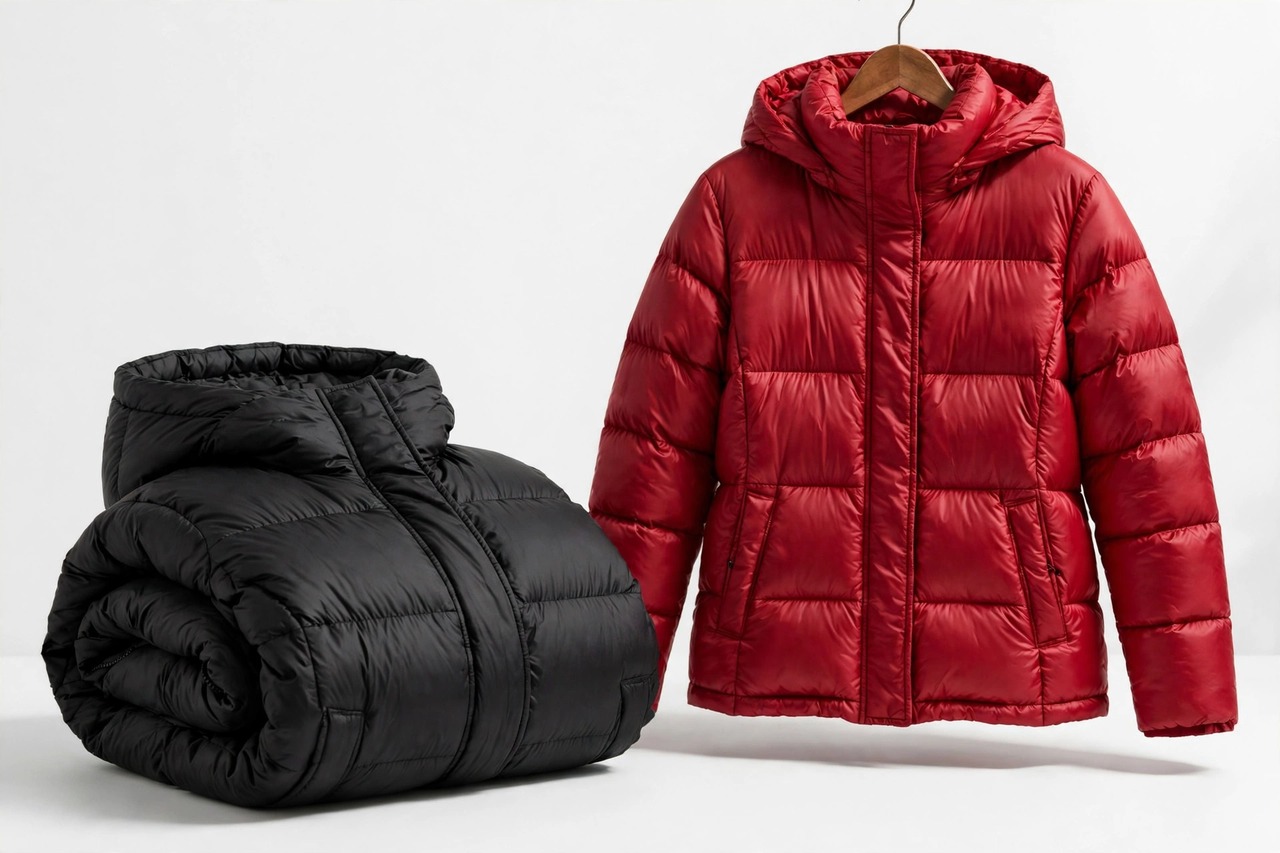
A down jacket warms you the way a duvet does: thousands of down clusters trap still air in tiny pockets, and still air is the insulation. Everything about the jacket — the quality of the down, how much of it there is, the compartments that hold it, the fabric that protects it — either protects that trapped air or lets it escape. Learn to read those four things and a wall of similar-looking puffers sorts itself quickly into light layers, serious winter coats and fashion pieces that only look warm.
This guide explains the numbers on the hangtag, the honest trade-off with synthetic insulation, and the care routine that keeps a down jacket lofty for a decade.
Fill Power Explained: 550 to 900
Fill power measures how much space one ounce of down occupies when it lofts fully. Higher numbers mean bigger, more resilient clusters that trap more air per ounce. Around 550 fill is serviceable and economical, common in everyday winter jackets where a bit of extra weight is acceptable. The 650 to 750 range is the sweet spot for most buyers: genuinely warm, noticeably lighter, and fairly priced. Fill power of 800 to 900 is premium territory, used in ultralight and expedition pieces where every ounce counts; it is warmer per gram, but the jackets are delicate and expensive, and for a city commute the difference over 700 fill is mostly in your bag, not on your back.
Fill power is only half the equation. Total warmth also depends on fill weight — how many ounces of down are inside. A jacket with a modest 600 fill but a generous fill weight can be warmer than a skimpy 800-fill layer. When comparing, check both numbers; brands that publish only fill power are telling you the flattering half.
Down vs. Synthetic, and What RDS Means
Down's weakness is water. Wet down clusters collapse, lose their loft and insulate almost not at all, and a soaked down jacket takes a long time to dry. Synthetic insulation, usually short-staple polyester, keeps much of its loft when damp, dries quickly and costs less, at the price of more weight and bulk for the same warmth and a shorter lifespan before it packs out. The practical rule: in dry, cold climates and for packable travel layers, down wins. In wet, changeable weather, or for jackets that will be washed often and treated roughly, synthetic or a hydrophobic treated down is the safer buy. Many shells now add a water-repellent finish that helps down survive drizzle, but no finish makes down a rain jacket.
If you buy down, look for the Responsible Down Standard, marked RDS, or a similar traceability certification. It verifies that the down was not taken from live-plucked or force-fed birds and that the supply chain is audited. Certification does not change warmth, but it is the clearest signal that the fill was sourced to a humane, documented standard.
Baffles, Shells and Fit for Layering
Baffles are the stitched compartments that keep down from migrating. Sewn-through baffles, where the shell and lining are stitched directly together, are light and fine for mild cold, but every stitch line is a cold spot. Box baffles add a fabric wall between shell and lining so the down lofts fully with no pinched seams; they are warmer, heavier and used in serious winter parkas. Shell fabrics balance protection and weight: thin 7 to 20 denier nylons keep ultralight jackets packable but snag easily, while 30 denier and above, often ripstop, handle daily wear, straps and seatbelts far better. A durable water-repellent coating on the shell sheds light snow and spills.
Fit decides whether the insulation can work. Down needs room to loft, so a jacket that is skin-tight compresses its own fill. At the same time, huge air gaps inside let warm air circulate away. Aim for a fit that takes a fleece or sweater underneath without strain, with sleeves long enough to cover wrists when you reach, and a hem that seals — drawcords, elastic or a two-way zip for sitting and stairs. Try it on layered, not over a t-shirt.
Washing, Drying and Storing for Loft
Down is washable and washing restores loft by removing the body oils that make clusters stick together. Use a front-loading machine, a down-specific or gentle detergent, warm water and an extra rinse, since soap residue kills loft. Then dry low and long in a tumble dryer with two or three clean tennis balls or dryer balls, which break up clumps as the down dries. Stop and pull apart remaining clumps by hand. The jacket is done only when it feels uniformly fluffy and light, which can take two to three hours; damp down put away will mildew.
Storage matters as much as washing. Never keep a down jacket compressed in its stuff sack or a vacuum bag for months — crushed clusters lose resilience permanently. Hang it in a closet or store it in the large cotton storage bag many brands include, in a cool dry place. Shake and air it at the start of the season, and your jacket should return to full loft year after year.
Related Women's Guides
Down Insulation, Explained
Down is the layer of fine feathers found under a bird's tougher exterior feathers, and it insulates by structure: the loose, fluffy clusters trap air, and the trapped air insulates against heat loss. The benefits of down are that it is warm, lightweight and packable, and — if well cared for — retains its loft up to three times longer than most synthetics. The down side of down: when wet, its thermal properties are virtually eliminated; it forms clumps when damp, mildews if left wet, and absorbs and retains odors.
Insulation quality is rated by fill power — the cubic inches displaced by one ounce of down (in³/oz), measured by placing an ounce of down in a graduated cylinder under a small weight. Eider down has the highest fill power, at 1200, but even 550 fill provides reasonably good insulation; 500–650 suits most conditions, while 800–900 fill is used in the lightest, warmest expedition-grade equipment. U.S. FTC rules govern the labels: a product labeled "100% Down" must contain only down feathers; one labeled simply "Down" may contain a mixture of fiber and feathers; and "Goose Down" must contain at least 90% goose down. The warmth is held in place by quilting — sewing two or more layers of fabric together into a padded material. For brand research, see our profiles of Canada Goose and The North Face, our feather and down suppliers directory, and our size-specific guides to petite down jackets and plus size down jackets.
Photos

More to Explore on Apparel Search
Women’s Clothes Guide by Letter: A · B · C · E · F · G · H · I · J · K · L · M · N · O · P · Q · R · S · T · U · V · W · X · Y · Z
Looking for Women's Clothing Stores?
This guide helps you choose women's down jackets by style, fabric and fit. To browse where to buy, visit our women's clothing store directory, where you can find retailers that carry them.