Women's Petite Hats Guide
Petite hats scale the whole hat down — a smaller crown circumference, a shallower crown depth and a narrower brim — so the hat sits on your head instead of over your ears and eyebrows.
Shop Women's Petite Hats Now
Shop Women's Petite Hats on Amazon Shop Women's Petite Hats on eBayThe Amazon and eBay links on this page are affiliate links. If you make a purchase through them, Apparel Search may earn a commission.
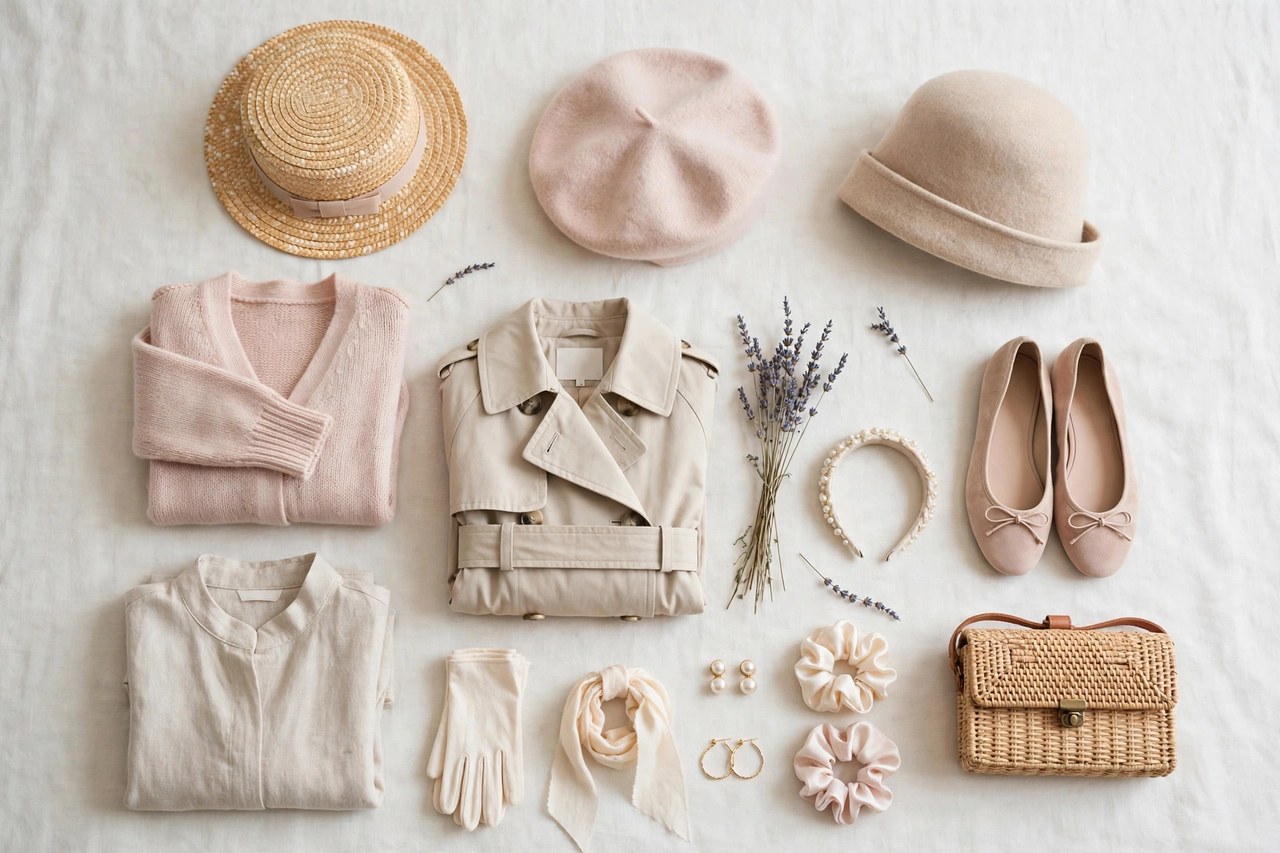
Most women's hats are made in a single average size, roughly 22 to 22.5 inches of head circumference, with a crown depth and brim width graded to match. On a smaller head — common among women 5'4" and under, though head size and height are only loosely linked — that average hat slides down to the eyebrows, covers the ears, and presents a brim wide enough to unbalance the whole outfit. Petite hats are made on a smaller block: less circumference, less depth, and a brim scaled to the frame wearing it.
This guide covers how to measure your head honestly, which dimensions beyond circumference actually decide fit, the main hat styles and how each scales for petites, and the adjustment tricks that rescue a borderline hat. It applies whether you need a structured felt hat, a summer sun hat or a simple knit beanie that does not swallow your face.
Measuring and the Three Dimensions of Fit
Measure around your head with a soft tape, across the forehead just above the eyebrows and around the fullest part of the back of the head — that is your hat size in inches or centimeters. Petite sizing typically serves heads of about 21 to 21.75 inches, below the usual one-size range. If you fall between the average and petite ranges, adjustable inner bands and sizing tape can bridge the gap, but start from the closest block rather than padding a hat that is fundamentally too big.
Circumference is only the first dimension. Crown depth decides whether the hat sits above the ears or swallows them; petite crowns are shallower by roughly a quarter to a half inch, which also keeps the hat's proportions right on a smaller face. Brim width is the third: a brim that reads elegant on a taller frame can read as a costume on a petite one, so petite sun hats and fedoras typically trim a half inch to an inch from standard brims while keeping the style's character intact.
Styles and How They Scale for Petites
The cloche, sitting close and low, is a natural petite style — in a small size it frames the face rather than hiding it. Fedoras and trilbys scale by brim: the trilby's naturally narrower brim is often the better petite choice, while a fedora in a petite block keeps its snap brim in proportion. Berets are size-forgiving and suit smaller heads simply by being worn at their true diameter rather than stretched. Bucket hats in petite sizing fix the common failure of the brim falling over the eyes.
Sun hats show the scaling problem most clearly: a five-inch brim on a petite frame blocks sight lines and catches every breeze. Petite sun hats keep real shade with brims around three to four inches, a smaller crown that grips properly, and often an inner drawstring for wind. Knit beanies and winter hats in petite cuts are shorter in body, so the cuff folds once at the right place instead of covering the eyebrows, and pom-poms and patterns are scaled down to match. In every style, try the hat with your hair as you actually wear it — volume changes fit by half a size.
Materials: Felt, Straw, Cotton and Knits
Wool felt is the structured-hat standard: warm, shape-holding and resilient, and the material where a properly sized petite block matters most because felt does not stretch to forgive a bad fit. Fur felt is the finer, more durable upgrade. Straw and paper-braid hats dominate summer; natural straw is light and breathable, while woven synthetics add crushability and rain tolerance — useful in a smaller travel hat that must pack without losing its scaled shape.
Cotton and canvas make casual caps and buckets; petite caps deserve special mention because the standard cap's deep crown is the most common too-big hat of all — look for low-profile crowns. Knit hats in wool, acrylic or cashmere blends rely on ribbing to fit a range of heads, but petite knits start smaller so the rib is not stretched flat on a small head. Whatever the material, check the inner band: a grosgrain sweatband, ideally adjustable, is what turns a close size into an exact one.
Fit Fixes, Care and Buying Tips
Small fit problems have small solutions. A hat a fraction loose takes sizing tape or felt reducer strips under the sweatband, placed at front and back first. A hat that lifts in wind needs a chin cord, hat pin or elastic band more than it needs a smaller size. What cannot be fixed is a crown so deep the hat rests on your ears or a brim so wide it hides your face — those are block problems, and they mean returning the hat and buying the petite size instead.
Care keeps a hat's size true: store structured hats on a stand or stuffed with tissue, never hung by the brim; brush felt with the nap; keep straw out of rain unless it is a synthetic weave rated for it; and never leave any hat in a hot car, where heat shrinks sweatbands measurably. Buy the style you wear most — for many petite women, one good felt hat and one packable sun hat, both in true small sizes — and keep your head measurement in inches and centimeters in your phone, because hat sizing is sold in both and guessing is how the wrong block ends up on your shelf.
Related Women's Guides
More to Explore on Apparel Search
Women’s Clothes Guide by Letter: Women's Apparel Directory N · Women's Clothes Directory O · Women's Apparel Directory Q · Women's Fashion Directory R · Women's Clothing Directory S · Women's Clothes Directory T
Looking for Women's Clothing Stores?
This guide helps you choose women's petite hats. To browse where to buy, visit our women's clothing store directory, where you can find retailers that carry them.