Women's Petite Accessories Guide
Petite accessories are scaled for women 5'4" and under — narrower belts, smaller bags, shorter scarves and finer jewelry that finish an outfit without overwhelming a smaller frame.
Shop Women's Petite Accessories Now
Shop Women's Petite Accessories on Amazon Shop Women's Petite Accessories on eBayThe Amazon and eBay links on this page are affiliate links. If you make a purchase through them, Apparel Search may earn a commission.
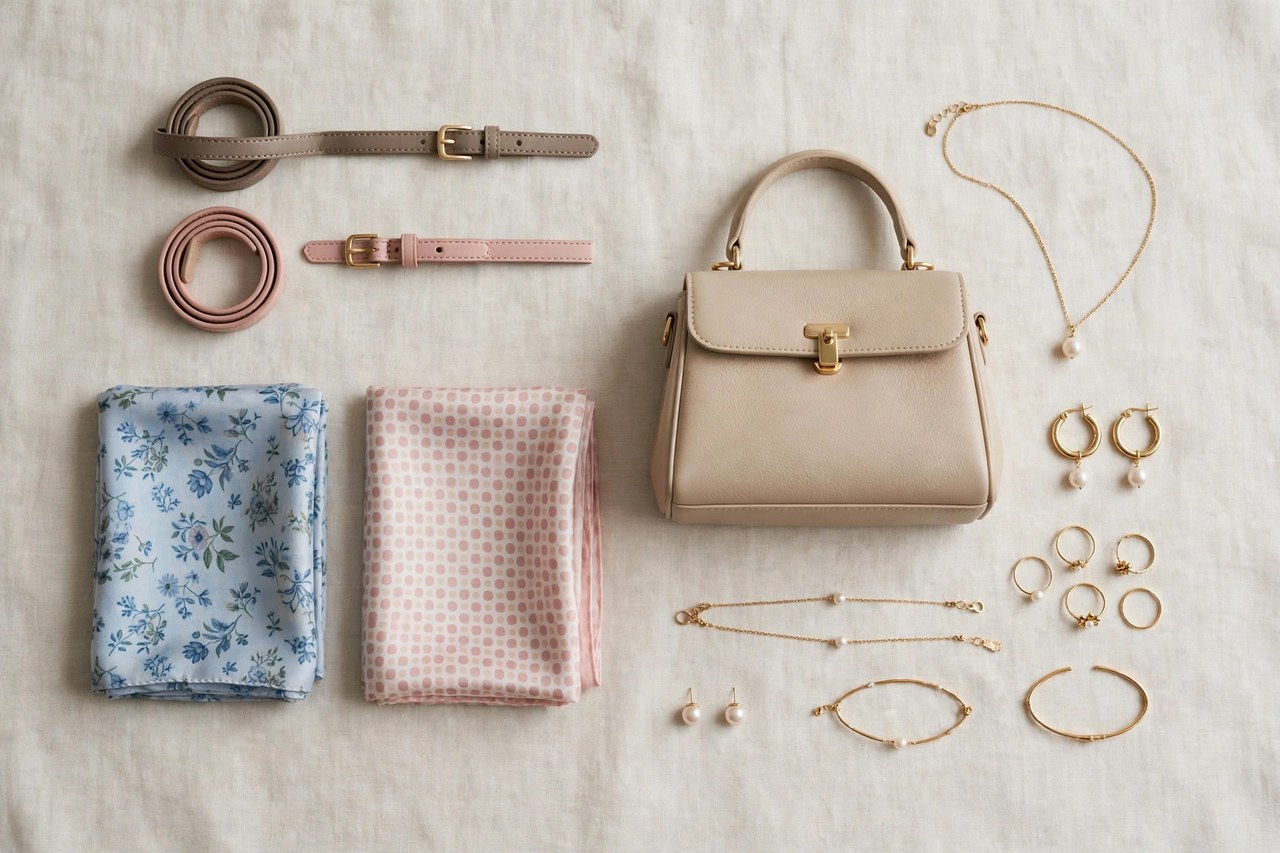
Petite accessories are not simply regular accessories worn by a shorter woman. When they are designed well, every dimension is reconsidered for a frame that is 5'4" and under: bag straps are shorter, belt holes start closer in, scarf lengths do not trail, hat crowns sit lower and jewelry pendants hang at the right point on a shorter torso. The difference sounds small until you wear an oversized tote that hits at the knee or a wrap belt with a foot of spare end flapping at the side.
This guide explains how scale works across the main petite accessory categories, why proportion matters more than trend size, and how to check fit before you buy. Because accessories have no standard petite sizing system the way clothing does, you will learn to read measurements — strap drop, bag width, belt length and scarf dimensions — and to use them as your real size chart for every finishing piece in the wardrobe.
Why Scale Matters on a Petite Frame
Proportion is visual balance. On a petite frame, a standard 14-inch-wide tote, a wide 3-inch belt or a long pendant necklace occupies proportionally far more of the body than it does on a taller woman, and it can shorten the silhouette further by cutting it at the wrong points. Scaled accessories keep the same design idea but reduce width, length and hardware size by roughly ten to fifteen percent, so the eye reads the outfit rather than the accessory alone.
Narrower shoulders and a shorter torso are the two measurements that drive most petite accessory problems. Shoulder bags slide off narrower shoulders unless the strap is grippy or adjustable to a shorter drop, scarves and long necklaces pool below the bust, and wide belts cover so much of a short waist that they erase it instead of defining it. Choosing the petite version, or the smallest size in a regular range, corrects all three without any alteration.
Bags, Belts, Scarves and Hats in Petite Sizes
Bags: look for widths under about 11 inches for everyday totes and satchels, crossbody straps that adjust down to roughly 19 to 21 inches of drop, and top handles that do not force the bag to hang below the hip. Belts in petite ranges are shorter overall, with the first hole placed for waists in the mid-20-inch range and narrower widths — one inch or less for waist belts — that suit a shorter rise and smaller belt loops.
Scarves for petites are shorter and narrower, typically 55 to 62 inches long instead of 70-plus, so a single loop does not swamp the neck or hide the outfit. Hats need smaller head sizes, often 21 to 22 inches, and shallower crowns and narrower brims — a 2- to 3-inch brim flatters a petite face where a 5-inch brim hides it. Gloves follow the same logic, with shorter fingers and narrower palms in petite or small sizes.
Jewelry, Eyewear and Small Details
Petite jewelry is about length and weight as much as looks. Necklaces of 14 to 16 inches sit at the collarbone on a shorter neck and torso where an 18-inch chain drops too low; pendants scaled under an inch keep the focal point in proportion. Bracelets with a 6- to 6.5-inch circumference stay on a small wrist instead of sliding over the hand, and lightweight earrings — small hoops, studs and short drops under about 1.5 inches — balance a smaller face without pulling the lobe.
Eyewear follows suit: petite frames have narrower lens widths, shorter temples and a smaller bridge, so glasses sit on the nose instead of slipping. Sunglasses in petite or narrow sizes avoid the oversized look swallowing the face unless that drama is deliberate. Even watches read better with case diameters around 26 to 32mm on a small wrist. None of this limits style — every trend exists in a scaled version — it simply puts the dimensions in your favor.
Buying Tips and Care
Shop by measurement, not by the word petite alone, because labeling is inconsistent. For bags, compare width and strap drop to a bag you already own that works. For belts, measure a belt that fits from buckle fold to the hole you use. For online orders, check whether straps, chains and scarves list full dimensions, and favor adjustable designs — extra belt holes, slider straps and wrap scarves forgive small errors in a way fixed lengths never do.
Care is the same as for regular accessories, with one petite-specific note: do not have standard accessories cut down casually. Shortening a bag strap at the hardware, re-punching belt holes evenly spaced, or having a jeweler shorten a chain properly all work; folding, knotting and tucking excess length usually looks improvised and wears unevenly. Store scarves rolled, belts coiled, and bags lightly stuffed so scaled shapes hold. A small, well-proportioned set of accessories will finish more outfits than a drawer of oversized bargains.
Related Women's Guides
Looking for Women's Clothing Stores?
This guide helps you choose women's petite accessories. To browse where to buy, visit our women's clothing store directory, where you can find retailers that carry them.