Women's Skorts Guide
A skort is a pair of shorts with a fabric flap across the front — and sometimes the back — so it presents as a skirt while wearing as shorts.
Shop Women's Skorts Now
Shop Women's Skorts on Amazon Shop Women's Skorts on eBayThe Amazon and eBay links on this page are affiliate links. If you make a purchase through them, Apparel Search may earn a commission.
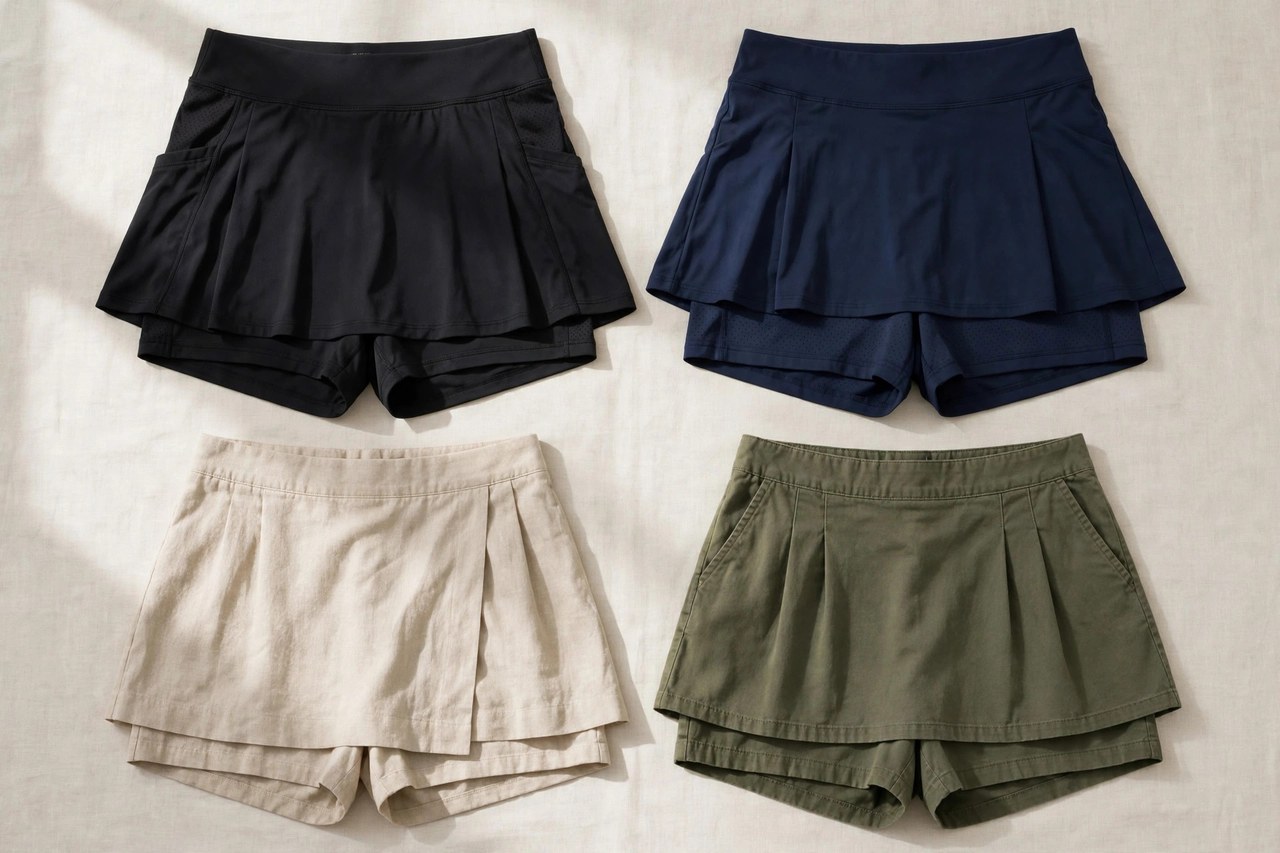
Skorts are a pair of shorts that have the appearance of being a skirt. They are made with a flap across the front — and sometimes the back — to create the appearance of a skirt, while the garment underneath, and against the body, is an ordinary pair of shorts. The name is simply the blend of skirt and shorts, and the idea is older than the word: women athletes and active wearers have wanted a skirt's line with a short's security for as long as both garments have existed.
This guide covers the skort as its own construction: the two ways the skirt illusion is built, the sports that made it standard equipment, the inner short's fabrics and lengths, and how to fit a garment that must succeed as two garments at once. It links the shorts family and the skirts family, and both of those guides point back here — the shorts page even poses its riddle: mix skirts with shorts, and you get skorts.
Two Constructions: Flap Front and Full Skirt
The flap-front skort follows that definition most literally: a shorts body with a panel of fabric across the front, cut and sometimes pleated to read as a skirt's front, while the back shows the shorts plainly. It is the lighter, cooler construction and the common one in golf and casual styles. The full-skirt skort wraps the skirt illusion all the way around — a complete overskirt, flat, pleated or flared, attached at the waistband over the inner short — so from every angle the garment reads as a skirt until movement or a close look reveals the shorts beneath.
Choosing between them is choosing how complete the illusion needs to be. A flap front is honest tailoring for settings that merely prefer a skirt's line; a full skirt serves dress codes and sports that require a skirt's appearance, and it moves and photographs like one. The full version carries more fabric, more warmth and more wind behavior — a flared overskirt in a gust is a skirt problem the shorts underneath cannot solve, which is why athletic full skorts keep their skirts short and close.
The Sports That Made the Skort Standard
Athletics is where the skort earned its place. Tennis skorts pair a pleated or A-line overskirt with compression or loose inner shorts that carry a ball pocket — often an upside-down pocket on the leg that holds a ball securely — and they replaced the tennis skirt-plus-brief combination for most players. Golf skorts run longer and more tailored, in flap and full versions, meeting course dress codes at knee-adjacent lengths. Running and training skorts put a light, split overskirt over short tights, and field hockey and lacrosse uniforms adopted skorts for the same coverage-with-movement logic.
Beyond sport, the skort's everyday case is the same engineering in civilian clothes: cycling to lunch, playground duty, travel days and amusement parks — any setting where a skirt is wanted and sitting on grass, climbing stairs and chasing a schedule are also on the program. School-uniform skorts exist for exactly this reason. The category's growth follows that logic outward from sport: wherever the dress code or the occasion says skirt and the day says otherwise, the skort is the negotiated settlement.
Inner Shorts: Fabrics, Lengths and Details
The inner short is the garment's working half, and its fabric decides comfort. Compression liners in polyester-elastane hug the thigh, wick moisture and prevent chafing on runs and matches; they should end mid-thigh and stay there, because a liner that rides up is worse than none. Loose inner shorts in woven or mesh fabrics breathe better and suit casual and golf skorts, trading chafe protection for air. Silicone or elastic grippers at the liner's hem, where present, are the tell of a sport-serious model.
Details divide good skorts from costume versions. The overskirt should be attached at the waistband only, hanging free so skirt and shorts move independently; side slits or pleats give the stride its room. Pockets are the category's battleground: better skorts hide a phone pocket on the inner short's leg and sometimes a zip pocket in the waistband, since decorative overskirt pockets rarely hold anything safely. Lengths run from athletic 3–4 inch liners to uniform skorts near the knee.
Fit and Care
Fit a skort by the shorts first, because they touch the body: the waistband secure without a drawstring doing all the work, the liner or inner short smooth at the thigh, the rise comfortable seated. Then judge the skirt: it should hang from the waistband without pulling across the shorts' fly or pockets, and its hem should clear the inner short's hem by design, not by accident. Walk stairs and sit down — the two movements the skort exists to civilize — and confirm the skirt settles back into place unaided. Sizes follow your shorts size in athletic brands and your skirt size in tailored ones; when in doubt, the inner garment rules.
Care is gentle machine washing for most modern skorts, with athletic versions treated like other performance clothing: cold wash, no fabric softener on wicking liners, hang dry to protect elastane and pleats alike. Pleated overskirts want to be hung by the waistband so the folds set as they dry. A skort remains the wardrobe's most practical compromise: a skirt to the eye, shorts to the wearer, and no negotiation required.
Related Women's Guides
Photos

More to Explore on Apparel Search
Looking for Women's Clothing Stores?
This guide helps you choose women's skorts. To browse where to buy, visit our women's clothing store directory, where you can find retailers that carry them.