Women's Sports Shorts Guide
Sports shorts are built for motion — inseam, liner and fabric decide whether a pair runs, lifts, lunges and rides along with you or against you.
Shop Women's Sports Shorts Now
Shop Women's Sports Shorts on Amazon Shop Women's Sports Shorts on eBayThe Amazon and eBay links on this page are affiliate links. If you make a purchase through them, Apparel Search may earn a commission.
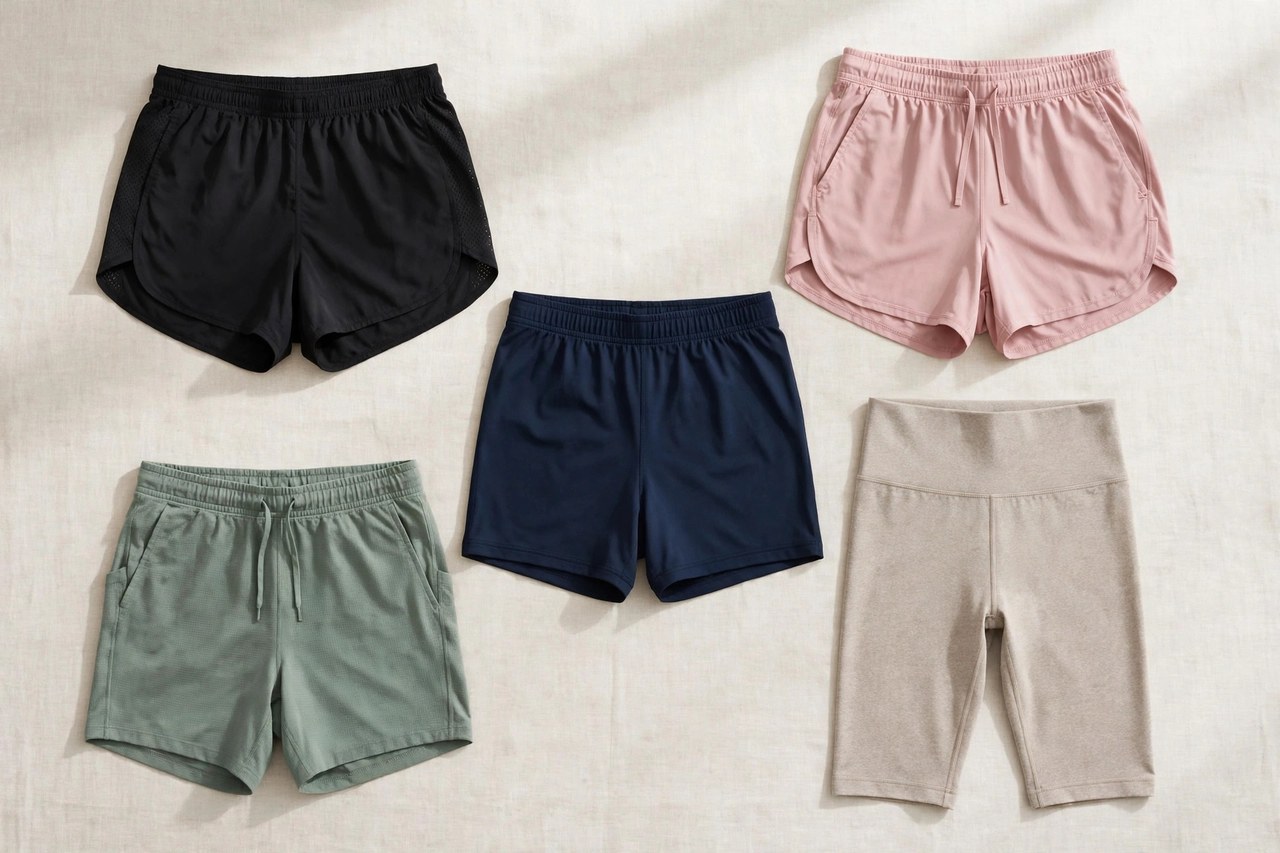
Sports shorts are shorts engineered for exercise: light, quick-drying, cut for a full range of leg movement and finished with waistbands and liners that stay where they are put at speed. They look like the simplest garment in the gym bag, but the differences between a running short, a training short and a court short are as real as the differences between their shoes — inseam, rise, liner and fabric are all functional decisions wearing casual disguises.
This guide covers sports shorts as athletic equipment: the main families by sport, how to read an inseam, the liner systems that divide the category, and the waistband and pocket details that decide whether a pair disappears during a workout or requires management every three minutes. Ordinary fashion shorts have their own pages in this guide; here, every feature answers to movement first.
The Families: Running, Training, Court and Field
Running shorts are the lightest family: short inseams, featherweight woven fabric, often a split side seam that opens as the leg drives, and a brief liner. They are built for one motion repeated at speed, and they flap, ride and breathe exactly as that brief requires. Training and gym shorts are sturdier — knit or heavier woven fabric, longer inseams, squat-proof opacity and a cut that survives lunges, floor work and machines without adjustment.
Court and field shorts adapt the idea to their sports: tennis and racket shorts prioritize pockets that actually hold a ball and a hem that stays decent through serves; soccer and basketball shorts run longer and looser in traditional cuts; volleyball and compression styles fit close like a second skin. Cycling-style shorts sold for general training borrow the close fit without the pad. Start from your sport's family, because a marathon short in the weight room and a lifting short on a long run both announce the mismatch within minutes.
Inseams and Liners: The Working Numbers
Inseam is the category's key measurement. 3–4 inch inseams are the racing and hot-weather zone, maximum freedom and minimum fabric. 5 inch is the versatile middle most runners and trainers live in. 7–9 inch styles serve court sports, coverage preferences and cooler days. Rise matters alongside: a higher rise stays put through bending and floor work, and pairs with the wide, flat waistbands that have largely replaced drawstring-only designs, though a drawstring remains the honest adjuster.
Liners divide the market. A built-in brief liner makes the short a complete garment, standard in running styles. Two-in-one shorts pair a close compression liner — 5 to 9 inches of thigh-hugging knit that prevents chafing — under a loose outer short, and have become the default for runners who want both coverage and glide. Unlined shorts expect your own base layer and suit gym training. Chafing, not modesty, is the engineering problem here, and the liner system you choose is your answer to it.
Waistbands, Pockets and Fabrics
A sports short lives or dies at its waistband. Wide elastic bands with an internal drawcord distribute pressure and stay level through movement; thin elastic twists, folds and migrates. Flatlock seams and laser-cut or bonded hems remove the ridges that chafe over distance. Pocket design is the modern battleground: a zip pocket that fits a phone, waistband stash pockets for keys and gels, and drop-in liner pockets all exist — judge them loaded and in motion, since an unloaded pocket demonstration in a shop proves nothing.
Fabrics are lightweight polyester or nylon wovens for outer shorts — quick-drying, rustle and all — and stretch knits with elastane for compression styles. Four-way stretch is the phrase that matters for training shorts that must squat and lunge. Mesh panels ventilate the sides and back yoke. UPF ratings appear on outdoor versions. As with sports shirts, the fabric label is a spec sheet: weight, stretch direction and drying speed predict the workout more accurately than the colorway does.
Fit Tests and Care
Fit sports shorts in motion. Lunge, squat, high-knee and sit in them in the shop; the waistband should stay level, the liner should stay placed, and nothing should need retrieving afterward. Check opacity of knit styles under a squat in bright light — a training short that fails this test fails publicly. Between sizes, size for the waistband's security, since a short that slides in a workout is worse than one that fits closely; the drawcord fine-tunes what the size begins.
Care follows the athletic wardrobe rules: cold wash, no fabric softener on wicking or compression fabrics, hang dry to protect elastane and waistband elastic. Wash promptly after hard sessions and never leave shorts sealed in a gym bag. A compression liner that has lost its squeeze or a waistband that no longer recovers is the pair's retirement notice. Keep two or three pairs in rotation matched to your sports, and the simplest garment in the bag becomes the one you never have to think about — which is the entire design goal.
Related Women's Guides
More to Explore on Apparel Search
Women’s Clothes Guide by Letter: A · B · C · D · E · F · G · H · I · J · K · L · M · N · O · P · Q · R · T · U · V · W · X · Y · Z
Looking for Women's Clothing Stores?
This guide helps you choose women's sports shorts. To browse where to buy, visit our women's clothing store directory, where you can find retailers that carry them.