Women's Sports Shirts Guide
A sports shirt is a top built to be exercised in — moisture-managing fabric, a cut that moves, and construction that survives sweat, sun and repeated washing.
Shop Women's Sports Shirts Now
Shop Women's Sports Shirts on Amazon Shop Women's Sports Shirts on eBayThe Amazon and eBay links on this page are affiliate links. If you make a purchase through them, Apparel Search may earn a commission.
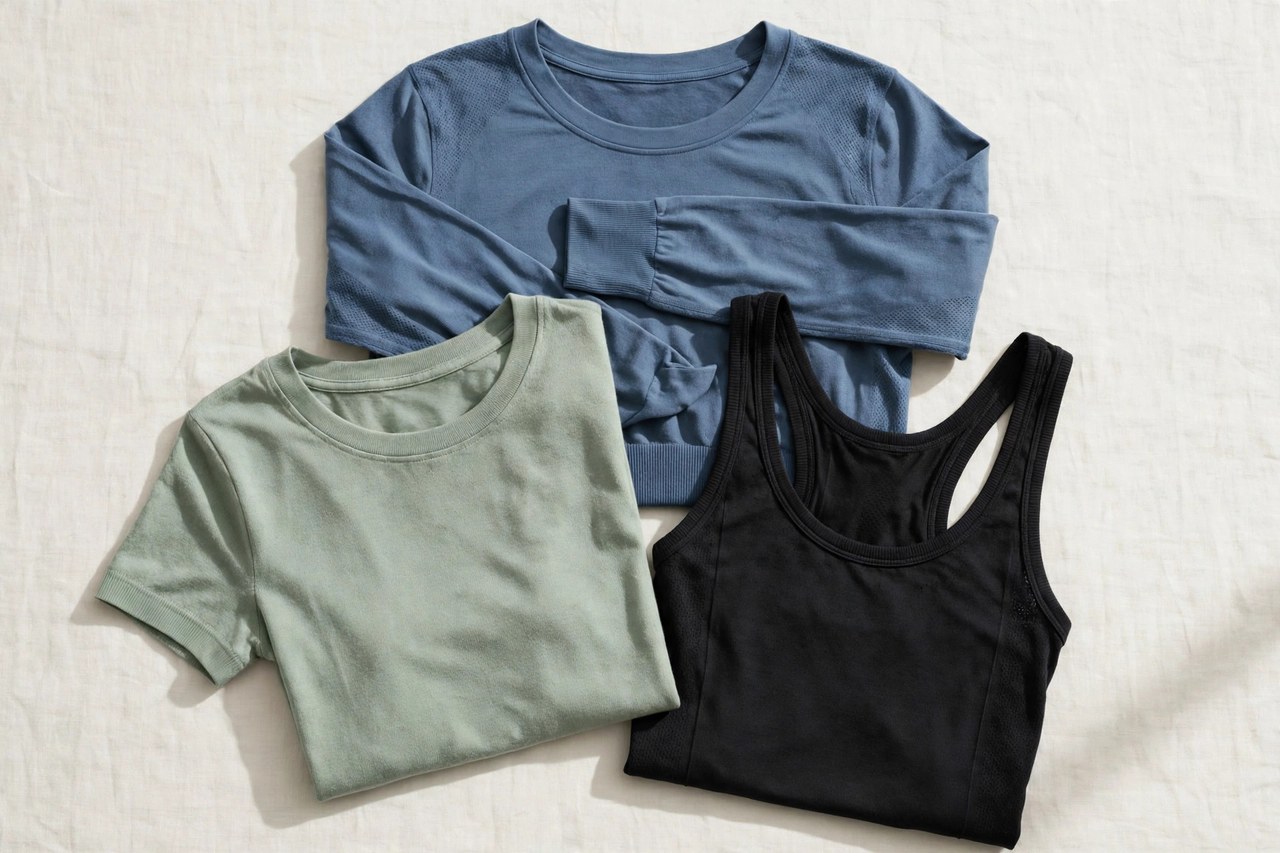
A sports shirt is a shirt whose brief is movement and sweat: a training tee, a running singlet, a tennis top, a team practice shirt. Where a fashion shirt is judged on how it looks standing still, a sports shirt is judged on how it behaves at minute forty of a workout — whether it moves moisture, stays in place, avoids chafing and keeps its shape through a wash cycle a week, every week.
This guide covers sports shirts as athletic tops, distinct from the sports jersey, which is a team's identity garment, and from the solid fashion tee. The subject here is fabric technology and functional cut: wicking knits, ventilation, sun protection, sleeve and hem engineering, and how to match a shirt to the way you actually train, from gym circuits to long outdoor runs to racket sports.
Performance Fabrics: Wicking, Mesh and UPF
The base fabric is almost always an engineered synthetic knit — polyester or nylon with elastane — built to wick: to pull sweat off the skin and spread it across the fabric surface where it evaporates. Cotton is the classic wrong answer for hard exercise, absorbing many times its weight in moisture and staying cold and heavy. Merino wool is the natural exception, regulating temperature and resisting odor on long outdoor days, at a higher price and with slower drying.
Construction adds the refinements. Mesh panels at the back, sides and underarms ventilate the heat zones. UPF-rated shirts build sun protection into long-sleeved training and outdoor shirts, essential for runners, golfers and gardeners who train in daylight. Anti-odor treatments and flatlock seams recur across serious lines. Read the fabric as a spec sheet: fiber, weight, ventilation placement and sun rating tell you the shirt's intended sport more honestly than its styling does.
Cuts for Different Sports
Sleeve design follows the sport. Sleeveless tanks and singlets free the shoulder completely for running, lifting and hot-weather training. Short sleeves are the all-rounders, with raglan sleeves — cut diagonally to the collar — the athlete's favorite for unrestricted reaching. Long sleeves serve sun protection, cool weather and compression-style training tops. Racket-sport and golf shirts add collars and structure because those sports' settings ask for them, and team practice shirts prioritize durability and printability over everything.
Length and hem are quiet engineering. Training shirts are cut long enough to stay put through overhead movement, with split or curved hems that do not bind at the hip; running shirts add reflective details for low light; gym shirts trade a little length for a clean line in the mirror. Women's sports shirts are patterned with a shaped torso rather than a shrunken men's block in better lines — check by raising both arms: a well-cut shirt rises slightly and settles back, while a bad one rides up and stays there.
Fit: Close, Regular and Relaxed
Sports shirts are sold across a fit spectrum and the right point on it is personal and practical. Close and compression fits support muscles, layer under uniforms and never flap in the wind on a run. Regular fits skim the body and suit most training. Relaxed fits maximize airflow in heat and comfort over a sports bra for studio and casual training. What matters at every fit is that seams sit where they should — shoulder seams on shoulders, flat seams away from backpack straps and armpit friction points.
Size for movement, not for the mirror alone. Squat, reach, twist and simulate your sport's main motion when trying a shirt; binding at the back or a hem that climbs is a size or cut problem, not something workouts will fix. If you train outdoors across seasons, buy the shirt that works over your winter base layer as well as alone in summer, or accept owning both weights — fabric weight, like sleeve length, is seasonal equipment, and the honest wardrobe treats it that way.
Care That Keeps Performance Working
Performance fabrics fail in the laundry more than in the gym. Wash sports shirts in cold water, and skip fabric softener entirely — softener coats the fibers and disables the wicking finish, the single most common way good shirts mysteriously stop working. Turn shirts inside out to protect prints and reflective details, wash with like synthetics, and hang dry; the dryer is unnecessary for fabrics engineered to dry fast, and its heat ages elastane.
Sweat left in a shirt breeds the permanent gym-bag smell that ordinary washing stops reaching, because bacteria settle into synthetic fibers. Wash promptly after hard sessions, use a sport-specific detergent for deep odor problems, and never leave a wet shirt sealed in a bag. Retire a sports shirt when its wicking no longer recovers after a proper wash or its elastane has relaxed into bagginess. A rotation of three or four training shirts, cared for this simply, will outlast a drawer of neglected ones several times over.
Related Women's Guides
More to Explore on Apparel Search
Women’s Clothes Guide by Letter: A · B · C · D · E · F · G · H · I · J · K · L · M · N · O · P · Q · R · T · U · V · W · X · Y · Z
Looking for Women's Clothing Stores?
This guide helps you choose women's sports shirts. To browse where to buy, visit our women's clothing store directory, where you can find retailers that carry them.