Women's Sports Coats Guide
A women's sports coat is a tailored odd jacket — a blazer-style coat sold separately from any suit, made to be worn with different trousers, skirts and dresses.
Shop Women's Sports Coats Now
Shop Women's Sports Coats on Amazon Shop Women's Sports Coats on eBayThe Amazon and eBay links on this page are affiliate links. If you make a purchase through them, Apparel Search may earn a commission.
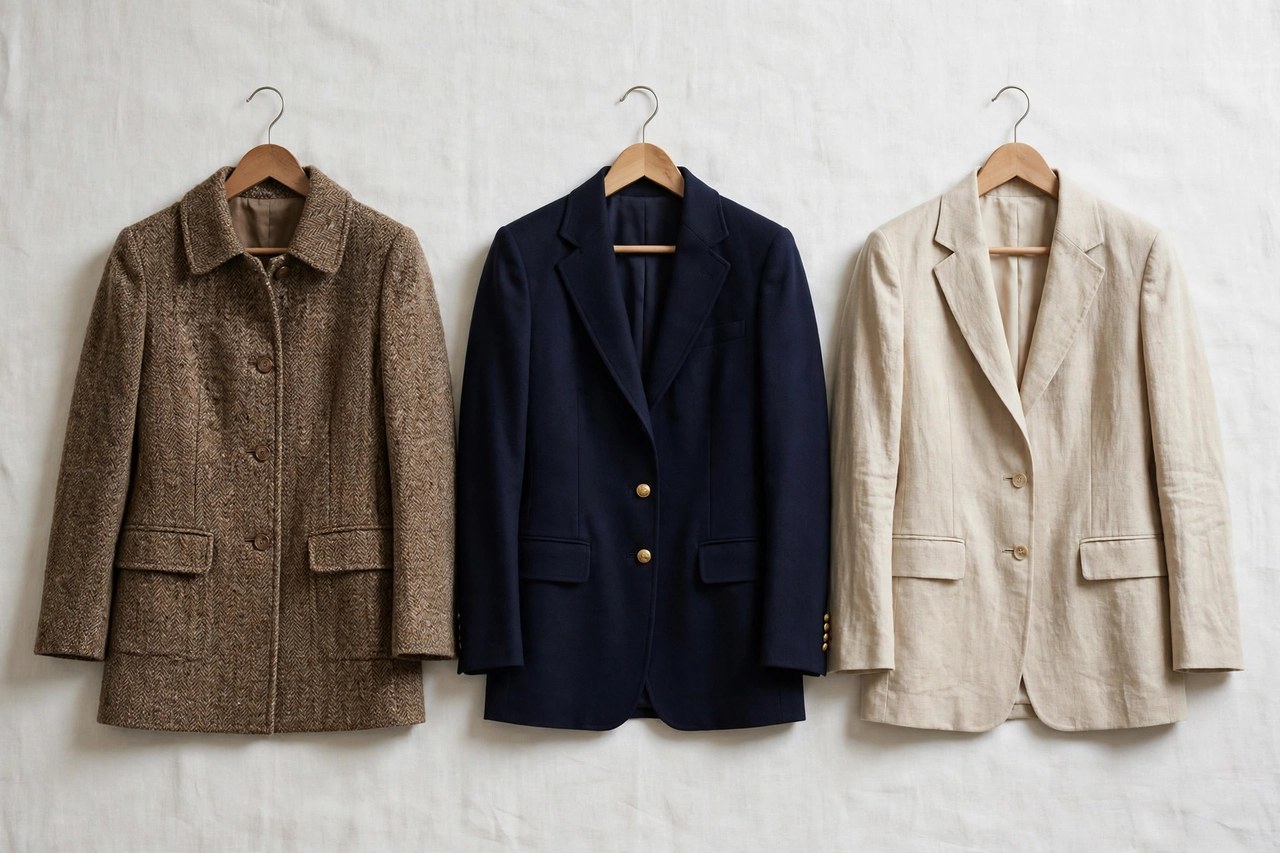
A sports coat, in tailoring language, is an odd jacket: a tailored jacket designed to be worn with trousers, skirts or dresses that are not made from its fabric. The term descends from jackets made for country sport, and the modern women's sports coat keeps that heritage of texture and informality — it is the jacket with pattern, weave or color in it, where a suit jacket is deliberately plain. Women's lines often label the same garment a blazer, and the two terms overlap heavily in shops.
This guide uses the tailoring distinction because it is the useful one: a sports coat is bought as a separate, judged on its own fabric and fit, and worn to pull unmatched pieces into an outfit. It covers the sports coat and blazer overlap honestly, the classic fabrics, the fit points that cannot be altered, and how one good odd jacket quietly becomes the most versatile tailored garment in a wardrobe.
Sports Coat or Blazer: The Honest Distinction
Traditionally, a blazer is a solid-colored jacket — navy above all — often with metal or contrasting buttons, derived from naval and club uniforms. A sports coat is the patterned, textured cousin: tweeds, checks, herringbones and hopsacks, originally for outdoor pursuits. In women's retail the words are used almost interchangeably, and the garment on the hanger may be called either. Shop by properties, not by the label: solid and smooth leans formal, patterned and textured leans casual, whatever the tag claims.
Both differ from the suit jacket in one hard rule: a suit jacket is half of a matched set and looks orphaned worn alone, with its smooth fabric and matching buttons giving it away. A sports coat is designed to stand alone — its fabric has enough character to hold a whole outfit's top half. If you own one tailored jacket, the odd jacket is the rational purchase, because it pairs with everything you already own instead of only with its other half.
Fabrics: Tweed, Hopsack, Linen and Knit
Classic sports coat fabrics have visible texture. Tweed brings flecked, multicolor yarns and durability for autumn and winter. Herringbone, houndstooth and windowpane checks pattern a coat without printing it. Hopsack and flannel give matte, soft structure in cooler months, while linen and cotton sports coats serve summer, cut less formally and worn with their natural creasing accepted as part of the look. Corduroy and velvet coats occupy the rich-textured winter end of the range.
Modern additions widen the category: knit sports coats in ponte or sweater-knit wear like a cardigan with a tailored face, travel without wrinkling and suit business-casual offices well. Fabric weight sets the season and the formality together, so read them as one decision. Whatever the cloth, check the pattern matching at the pockets and center back on checked and striped coats — matched patterns are the visible signature of careful making, and mismatched ones cannot be altered away.
Fit Points That Matter
Tailored jackets are judged at fixed points. The shoulder must sit at your shoulder — it is the one dimension a tailor cannot economically change. The jacket should button without pulling an X into the fabric, the sleeves should show a sliver of shirt cuff, and the length should cover the seat in classic cuts or end at the hip bone in modern cropped ones. The collar should hug the neck without a gap at the back, a flaw visible from across the room.
Women's sports coats come in shaped, straight and boyfriend cuts; the shaped cut follows the waist, the boyfriend cut borrows the longer, straighter men's line deliberately. Lapel width dates a jacket more than any other feature and should be chosen in proportion to your frame rather than to the season's extremes. Buy the coat that fits the shoulders and the largest of your measurements, then tailor the waist: that order of operations is the whole secret of tailored shopping, in this category and every other.
Wearing the Odd Jacket
The sports coat's job is combination. A tweed coat over a plain dress makes the dress an outfit; a navy blazer-style coat sharpens jeans and a white shirt into intentional dress; a linen coat finishes summer trousers. Because the coat carries texture or color, keep the pieces under it simpler than you would with a suit — the jacket is the outfit's argument, and everything else is support. Buttons, scarves and a change of shoes move the same coat from office to evening without changing the coat.
Care is standard tailored care: hang on a wide, shaped hanger, rest the coat a day between wearings, brush after wear, and dry clean sparingly since each cleaning ages wool. Store summer linen and winter tweed in rotation so each rests half the year. A good sports coat is measured in decades, not seasons — it is one of the few garments where buying the best fabric and fit you can manage is demonstrably the economical strategy.
Related Women's Guides
More to Explore on Apparel Search
Women’s Clothes Guide by Letter: A · B · C · D · E · F · G · H · I · J · K · L · M · N · O · P · Q · R · T · U · V · W · X · Y · Z
Looking for Women's Clothing Stores?
This guide helps you choose women's sports coats. To browse where to buy, visit our women's clothing store directory, where you can find retailers that carry them.