The big, blobby black-and-white spots copied from a Holstein hide — what cow print is, how it differs from dalmatian and leopard, where its western character comes from, and how to wear it as a statement piece, a shoe or a bag.
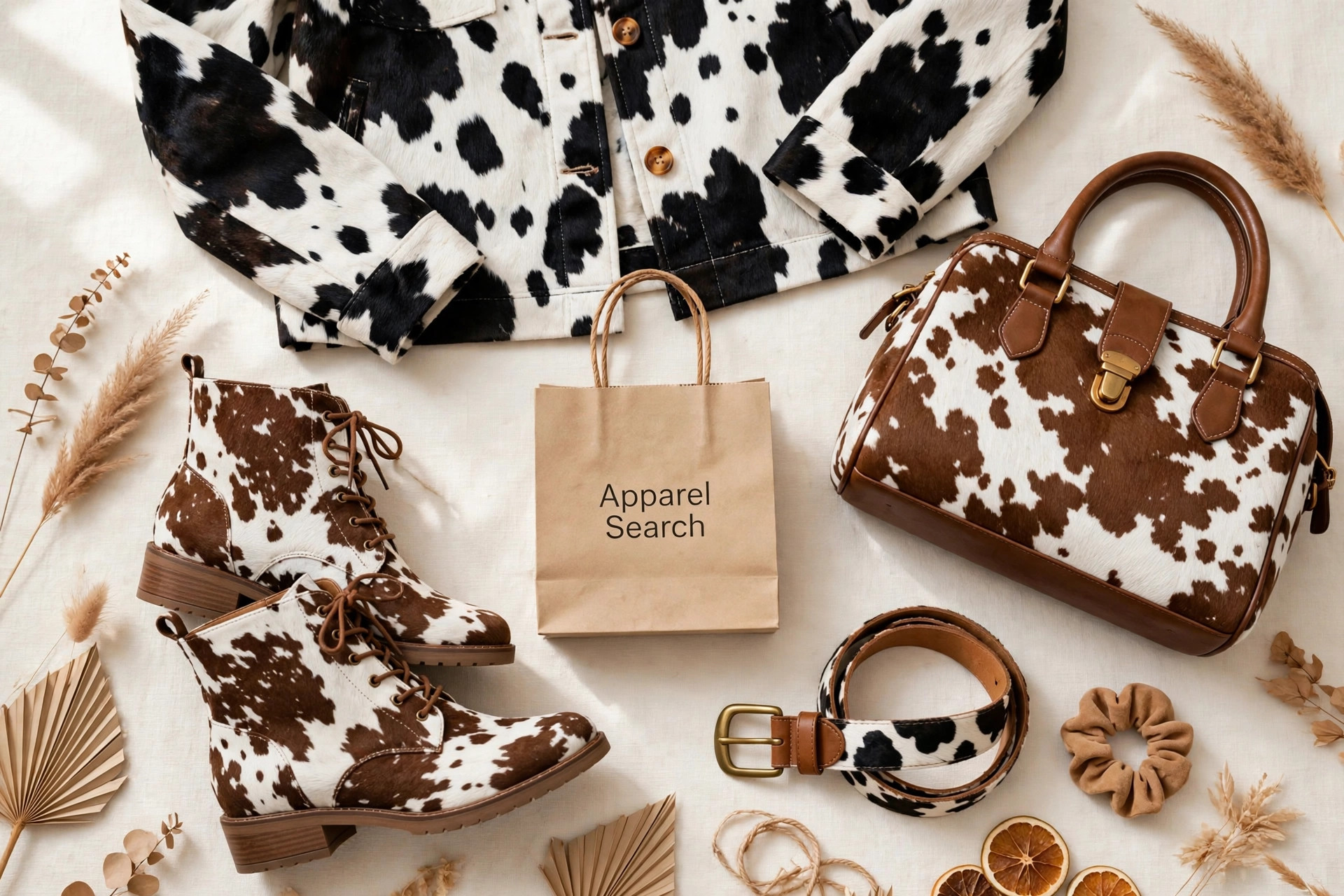
Cow print in both of its classic colorways: black on white for the jacket and belt, warm brown on white for the boots and bag.
Cow print is an animal print copied from the patched coat of Holstein-type cattle: large, irregular dark patches with sharply defined edges, scattered unevenly over a white ground — most often black on white, and often brown on white in a softer second colorway. It is the playful, graphic member of the animal print family: bolder and simpler than leopard, larger in scale than dalmatian, and carrying a distinctly western, pastoral character none of its relatives share.
Reading the Pattern: What Makes a Print a Cow Print
Three things identify cow print, and they are the same three tests our Animal Prints overview applies to the whole family: the shape of the marking, the scale of the pattern and the contrast between its colors. The markings are patches, not spots in the polka sense — broad, rounded, amoeba-like shapes with smooth but unpredictable outlines, varying from a few inches across to patches covering much of a garment panel. Britannica describes the Holstein-Friesian breed the pattern is copied from as piebald dairy cattle whose coat of black and white patches is sharply defined rather than blended, and unique to each animal, like a fingerprint. A convincing cow print keeps that quality: the patches should look placed by chance, never arranged.
Scale is the second test. Cow print is a large-scale print — one of the largest in the animal family, rivalled only by giraffe — and it needs room; on a small item the pattern is cropped, so a shoe or bag shows one or two big patches rather than the full scatter. Contrast is the third test, and it is the highest in the family alongside zebra: black on white is a maximum-contrast pairing, which is why cow print reads clearly across a room. The brown-and-white version lowers that contrast a step — the patches warm toward chestnut or chocolate, the white softens toward cream — and the whole effect turns earthier and easier to wear, sitting naturally with suede, tan leather and denim.
What cow print is not matters too. It has no rosettes, no stripes, no scales and no repeat you can set a ruler by. If the dark shapes are small and evenly sprinkled, you are looking at dalmatian; if they ring a darker center on a golden ground, leopard. Good cow print also respects the white: broad, quiet areas of ground between the patches are part of the design, and keep a large garment from looking busy.
Cowhide, Hair-on-Hide and Printed Fabric
Cow print reaches the wardrobe by three different routes, and telling them apart is the first buying skill, because they differ in price, weight, feel and care.
Real Hair-on Cowhide
A hair-on hide is an actual cattle hide tanned with its hair left in place, so the pattern is not printed at all — it is the animal's own, and no two pieces match exactly. In fashion it appears where its toughness and texture show to advantage: bags, belts, boots, jackets and statement coats. Coveteur's history of the material notes that cowhide was valued long before it was fashionable, used for its warmth and durability, and that it moved through practical, expressive and bohemian phases across the twentieth century before its current revival. Expect hair-on pieces to be heavier and stiffer than cloth, and to develop worn spots where they rub constantly — the side of a bag carried against the hip, for instance. That wear is characteristic, not a defect, but worth knowing before you buy.
Calf Hair and Pony Hair
Much of what is sold as cow print on shoes and bags is not full cowhide but calf hair — sometimes labelled pony hair, a trade name for hair-on calfskin that has nothing to do with ponies. The hair is shorter, finer and more even, the leather beneath thinner and more flexible, and the surface takes dye and print well, so calf hair is often printed with the cow pattern rather than carrying a natural one. It gives the plush, slightly glossy finish seen on loafers, ballet flats, ankle boots and structured handbags. It is still hair on leather, though, and is cared for like hair-on hide, not like fabric.
Printed Fabric and Faux Versions
The most common route is also the simplest: the pattern printed onto ordinary cloth — cotton twill and denim, jersey and fleece, satin and crepe, canvas for totes and sneakers, and faux fur and faux leather where a textured effect is wanted without any hide at all. Printed versions are lighter, cheaper, washable within the limits of their base fabric, and free of the worn-spot problem; their trade-off is flatness. A printed pattern sits on the surface, lacking the depth of real hair, and cheap print jobs can look it — hard digital edges, a repeat you can spot, a white ground that greys after washing. The better printed pieces use a large, non-obvious repeat and a ground that stays clean white or cream.
How Cow Print Differs From the Other Animal Prints
Cow print's closest relative is also its most common mix-up. Dalmatian print is likewise black spots on white, but the resemblance ends at the palette. Dalmatian copies a dog's coat: its spots are smaller, rounder, more numerous and spread with a fairly even density, so the surface feels busy and fine-grained. Cow print patches are several times larger, blobbier in outline and separated by wide stretches of untouched white, so the surface feels bold and spacious. Side by side the difference is instant — dalmatian fizzes, cow print strides. Styling follows: dalmatian rewards neat, tailored cuts that contain its energy, while cow print rewards simple, roomy shapes that give its big patches somewhere to land.
Against leopard, the contrast is one of mood as much as pattern. Leopard's rosettes — broken black rings around darker golden centers, on a tan ground — read warm, classic and a little glamorous, which is why our leopard print dress guide treats it almost as a neutral. Cow print's flat patches on white read cool, graphic and playful. Fashion historian Roberta Gorin-Paracka, quoted in i-D's account of the print's 2019 resurgence, described cow print as the irreverent choice and a visual marker of an American western aesthetic, where leopard is coded for allure. In plain terms: leopard says evening, cow print says daylight and a sense of humor — and that difference decides which one belongs in an outfit.
The rest of the family sits further away. Zebra shares cow print's black-and-white contrast but draws it in flowing stripes that wrap the body, where cow print's patches sit still. Snake print works at the opposite end of contrast, low and tonal, reading as texture rather than pattern. Tiger and giraffe share cow print's large scale but bring orange or chestnut mosaic coloring that changes every pairing rule. The hub linked at the top of this guide lays the whole family out side by side, and the explore section below points to the individual guides.
Western Roots and Fashion Revivals
Cow print's western character is not a costume added later; it is the pattern's origin. The hide itself was working material in cattle country long before it was a fashion pattern — durable, warm and available wherever cattle were raised — and the spotted hide became part of the visual language of the American West alongside denim, tooled leather, fringe and the cowboy boot. That is why cow print still reads as western even on a city ballet flat or a structured tote. Our women's westernwear guide covers the full wardrobe the print grew out of.
Fashion has revived the print in waves, usually when western style itself swings back into view. A widely noted modern resurgence arrived at the end of the 2010s: i-D, writing in 2019, traced the wave from Doja Cat's 2018 "Mooo!" video — a matching cow print outfit worn as a joke that landed as a look — through to high fashion, noting Burberry among the houses showing cow print that season, and WGSN forecasters connecting the print to a broader reclaiming of western aesthetics in music and style. The appeal in that wave was tone: joyful, tongue-in-cheek, and a deliberate break from sleeker animal prints.
The current revival is more polished. Editorialist's 2025 trend report credits an oversized patchwork cow print coat at Bottega Veneta's Fall/Winter 2024 show with kickstarting the latest cycle, followed by a cropped pony hair jacket in Dior's 2024 cruise collection and calf hair pieces on street-style regulars at the fashion weeks that followed. Coveteur, covering the same return, pointed to the Bottega Veneta patchwork cowhide coat in Milan and to cowhide jackets and a cow print dress at Brandon Maxwell's Spring/Summer 2026 show in New York. Notice what changed between the waves: the 2019 version leaned novelty — bright, jokey, head-to-toe — while the newer version treats cow print the way leopard has long been treated, as a near-neutral pattern on well-cut coats, jackets, skirts and bags. The styling sections below are written for that longer-lived approach, with the louder version kept for festivals and parties.
How to Wear Cow Print: The Statement-Piece Strategy
The rule that makes cow print work is the one-print rule that governs the whole animal family, applied with extra respect for scale: choose one cow print piece, let it lead, and build everything else from plain colors drawn from the print and its natural partners. The patches are large and the contrast high, so a single piece carries more visual weight than an equivalent piece in leopard or snake. A cow print coat over black trousers and a white shirt is a complete outfit; so is a cow print midi skirt with a plain black knit and black boots. The print is doing the talking; everything else should be fluent but quiet.
Shape matters as much as color. Because the pattern is graphic and a little playful, it looks most intentional on clean, simple silhouettes — a straight coat, a slip or shirt dress, wide-leg trousers, a boxy jacket — where the cut is calm and the print supplies the interest. Fussy details fight it: heavy ruffles, busy seams and novelty trims compete with patches already doing plenty. Fabric quality shows, too. On a fluid crepe, a firm twill or a plush calf hair, cow print looks designed; on thin, shiny, poorly printed cloth it can tip toward costume — the one direction this print must never take outside an actual costume party.
The Accessories-First Route: Bags, Shoes and Belts
If a full garment feels like too much pattern, accessories are the designed entry point — and for many wardrobes the best permanent home for this print, since a cow print accessory turns plain staples into an outfit without committing your clothes to the trend.
Cow Print Shoes
Shoes are the easiest first purchase. A cow print shoe delivers the pattern in a cropped, manageable dose and pairs with the plain trousers, skirts and denim most people already own. Calf hair loafers and ballet flats are the polished option, working with tailoring and dresses alike; cow print ankle boots carry the western reference most strongly and are superb with straight-leg denim and midi skirts; sneakers in cow print canvas or leather are the casual route, best with otherwise plain, tonal outfits so the shoes stay the point. Our animal print shoes guide covers printed shoes across the whole family — fit, materials and styling — and its calf hair care advice applies directly to cow print pairs. One practical check: on a pair, the patches will never mirror exactly, and should not, but the balance of dark to light should feel similar on both feet.
Cow Print Handbags
A cow print bag is the single most versatile piece in this print: large enough to show the pattern properly, genuinely luxurious-looking in structured calf hair, and able to animate the plain coats and knitwear that dominate a real wardrobe all winter. Brown-and-white shoulder bags and totes read warm and pair with camel, chocolate and denim; black-and-white versions are sharper, the graphic element in a monochrome outfit. Because a bag is carried against clothing, remember the hair-on caveat: constant rubbing will wear the hair on the bag's back side first, so rotate bags and avoid daily wear against abrasive coats. Shapes, sizes and print-by-print styling are covered in our animal print handbags guide.
Belts and Small Goods
The smallest doses are sometimes the smartest. A cow print belt over a plain dress, or through the loops of black trousers or jeans, gives the pattern in a single stripe that can be removed the day the mood passes; card cases and pouches do the same job inside a plain bag. These are also the safest places to buy the print cheaply, because at small scale the difference between fine calf hair and a decent printed faux leather is hardest to see — and the cost of a mistake is lowest.
Pairing Colors: Denim, Red and the Neutrals
Cow print is unusually cooperative with color, because its own palette is so simple. Start with denim, its oldest partner. Blue denim of almost any wash grounds the print's graphic contrast and leans into its western roots without costume: cow print boots with straight jeans, a cow print jacket over a denim shirt in a different wash, a cow print bag with a full denim outfit. If you enjoy denim worn top and bottom, our double denim guide explains how to separate the washes — the same separation keeps a cow print piece from blurring into the jeans beneath it.
The neutrals come next, drawn straight from the print itself. Black sharpens black-and-white cow print into something almost formal; white and cream freshen it for spring; tan, camel and brown leather warm it, and are the natural partners for the brown-and-white colorway, which can look muddy against stark black but glows against chocolate, cognac and suede. Grey is the underused option — a soft grey knit calms a cow print skirt beautifully and keeps the outfit out of western territory altogether.
Then there is the single accent. Because the print is monochrome, one clear color placed against it looks deliberate and striking, and red is the traditional choice — red shoes with a cow print dress, a red bag with cow print boots (never both at once), or red lipstick and nails with a cow print jacket. Cobalt and emerald can play the same role. The discipline is in the count: one accent, in one place. Two competing brights turn a graphic outfit noisy, and patterned partners should be left aside — with cow print leading, plain partners flatter it most.
Dos and Don'ts
Do
Let one cow print piece lead; keep the rest of the outfit plain.
Match scale to garment: big patches on coats and wide trousers, cropped patches on shoes and bags.
Pair it first with denim, black, white, cream and brown leather.
Choose clean, simple silhouettes so the print supplies the interest.
Try the print first as a bag, belt or pair of shoes if you are unsure.
Check patch placement in a mirror — avoid one large patch centered where you do not want the eye to land.
Don't
Wear two different cow print pieces together unless they are a true matching set.
Mix cow print with another animal print in the same outfit.
Add a second bright accent once one red or colored piece is in place.
Choose thin, shiny, cheaply printed fabric — it tips the print toward costume.
Stack cow print with full western costume extras — hat, fringe and boots all at once — outside fancy dress.
Expect a hair-on bag or boot to stay perfect where it rubs daily; rotate your pieces.
Care: Printed Pieces and Hair-on-Hide
Care splits cleanly by material, which is why the label matters. Printed fabric cow print is cared for as its base fabric: follow the care label, and where machine washing is allowed, wash cold, inside out, with similar colors, to protect the dark patches from fading and keep the white ground from greying. Line drying or a cool tumble setting preserves the contrast that makes the print; hot drying is its enemy. Printed faux leather and canvas need only a wipe with a damp cloth and mild soap, kept out of prolonged direct sun, which fades dark patches unevenly.
Hair-on cowhide and calf hair need a different mindset: treat them as hair on leather, never as cloth. Keep them dry; if a piece gets rained on, blot — do not rub — with a clean dry cloth and let it dry naturally at room temperature, away from radiators and hairdryers, whose heat stiffens the hide. Brush dust off with a soft brush, always in the direction the hair lies. Never soak a hair-on piece, machine wash it, or apply household cleaners unless the maker specifies them; stubborn marks belong to a specialist leather and hide cleaner. Store hair-on bags stuffed lightly, in breathable covers rather than plastic, somewhere airy and out of strong sunlight, and rest shoes between wears. Handled this way, hair-on pieces age as good leather does, keeping their pattern for years.
Common Questions
What is cow print?
Cow print is an animal print copied from the coat of Holstein-type cattle: large, irregular, sharply defined dark patches scattered over a white ground. In fashion the patches are usually black on white or brown on white. Unlike a repeating pattern, a good cow print never lines its spots up in rows, because no real hide does.
What is the difference between cow print and dalmatian print?
Scale and shape. Dalmatian spots are smaller, rounder and spread more evenly and densely across the white ground, copying a dog's coat. Cow print patches are much larger, blobbier and more widely spaced, with broad areas of plain white between them, copying a cow's hide. Cow print reads bolder and more graphic at a distance; dalmatian reads finer and busier up close.
Is cow print made from real cowhide?
Sometimes, but usually not. Cow print appears in three forms: real hair-on cowhide, which is an actual hide with its hair left on; calf hair or pony hair, a shorter-haired leather often used for shoes and bags; and printed fabric, where the pattern is printed onto cotton, denim, knit or synthetic cloth. Printed versions are the most common, the lightest and the easiest to care for. Check the label: genuine hide is sold as leather or hair-on-hide, printed cloth is not.
What colors go with cow print?
Denim is the classic partner, followed by the neutrals inside the print itself: black, white, cream, tan and brown leather. One strong accent works beautifully against the monochrome pattern, and red is the traditional choice. Brown-and-white cow print is softer than black-and-white and pairs especially well with warm neutrals, suede and gold-toned jewelry.
How do you care for hair-on-hide cow print?
Keep it dry and treat it as hair, not cloth. Brush loose dirt away in the direction the hair lies, blot spills at once with a clean dry cloth rather than rubbing, and never soak it, machine wash it or dry it with direct heat. Store it somewhere airy, out of strong sunlight, and take stubborn marks to a specialist leather cleaner. Printed fabric versions are far simpler: follow the garment care label, wash cold and inside out where the label allows, and keep dark spots out of hot dryers to protect the contrast.