01 · The Bag Itself
One Strap, Worn Across the Body
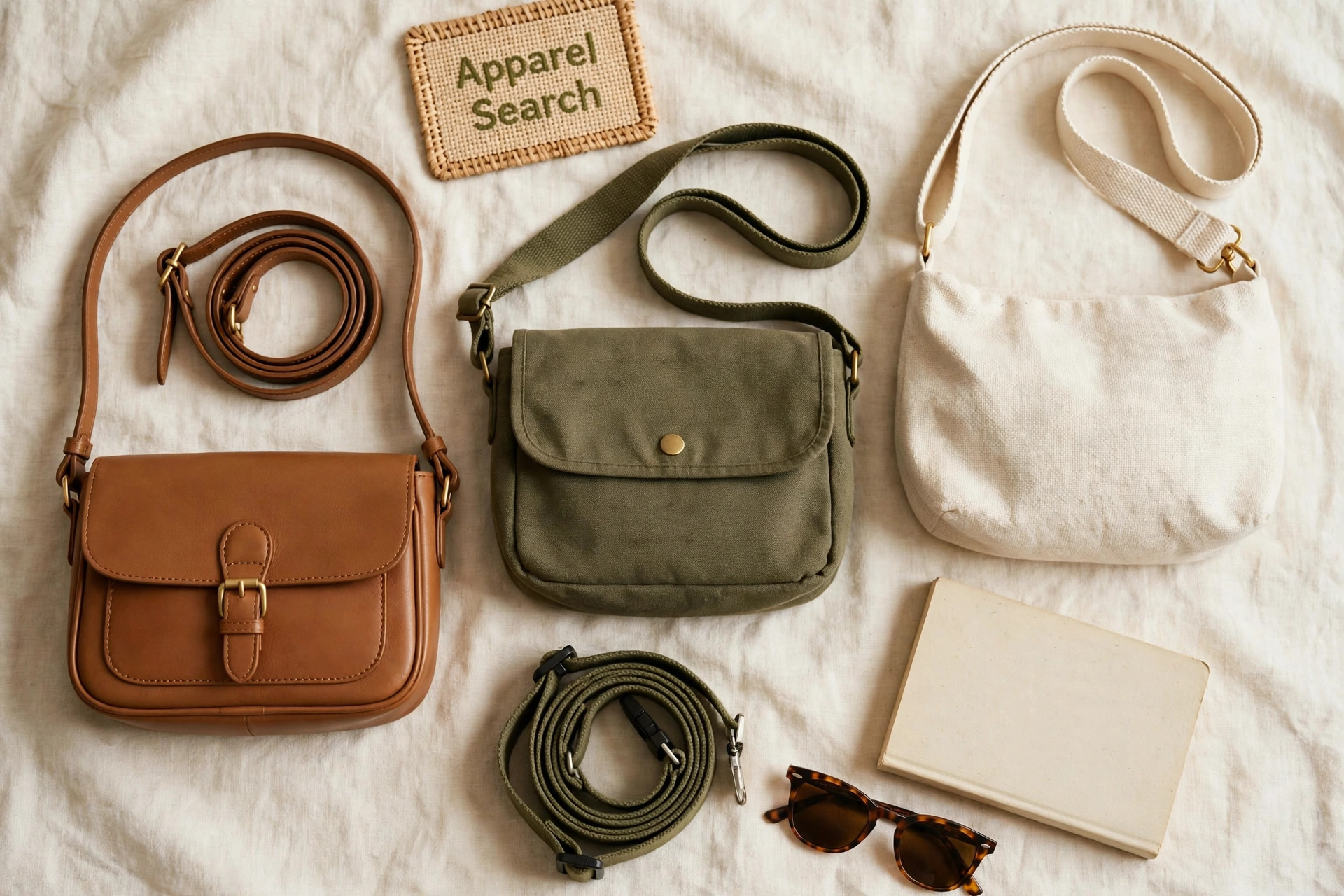
A crossbody bag hangs from a single long strap worn diagonally across the torso, so the bag rests against the opposite hip and stays put without a hand or a shoulder shrug. That geometry is why it has become the default everyday bag: it spreads its weight across the body instead of concentrating it on one shoulder.
The crossbody bag definition covers the term itself; this guide covers the choosing — size, strap drop, wearing positions, styling, travel and care. For the styles themselves, the crossbody bags listing gathers the shapes in one place.
02 · Size & Body
Choosing a Size That Suits Your Body
Start with the load, not the mirror. A phone, cardholder, keys and lip balm fit a mini of about eight inches wide; add sunglasses, a paperback and an umbrella and you need a medium of ten to twelve inches; a tablet pushes you toward a large style. Then check proportion: an oversized bag overwhelms a petite frame, while a tiny bag on a taller frame tempts you to overstuff it, straining seams and zips.
Try the bag filled, with your own things. It should sit flat against the hip, close easily, and show no bulges. A structured base helps a larger crossbody hold its line; a soft body suits smaller sizes.
03 · The Strap
Strap Drop and Adjustability
Drop — the distance from the top of the strap to the top of the bag — decides where the bag lands. Around 20 to 25 inches puts most bags at the hip. A shorter drop parks it high on the ribs, neat on petite frames; a longer one lets it swing at the thigh. Adjustability makes one bag serve all year: the strap that fits a T-shirt in July needs extra inches over a padded coat in January, so look for a slider with a genuine range and hardware that does not slip.
Width matters too: a strap of an inch or more spreads pressure, while a thin chain concentrates the load. Detachable straps add options — swap in a wider strap, or carry the bag as a clutch.
04 · Positions
Front, Side or Back: Where to Wear It
At the side, on the hip, is the everyday default: easy access, a clean line, and the bag moves with you. At the front is the practical position for crowds, markets and transport — you can see the zip, rest a hand on the bag, and reach a phone or ticket without a rummage. At the back suits cycling and long walks, where it stays clear of your arms and stride, but it is the least secure position and the hardest to reach, so keep only low-value items in a back-worn bag and swing it round whenever you stop.
Whichever position you choose, swap sides through a long day; even a well-spread load favours one shoulder.
05 · Styling
Styling With Coats and Dresses
Over a coat, lengthen the strap so the bag clears the coat’s bulk and sits at the hip rather than riding into the ribs; over a belted coat it looks best outside the belt, and a smooth leather strap slides over wool where a chain would catch. With dresses, position is the styling: worn high at the front, a small crossbody defines the waist of a loose dress almost like a belt; worn long at the side, it keeps a fitted dress’s line uninterrupted. Match formality to the outfit — structured leather for tailoring and occasion dresses, soft fabric for casual and summer dresses — and let one element echo, in shoe colour or jewellery metal.
06 · Travel & Hands-Free Days
Travel, Anti-Theft Practicality and Hands-Free Occasions
Travellers favour the crossbody because the strap cannot slip off a shoulder, the bag stays against your body where you can feel it, and both hands stay free for tickets and luggage. For anti-theft value, choose a zip closure rather than an open or magnetic top, wear it at the front in crowds with the zip pull tucked toward you, and look for a wide strap and a body-side back pocket for a passport or phone. That makes casual dipping and snatching much harder — the realistic goal.
The same hands-free logic serves markets, dog walks, festivals, sightseeing and commuting. When the load outgrows it — a laptop, a change of shoes, shopping — that is tote territory, and the women’s tote bags guide sizes that step up.
07 · Care
Caring for Leather and Fabric Versions
Leather: wipe with a soft, slightly damp cloth, condition occasionally so the hide does not dry and crack, and store it stuffed lightly in a dust bag away from sunlight. If it gets wet, let it dry naturally, never against a radiator. Fabric and canvas: sponge marks with lukewarm water and a drop of mild soap rather than soaking the bag, rinse with a damp cloth, and dry it stuffed to hold its shape; nylon simply wipes clean, which is why it dominates travel styles. For both, keep pens capped and cosmetics in a pouch, and check strap stitching and zip pulls each season — a small repair early beats a failure mid-trip. Work loads in leather are covered further in the women’s laptop bags guide.
Questions
Common Questions
What strap drop suits a crossbody bag?
Most adults are comfortable with a drop of about 20 to 25 inches, which places the bag at the hip. Shorter drops sit higher on the ribs and suit petite frames or a deliberate high carry; longer drops swing more as you walk. An adjustable strap that covers that whole range lets one bag work over both thin dresses and thick coats.
Is a crossbody bag safer for travel?
It helps, because the strap cannot slip off a shoulder and the bag stays against your body where you can feel it. Worn at the front in crowded places, with the zip closed and the opening facing you, it is much harder to dip into or snatch than a shoulder bag — but it is a deterrent, not a guarantee, so keep valuables divided and stay aware.
How do you clean a fabric crossbody bag?
Empty it, shake out the lining, and sponge the outside with lukewarm water and a drop of mild soap, working on marks rather than soaking the whole bag. Rinse with a damp cloth, stuff it lightly to hold its shape, and dry it away from heat. Check any care label first, and test coloured fabrics in a hidden spot.
More to Explore
Search Apparel Search