Aloha Shirt
Clothing Definitions — definitions of garments and clothing terms from Apparel Search
Search Apparel Search
At a Glance
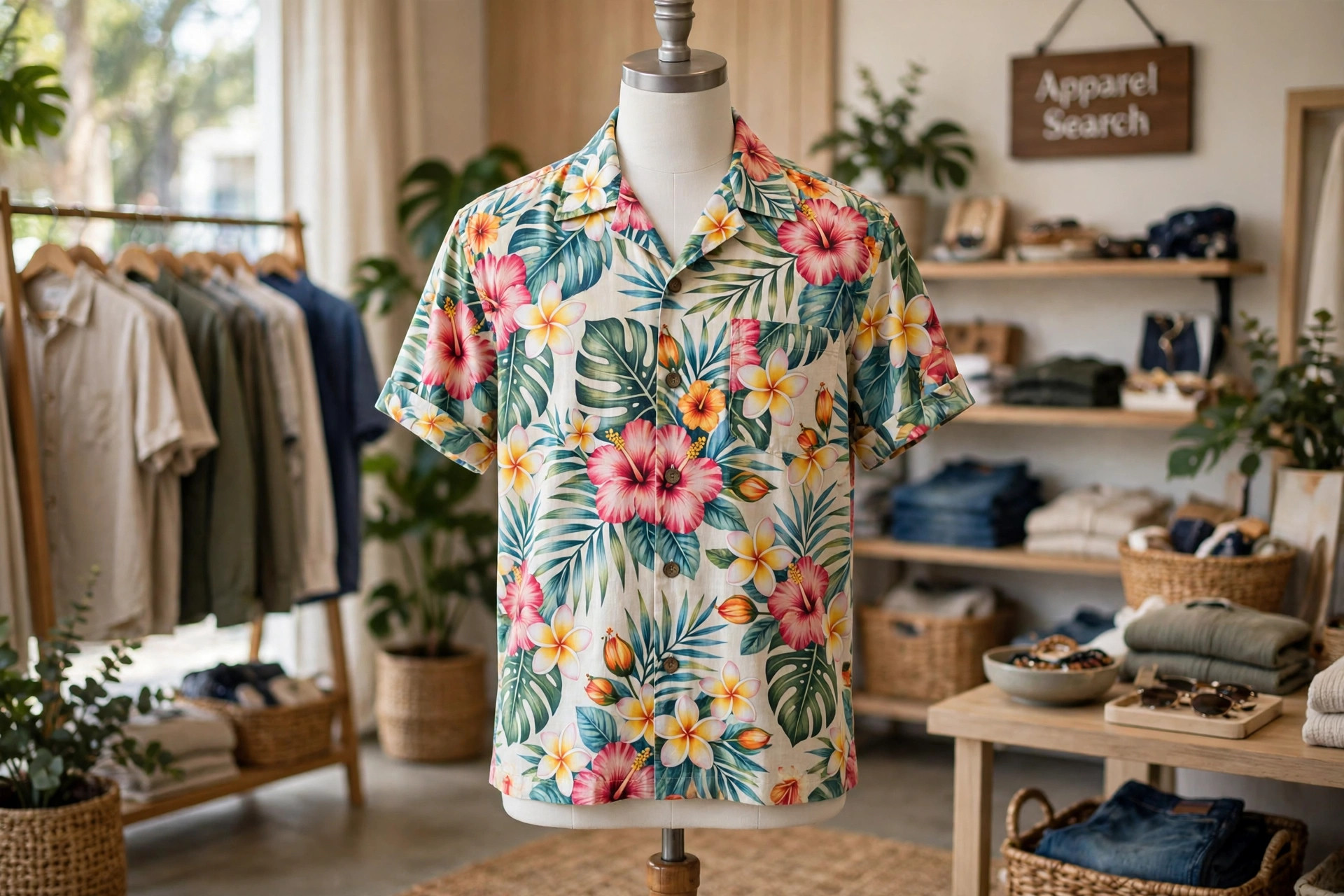
Definition: An Aloha shirt is a short-sleeved dress shirt originating in Hawai'i, printed with floral or Polynesian motifs — brightly coloured for the visitor market, and in muted local versions accepted as formal wear in Hawai'i itself.
Also known as: Widely called the Hawaiian shirt outside Hawai'i — a name Hawaiians themselves generally do not use.
Category: Clothing Definitions
Word Origin
The name pairs the Hawaiian word aloha — a greeting carrying meanings of love, peace and welcome — with the shirt it came to describe, after the Honolulu Advertiser coined the term for Ellery Chun's shirts in 1935.
Ask a visitor to Hawai'i about the Aloha shirt and they will describe holiday wear: short sleeves, bright flowers, a shirt that means vacation. Ask a resident and you may get a different answer, because in Hawai'i the muted version of the same shirt is formal wear, acceptable in business and government. Both are the same garment — a printed, usually short-sleeved dress shirt that became the premier textile export of the Hawai'i manufacturing industry — living a double life on the islands and everywhere else.
Missionary-Era Beginnings
The shirt's roots reach back to the early years of the Kingdom of Hawai'i, when Congregational and Presbyterian missionaries arrived from New England and imposed strict dress codes on Native Hawaiians. Many people were put into quick-sewn shirts made from whatever fabrics the missionary seamstresses had at hand. That imposed shirt — a Western garment form produced locally from available cloth — is the ancestor the Aloha shirt grew from, once local makers and merchants began choosing the cloth and the patterns for themselves.
Ellery Chun and the Commercial Aloha Shirt
The modern Aloha shirt was first made commercially in the early 1930s by Ellery Chun, a Chinese merchant at King-Smith Clothiers and Dry Goods in Waikiki. Chun began sewing brightly coloured shirts for tourists out of leftover kimono fabrics he had in stock. The Honolulu Advertiser quickly coined the term Aloha shirt for the creation, Chun trademarked the name, and the first advertisement for his shirts ran in the paper on June 28, 1935.
Local residents — surfers especially — and tourists bought out Chun's stock, and within a few years designer labels had sprung up across Hawai'i manufacturing Aloha shirts in quantity. The shirt's fame on the mainland boomed after the Second World War, helped by famous wearers: President Harry Truman wore Aloha shirts regularly in the White House and in retirement, and John Wayne, Duke Kahanamoku, Bing Crosby, Arthur Godfrey and Johnny Weissmuller all endorsed labels or entertained in the shirts. Our Hawaiian shirts product guide follows the style into today's market.
Two Shirts in One: Export Bright, Local Muted
The split in the market is the Aloha shirt's most distinctive feature. Shirts exported to the mainland United States and elsewhere are typically brilliant in colour, covered in floral patterns or generic Polynesian motifs, and worn as casual, informal dress. Shirts made for local residents run the other way: dull in tone, sometimes uniformly coloured or carefully colour-coordinated, decorated with traditional Hawaiian quilt designs or simple plant patterns in muted, non-flashy colours — and those local shirts are considered formal wear in business and government settings.
The corresponding Hawaiian garment for women, the muumuu, follows the same pattern: brilliantly coloured floral versions for export and casual wear, and more respectful, muted quilt-pattern versions for local wear. Read together, the two garments show a clothing culture maintaining its own standards of formality inside a style the outside world treats as pure leisure — a distinction worth knowing before judging an Aloha shirt's appropriateness by mainland rules. For a close tropical relative, compare the guayabera shirt.
Wearing the shirt well is mostly a matter of respecting which version you have. The bright export style is leisure dress and pairs with shorts and sandals; the muted local style is worn as a shirt is worn anywhere — with trousers, neat and buttoned — and in Hawai'i it will not look out of place in an office or a government building. Confusing the two registers is the visitor's classic mistake.
Anatomy of the Shirt
The classic Aloha shirt has a settled anatomy. It is cut loose and straight through the body, worn untucked, with short sleeves and a soft camp collar that lies open at the neck — a pattern suited to a warm climate and an unhurried register of dress. A single chest pocket is standard, and on better-made shirts the print is matched across the pocket and the front opening, so the pattern runs unbroken over the whole garment; that matching is the quickest quality test a buyer can make.
Prints are the shirt's glory and its archive: hibiscus and other island flowers, palm and beach scenes, ocean life, and the traditional quilt and plant designs of the local market, printed on rayon, silk or cotton. Buttons on traditional shirts are made from coconut shell, bamboo or mother-of-pearl rather than plastic. Together these details separate the genuine article — designed and made in Hawai'i, the state's premier textile export — from the generic holiday shirt that borrows its colours without its construction.
Common Questions
What is an Aloha shirt?
An Aloha shirt is a short-sleeved dress shirt originating in Hawai'i, printed with floral or Polynesian motifs. Brightly coloured versions are worn as casual wear worldwide, while muted local versions count as formal wear in Hawai'i itself.
Who created the modern Aloha shirt?
The modern Aloha shirt was first manufactured commercially in the early 1930s by Ellery Chun of King-Smith Clothiers and Dry Goods in Waikiki, who sewed brightly coloured shirts for tourists from leftover kimono fabrics and trademarked the name.
When was the Aloha shirt first advertised?
The first advertisement for Chun's Aloha shirt appeared in the Honolulu Advertiser on June 28, 1935. The newspaper had coined the term Aloha shirt to describe his creation.