Organza
Fabric Definitions — fabric and textile definitions from Apparel Search
Search Apparel Search
At a Glance
Definition: Organza is a sheer, lightweight plain-weave fabric with a stiff, crisp hand and a subtle shimmer, traditionally woven from silk filament yarns twisted tightly before weaving.
Category: Fabric Definitions
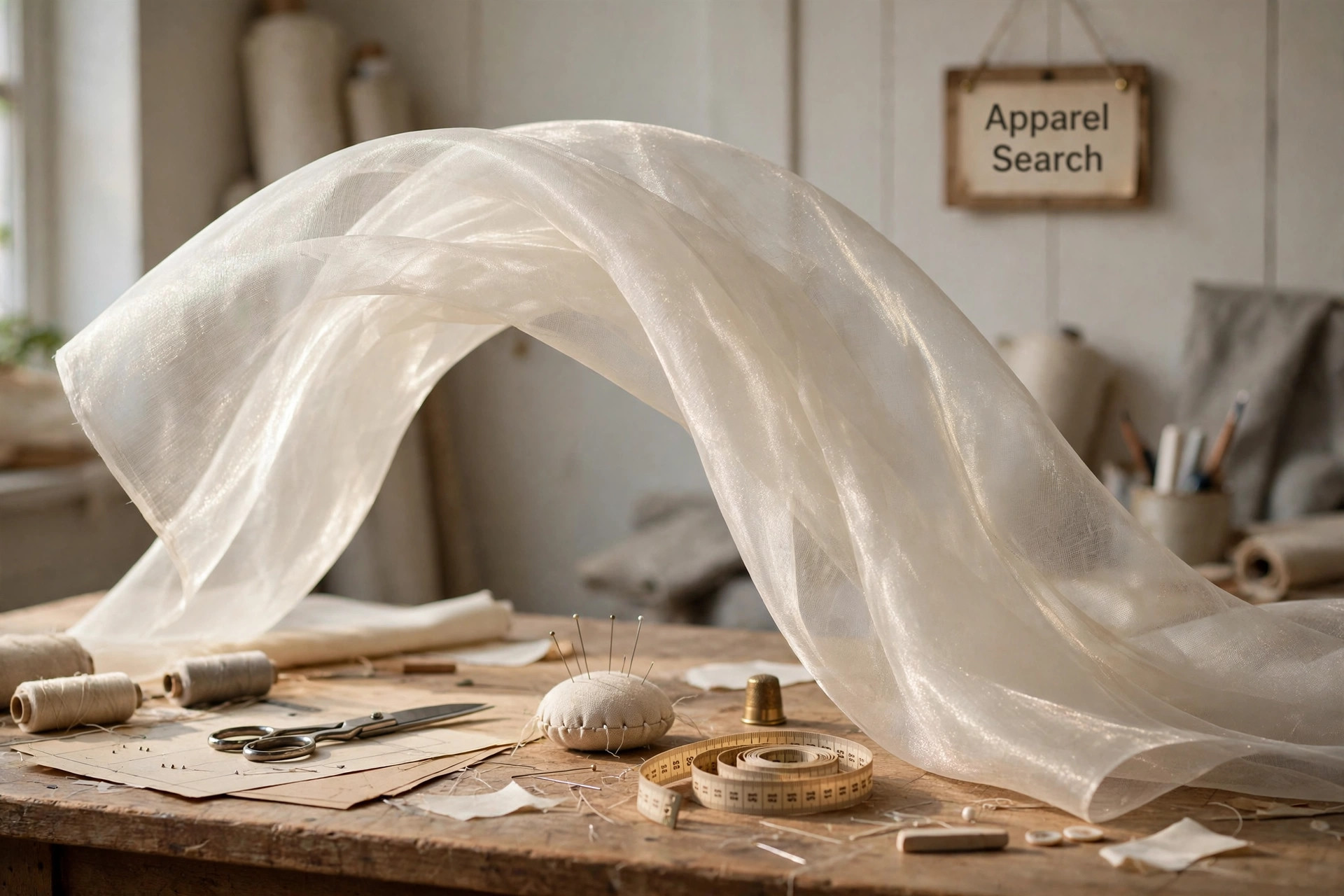
Organza is a sheer, lightweight plain-weave fabric with a stiff, crisp hand and a subtle shimmer, traditionally woven from silk filament yarns twisted tightly before weaving. The tight twist and the fine yarns leave tiny spaces between the threads, which is why organza is transparent yet holds its shape — it stands away from the body where chiffon would collapse.
Construction and Properties
Organza is woven in a plain weave — each weft thread passing alternately over and under each warp thread — from continuous filament yarns given a hard twist. Silk organza, still the standard for bridal work, has a smooth surface and a warm lustre. Polyester and nylon organzas imitate the stiffness at lower cost and are common in decorations, gift bags and costume work, though they melt rather than scorch under a hot iron and feel harsher against the skin.
All organzas share the family's working properties: they crease visibly, fray readily at cut edges, hold pressed folds, and support volume — a single layer of organza can hold a sleeve or skirt out in a sculpted shape with no lining beneath it.
Care follows the fibre. Silk organza is best dry-cleaned or hand-washed cold with great care: it water-spots easily and its creases set hard. Polyester organza tolerates gentle machine washing but must be ironed cool, since its fibres melt at temperatures silk merely tolerates. In both cases, roll rather than fold for storage where possible, so the crisp folds the fabric holds so well do not become permanent creases in the wrong places.
Where Organza Is Used
Bridal and evening dress is organza's home ground: veils, overlays on wedding gowns, puffed sleeves, full skirts and the structured bows and sashes that need to keep a shape all day. Because it is sheer but self-supporting, designers layer it over satin or crepe to add depth and a floating surface to a dress. Beyond clothing, the same stiffness serves in millinery, table overlays, floral wrapping and gift bags. For wearing sheer fabrics well — layering, coverage and styling — see the Sheer Clothing Guide.
In the sewing room organza has a second, hidden career: silk organza is the classic press cloth, and strips of it are used as a lightweight interfacing — the technique dressmakers call an organza underlining — that supports delicate fabrics without changing their drape.
Organza, Chiffon and Tulle
The three sheer fabrics are often confused. Organza is crisp and holds shape; chiffon — represented on this site by the chiffon fabric directory — is soft, matte and drapes in folds; tulle is not a weave at all but a fine hexagonal net. Choosing between them is choosing behaviour: structure from organza, flow from chiffon, and airy volume from tulle.
Organza belongs to a family of light dress fabrics woven on the same plain-weave principle, among them voile, challis, batiste, crepe and georgette — softer, drapier cloths against which organza's crisp self-support stands out.
Common Questions
Is organza the same as tulle?
No. Organza is a woven fabric — warp and weft threads in a plain weave — while tulle is a net, made by twisting threads into a hexagonal mesh. Organza has a smooth, continuous surface with a slight shimmer; tulle is visibly a net. Both are sheer and stiff, which is why they are used in similar bridal roles.
Can organza be washed?
Silk organza is best dry-cleaned or hand-washed cold with great care: it water-spots easily and creases set hard. Polyester organza tolerates gentle machine washing but must be ironed cool, since the fibres melt at temperatures silk merely tolerates. In both cases, roll rather than fold for storage where possible.
Why is organza used as a press cloth?
Silk organza is transparent, heat-resistant and smooth, so an iron can be applied through it while the fabric underneath stays visible — protecting delicate cloth from shine and scorching while still letting the sewer see seams and markings. It is the standard press cloth in couture workrooms.