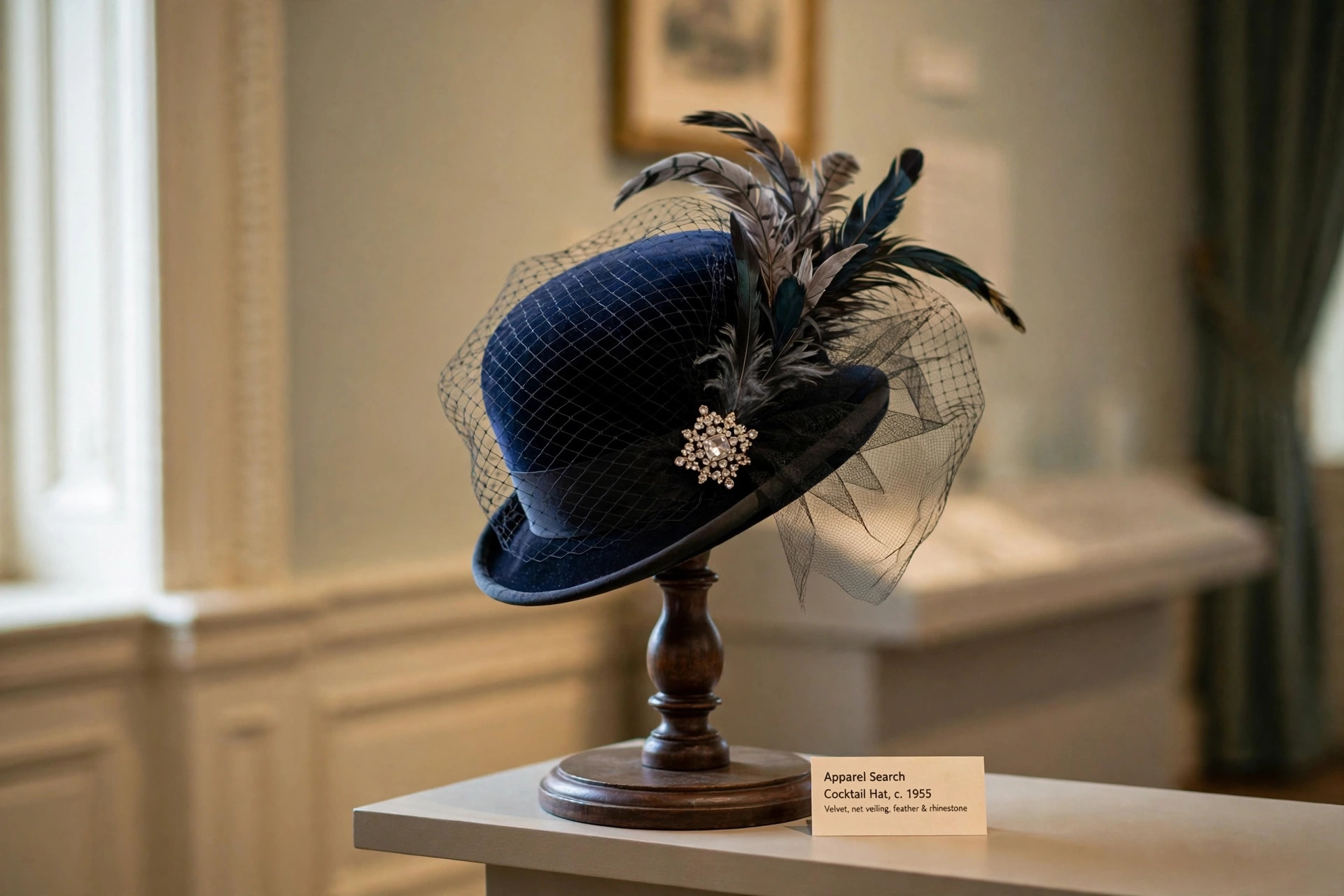
The cocktail hat was a small, decorative hat made not for warmth or shade but purely for ornament. Perched forward on the head — which is why such hats are also called perchers — it finished an afternoon or evening outfit, framing the face with veiling, feathers, flowers, or jewels while leaving an elaborate hairstyle fully on show.
Its origins lie in the small tilted hats of the 1930s, but its true era was the age of the cocktail party, reaching a peak in 1950s fashion, when a hat was still considered essential to a polished appearance after five o'clock.
The Cocktail Hour
Between the wars, new occasions needed new dress codes. Cocktail parties, theatre evenings, and smart restaurant dinners fell between day and full evening dress, and the cocktail hat solved the problem: more dressed than a day hat, lighter than a tiara or evening coiffure ornament, and small enough to wear indoors without apology.
In the 1950s, etiquette demanded a hat or head covering for many public and religious occasions, and the cocktail hat met the rule with wit. A crescent of felt, a swirl of velvet, or a tiny pillbox base could carry a spotted veil, a bird's wing feather, or a cluster of rhinestones.
Construction of a Percher
A cocktail hat began with a small foundation — buckram, felt, or sinamay — shaped as a disc, crescent, or shallow cap. Onto that base the milliner wired and stitched the decoration: veiling gathered to fall just to the eyes, feather pads, silk flowers, bows, or beading. Nothing was left to chance; each element was placed to be seen from the wearer's best angle.
Attachment was engineering in miniature. Elastic worn under the hair, small combs, or a headband held the hat at its jaunty tilt through an evening of conversation, dancing, and raised glasses. Many surviving examples weigh only a few ounces.
Decline and Return
When everyday hat-wearing collapsed in the 1960s, the cocktail hat lost its occasion. Yet it never vanished from weddings, race meetings, and formal parties, where its modern descendants — fascinators and headpieces — follow exactly the same recipe of a small base and maximal decoration.
Vintage cocktail hats are now collected as miniature sculptures of their era: a few inches of velvet and veiling that capture 1950s glamour more completely than many full gowns.
Common Questions
- What is a cocktail hat?
- A cocktail hat is a small, purely decorative women's hat of the cocktail era, perched at an angle on the head and trimmed with veiling, feathers, flowers, or jewels.
- Why were cocktail hats so small?
- They were ornaments, not protection, and were worn indoors at parties. Their small size finished an outfit and satisfied hat etiquette while leaving the hairstyle visible.
- Is a cocktail hat the same as a fascinator?
- They are close relatives. The modern fascinator descends directly from the cocktail hat and percher, using the same small base with feathers, veiling, or flowers.
Historic Garments & Accessories
- Fashion History Guide
- Pelisse
- Polonaise
- Robe à la Française
- Robe à l'Anglaise
- Robe en Chemise (Chemise à la Reine)
- Justacorps
- Inverness Cape
- Kirtle
- Bliaut
- Houppelande
- Poulaine
- Pomander
- Caraco
- Banyan
- Pagoda Sleeve
- Paned Sleeve
- Kokoshnik
- Hennin
- Bergère Hat
- Capeline
- Cartwheel Hat
- Cocktail Hat
- Gainsborough Hat
- Halo Hat
- Shako