Pierre Cardin
Fashion Definitions — fashion history, brands and industry terms from Apparel Search
Pierre Cardin was born in 1922 near Venice, Italy, to French parents, and moved to Paris in 1945, where he studied architecture and worked with Paquin and Schiaparelli before becoming head of Christian Dior's tailoring atelier in 1947. He founded his own house in 1950, began haute couture in 1953, and became known for an avant-garde style and space age designs built on geometric shapes and motifs. He introduced the bubble dress in 1954, was the first couturier to treat Japan as a high fashion market in 1959, and that same year was briefly expelled from the Chambre Syndicale for launching a ready-to-wear collection for the Printemps department store.
Cardin was known for his avant-garde style and his space age designs. He prefers geometric shapes and motifs, often ignoring the female form. He advanced into unisex fashions, sometimes experimental, and not always practical. He introduced the "bubble dress" in 1954.
Cardin was the first couturier to turn to Japan as a high fashion market when he travelled there in 1959.
In 1959, he was expelled from the Chambre Syndicale for launching a ready-to-wear collection for the Printemps department store as the first couturier in Paris, but was soon reinstated. However, he resigned from the Chambre Syndicale in 1966 and now shows his collections in his own venue, the Espace Cardin (opened 1971) in Paris, formerly the Théâtre des Ambassadeurs, near the American Embassy. The Espace Cardin is also used to promote new artistic talents, like theater ensembles, musicians, etc.His fellow designer, Andre Oliver, who joined him in 1971 and assumed responsibility for the haute couture collections in 1987, died in 1993.
Cardin was a member of the Chambre Syndicale de la Haute Couture et du Pret-a-Porter and of the Maison du Haute Couture from 1953 to 1993. Like many other designers today, Cardin decided in 1994 to show his collection only to a small circle of selected clients and journalists.
He purchased Maxim's restaurants in 1981 and soon opened branches in New York, London, and Beijing (1983). A chain of Maxim's Hotels are now included in the assets. Cardin has also licenced a wide range of food products under that name.
Cardin owns the ruins of the castle in Lacoste, Vaucluse that was formerly inhabited by the Marquis de Sade. He has partially renovated the site and regularly organizes theatre festivals there.
Learn more about Pierre Cardin.
| The above article is licensed under the GNU Free Documentation License. From Wikipedia, https://en.wikipedia.org/wiki/pierre_cardin the free encyclopedia 2/1/06 |
|
|
|||
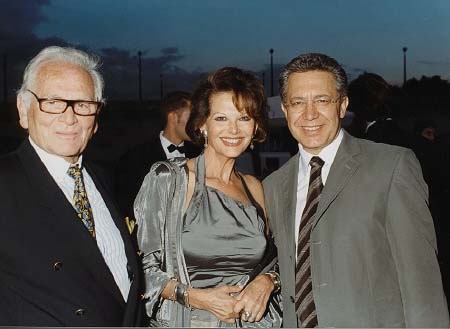 Picture of: Mr Pierre Cardin, Mrs Claudia Cardinale and, UNESCO Goodwill Ambassadors - Fair Use
|
Architecture First, Then the Ateliers of Paris
Cardin's formation began outside fashion. Born near Venice to French parents, he moved to Paris in 1945 and studied architecture — the discipline of geometry, structure and planned space. That training is visible in everything he later became known for: geometric shapes and motifs are an architect's vocabulary applied to cloth. His apprenticeship then ran through the post-war Paris houses in quick succession. He worked with Paquin after the war, then with Schiaparelli, and in 1947 became head of Christian Dior's tailoring atelier, the workshop responsible for structured garments. He was denied work at Balenciaga, a rejection worth noting because it closed the most traditional door in Paris couture and left him to build his own. He founded his house in 1950 and began haute couture in 1953, so by his early thirties he had an architect's eye, a tailor's training and his own couture salon.
Space Age Shapes and the Bubble Dress
The style he built on that foundation was deliberately futuristic. Cardin was known for an avant-garde style and space age designs, preferring geometric shapes and motifs and often ignoring the female form. Ignoring the form is the radical element. Most dress design starts from the body's curves and either follows or reshapes them; a geometric design starts from a shape — a circle, a cone, a trapezoid — and lets the body live inside it. The bubble dress of 1954 is the early, famous result: a skirt that balloons out and is gathered back in at the hem, making a rounded volume that owes nothing to the waist or hips beneath it. He also advanced into unisex fashions, sometimes experimental and not always practical. That qualification matters. Experimental clothing tests an idea at the cost of wearability, and Cardin accepted the trade openly, treating some collections as research into how people might dress rather than as garments for the present season.
The Couturier Who Broke the Rules of Selling
Cardin's second revolution was commercial. In 1959 he became the first couturier to turn to Japan as a high fashion market, travelling there when Paris houses still looked mainly to America and Europe for clients. The same year he was expelled from the Chambre Syndicale, the Paris couture governing body, for launching a ready-to-wear collection for the Printemps department store — the first couturier in Paris to put his name on ready-made clothes sold in a store. The expulsion states the old rule plainly: couture was bespoke, exclusive and salon-sold, and ready-to-wear was considered a betrayal of it. He was soon reinstated, but resigned in 1966 and thereafter showed in his own venue, the Espace Cardin, opened in 1971 in the former Theatre des Ambassadeurs. Owning the venue completed his independence: he controlled the clothes, the price level at which they were sold and the room in which they were seen.
The later record shows how far that independence extended. He was a member of the Chambre Syndicale de la Haute Couture from 1953 to 1993, yet from 1994 he showed his collection only to a small circle of selected clients and journalists — exclusivity chosen by himself rather than imposed by a governing body. His fellow designer Andre Oliver, who joined him in 1971 and took responsibility for the haute couture collections in 1987, died in 1993. Beyond fashion he bought Maxim's restaurants in 1981 and opened branches in New York, London and Beijing, added Maxim's hotels, licensed food products under the name, and owned the ruined castle at Lacoste once inhabited by the Marquis de Sade, where he held theatre festivals. Whether in restaurants, hotels or a castle, the pattern is the same one he established in 1959: a designer's name treated as something that can be placed on products and places far beyond the couture salon that created it.
Common Questions
What design is Pierre Cardin most associated with introducing?
Cardin introduced the bubble dress in 1954. More broadly he was known for avant-garde, space age designs that preferred geometric shapes and motifs and often ignored the female form.
Why was Cardin expelled from the Chambre Syndicale in 1959?
He was expelled for launching a ready-to-wear collection for the Printemps department store, the first Paris couturier to sell ready-to-wear through a department store. He was soon reinstated, then resigned from the Chambre Syndicale in 1966.
What was the Espace Cardin?
The Espace Cardin, opened in 1971 in Paris in the former Theatre des Ambassadeurs near the American Embassy, was Cardin's own venue for showing his collections, also used to promote new artistic talent such as theatre ensembles and musicians.
More to Explore
- fashion designer
- Schiaparelli
- Christian Dior
- Balenciaga
- haute couture
- avant-garde
- Chambre Syndicale
- ready-to-wear
- couturier
- Pierre Cardin Collections
- Pierre Cardin Fall Fashions
- Pierre Cardin Fashion Week
- Pierre Cardin News
- Pierre Cardin Profiles
- Pierre Cardin Runway
- Pierre Cardin Spring Fashions
- about Pierre Cardin
- GNU Free Documentation License
- https://en.wikipedia.org/wiki/pierre_cardin
- Fashion Designer By Country
- American Fashion Designers
- British Fashion Designers
- Italian Fashion Designers
- Japanese Fashion Designers
- Belgian Fashion Designers
- Indian Fashion Designers
- French Fashion Designers
- Claudia Cardinale
- Fashion Definition
- Fashion Design
- LA Fashion
- NY Fashion