Tuque
Hat & Headwear Definitions — hats, caps, helmets and headwear terms from Apparel Search
A tuque is a knitted hat, originally usually of wool though now often of synthetic fibres, designed to provide warmth in winter. Sometimes considered Canada's national hat, all tuques are tapered and brimless, and they are often topped with pompoms. A tuque is a warm winter cap, entirely different from the chef's toque, despite the similar spelling.
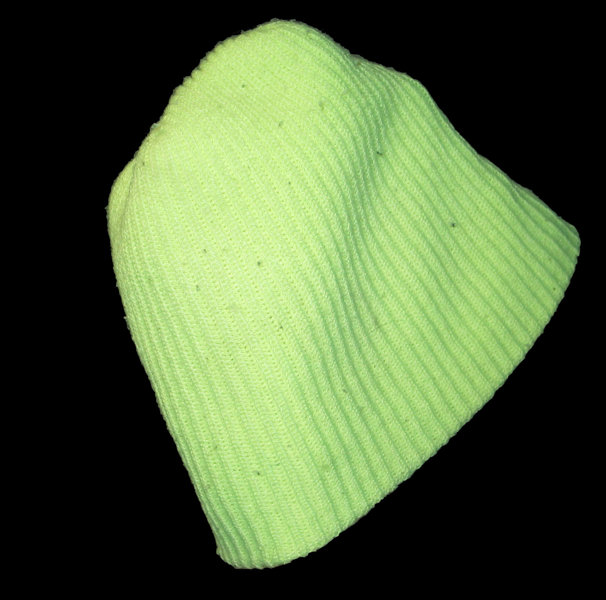 A tuque (Canadian French: tuque) is a knitted hat, originally usually of wool though now often of synthetic fibers, that is designed to provide warmth in winter. Sometimes considered Canada's national hat, all tuques are tapered and brimless, and they are often topped with pompoms.
The word tuque is not etymologically related to the name of the chef's toque, although tuque is sometimes spelled "toque" (though still pronounced /tuk/) by assimilation. The word is also sometimes spelled "touque"; while this is technically a misspelling, it's a quite common (http://www.google.ca/search?client=firefox-a&rls=org.mozilla%3Aen-US%3Aofficial_s&hl=en&q=touque&meta=&btnG=Google+Search) one.
During the 1837 Patriotes Rebellion a red tuque became a symbol of French-Canadian nationalism, a symbol that was briefly revived by the Front de liberation du Quebec in the 1970s.
Today some consider tuques to be somewhat lacking in sophistication, though they are indispensable in cold climates. The most famous media characters to sport this kind of hat are the SCTV characters, Bob and Doug McKenzie. Michael Nesmith of the Monkees also wore this hat in his television series.
In the United States, this type of hat is usually referred to as a knit hat or knit cap or sock cap, and sometimes as a ski hat. In the U.S. southern states, it is sometimes called a toboggan.
There is also a town known as La Tuque, Quebec, named after a nearby hill that resembles a tuque.
A beanie is a similar type of hat.
| The above article is licensed under the GNU Free Documentation License. From Wikipedia, the free encyclopedia https://en.wikipedia.org/wiki/tuque 6/11/05 |
A Knitted Hat Built for Winter Warmth
The tuque exists for one purpose, stated plainly in its definition: it is designed to provide warmth in winter. Everything about its form serves that purpose. It is a knitted hat, so the fabric is made in a continuous, stretchable structure that fits closely over the head and ears without stiff shaping. All tuques are tapered and brimless: tapered, narrowing toward the top so there is no loose excess of material above the head, and brimless, because a brim sheds no warmth and a winter hat has no use for one. They are often topped with pompoms, a finishing flourish at the very top of the taper that has become part of the hat's familiar look, cheerful rather than functional, and one of the easiest ways to recognise the style at a distance in a Canadian winter scene.
Material follows purpose. A tuque was originally usually of wool, the natural fibre long relied on for warm knitted clothing, though tuques are now often of synthetic fibres. That change from wool to synthetics is a change of yarn, not of type: a knitted, tapered, brimless winter hat is a tuque in either material. Sometimes considered Canada's national hat, the tuque holds that place because cold is a defining condition of Canadian life and this is the hat shaped entirely by cold. Today some consider tuques to be somewhat lacking in sophistication, though they are indispensable in cold climates, a judgement that captures the hat exactly: it is valued for necessity, not elegance, and in real winter weather necessity wins.
Names, Spellings and a Symbol
The tuque's naming needs care, because it collides with the chef's hat. The word tuque is not etymologically related to the name of the chef's toque, although tuque is sometimes spelled toque, though still pronounced tuk, by assimilation. The word is also sometimes spelled touque; while this is technically a misspelling, it is a quite common one. In the United States, this type of hat is usually referred to as a knit hat or knit cap or sock cap, and sometimes as a ski hat, and in the U.S. southern states it is sometimes called a toboggan. A beanie is a similar type of hat. A reader moving between Canadian and American sources should therefore expect several names for substantially the same warm knitted cap, with tuque the Canadian French name at the centre of them.
The tuque has also carried meaning beyond warmth. During the 1837 Patriotes Rebellion a red tuque became a symbol of French-Canadian nationalism, a symbol briefly revived by the Front de liberation du Quebec in the 1970s. A simple knitted cap could serve as a symbol precisely because it was ordinary, local and worn by everyone in winter; in red, it became a visible statement. The hat appears in Canadian popular culture in the same everyday spirit, since the most famous media characters to sport this kind of hat are the SCTV characters Bob and Doug McKenzie, and Michael Nesmith of the Monkees also wore this hat in his television series. There is also a town known as La Tuque, Quebec, named after a nearby hill that resembles a tuque, which shows how completely the hat's tapered silhouette is part of the Canadian landscape, familiar enough to name a place by its outline.
Common Questions
What shape is a tuque?
All tuques are tapered and brimless, and they are often topped with pompoms. The knitted, close-fitting shape is designed to provide warmth in winter.
What are tuques made of?
A tuque is a knitted hat originally usually made of wool, though now often of synthetic fibres. The knitting and the close fit are what hold warmth around the head.
Is a tuque the same as a toque?
No. The word tuque is not etymologically related to the name of the chef's toque, although tuque is sometimes spelled toque, still pronounced tuk, by assimilation. A tuque is a Canadian knitted winter hat; a toque is a European hat and a chef's hat.