Fringe
Miscellaneous Definitions — the ornamental border of loose threads or strips, from warp ends to sewn-on trim, from Apparel Search
Search Apparel Search
At a Glance
Definition: A fringe is an ornamental appendage to the border of an item, originally consisting of the ends of the warp projecting beyond the woven fabric, and more commonly made separately and sewed on, of twisted or plaited ends, loose threads of wool, silk or linen, or narrow strips of leather.
Category: Miscellaneous Definitions
A fringe is an ornamental appendage to the border of an item. It originally consisted of the ends of the warp, projecting beyond the woven fabric. More commonly it is made separately and sewed on, consisting sometimes of projecting ends twisted or plaited together, and sometimes of loose threads of wool, silk or linen, or narrow strips of leather. This page covers fringe's two forms — the warp ends a weaver dresses up, and the manufactured trim sewn to any border — what fringe does to a garment, and the word's other lives outside textiles. Ready to wear it rather than define it? See How to Wear Fringe.
From Warp Ends to a Sewn-On Border
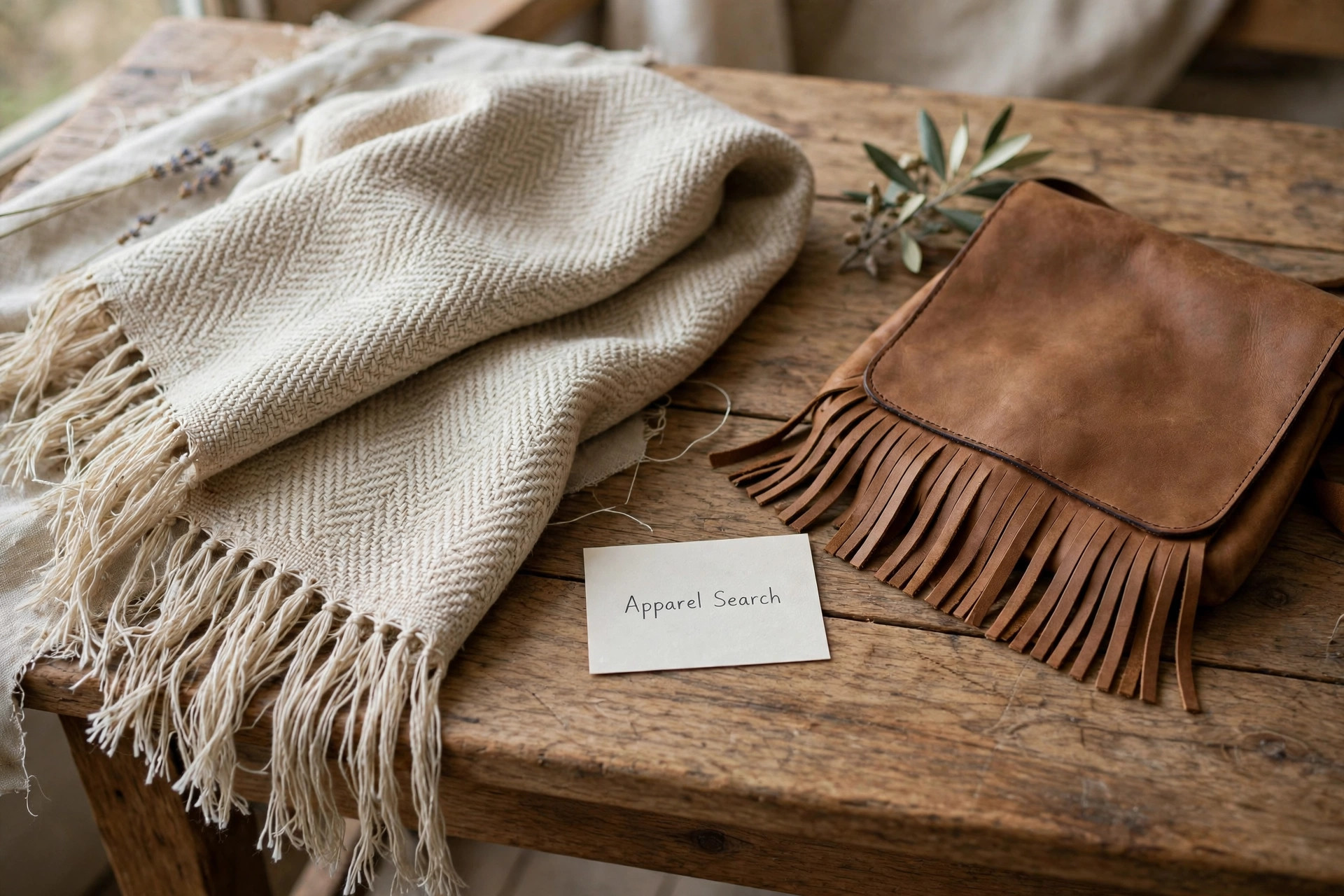
Fringe began as a by-product that weavers turned into a finish. When a length of cloth is woven on a loom, the warp threads run the full length of the piece and extend beyond the last weft row at each end. A fringe originally consisted of exactly those ends of the warp, projecting beyond the woven fabric: left plain, they would tangle and fray untidily, but knotted, twisted or left in an ordered row, they finished the cloth's edge, stopped the weft from slipping off the warp ends, and gave the piece a soft, moving border. That origin explains why fringe belongs naturally to woven goods such as shawls, blankets, rugs and scarves: on those items the fringe is not added decoration but the cloth's own threads, continued past the weaving and dressed up. The practical and the ornamental are the same threads.
More commonly, in modern manufacture and dressmaking, fringe is made separately and sewed on. A manufactured fringe is a heading strip with the loose elements hanging from it, ready to be stitched along any border. It consists sometimes of projecting ends twisted or plaited together — bundles of thread worked into cords that hold their shape and resist tangling — and sometimes of loose threads of wool, silk or linen, which hang freely and move with every motion, or narrow strips of leather, or the like. The leather version is the signature of buckskin garments: a buckskin jacket or bag fringed in its own material has its edges cut into long narrow strips that swing as the wearer moves, a form associated with frontier and western dress. Sewn-on fringe lets any garment borrow the effect, since the border no longer needs to be a woven warp edge at all — it sits in the same family of garment finishings as buttons and zippers, the applied details that complete a piece.
What Fringe Does to a Garment
As an ornamental appendage to the border of an item, fringe works by movement and outline. It softens a hard edge into a trembling line, lengthens a hem or a sleeve visually without adding opaque cloth, and draws attention to the border it hangs from, which is why it is placed at the edges a designer most wants noticed: the hem of a shawl, the yoke and sleeves of a western shirt, the bottom of a bag, the edge of a scarf. Fringe also changes with the wearer's motion more than almost any other trim, because each thread or strip swings on its own, so a fringed garment is animated even when its cloth is plain. Its costs are practical: fringe tangles and catches, and needs combing out and trimming to stay even, so it belongs chiefly to dress, ceremony, dance and leisure clothing rather than to workwear. The styling side of the trim — how much fringe to wear at once, and where — is covered in How to Wear Fringe.
The Word's Other Lives
The original page also collected the word's meanings outside fashion, and they are worth separating so the clothing sense stays clear. A fringe is the front part of the hair that hangs down above the eyes — in American English this is usually called "bangs". The Fringe is a term used to refer to non-mainstream theatre, where experimental forms of stagecraft are performed; the Edinburgh Festival is an arts festival held in Edinburgh, Scotland that has a large fringe theatre component. Fringe science is a phrase used to describe scientific inquiry in an established field that departs significantly from mainstream or orthodox theories. By extension, any cultural manifestation not in the mainstream can be said to be on the fringe.
All of these senses share the textile metaphor underneath: the fringe is what hangs at the border, attached to the main body but loose at its ends, whether that body is a woven cloth, a forehead, a festival or a field of study. The clothing definition remains the literal one from which the others borrow their image.
Common Questions
What is a fringe in clothing and textiles?
A fringe is an ornamental appendage to the border of an item. It originally consisted of the ends of the warp projecting beyond the woven fabric, and is more commonly made separately and sewn on to garments, buckskins and household textiles.
What is fringe made from?
Fringe consists sometimes of projecting ends twisted or plaited together, and sometimes of loose threads of wool, silk or linen, or narrow strips of leather, or the like. Leather fringe on buckskin garments is cut into narrow strips rather than made of threads.
What other meanings does fringe have?
A fringe is also the front part of the hair that hangs down above the eyes, usually called bangs in American English. By extension, any cultural manifestation not in the mainstream can be said to be on the fringe, as with fringe theatre and fringe science.