Opaque (Opacity)
Miscellaneous Definitions — the fabric that lets no light through, and the scale from transparent to opaque, from Apparel Search
Search Apparel Search
At a Glance
Definition: A substance or object that is opaque is neither transparent nor translucent: it does not allow light to pass through it, and the property of being opaque is called opacity — in clothing, a fabric that cannot be seen through in wear.
Category: Miscellaneous Definitions
A substance or object that is opaque is neither transparent nor translucent. It does not allow light to pass through it, and the property of being opaque is called opacity. Degrees of opacity are converse to degrees of transparency. In clothing the term is a practical standard rather than a physics abstraction: an opaque fabric cannot be seen through in wear, while fabrics short of opacity — sheer, translucent or transparent — show the body or the garments beneath them to increasing degrees. This page covers the three-point scale, what construction does to a fabric's place on it, and why opacity is judged in wearing conditions.
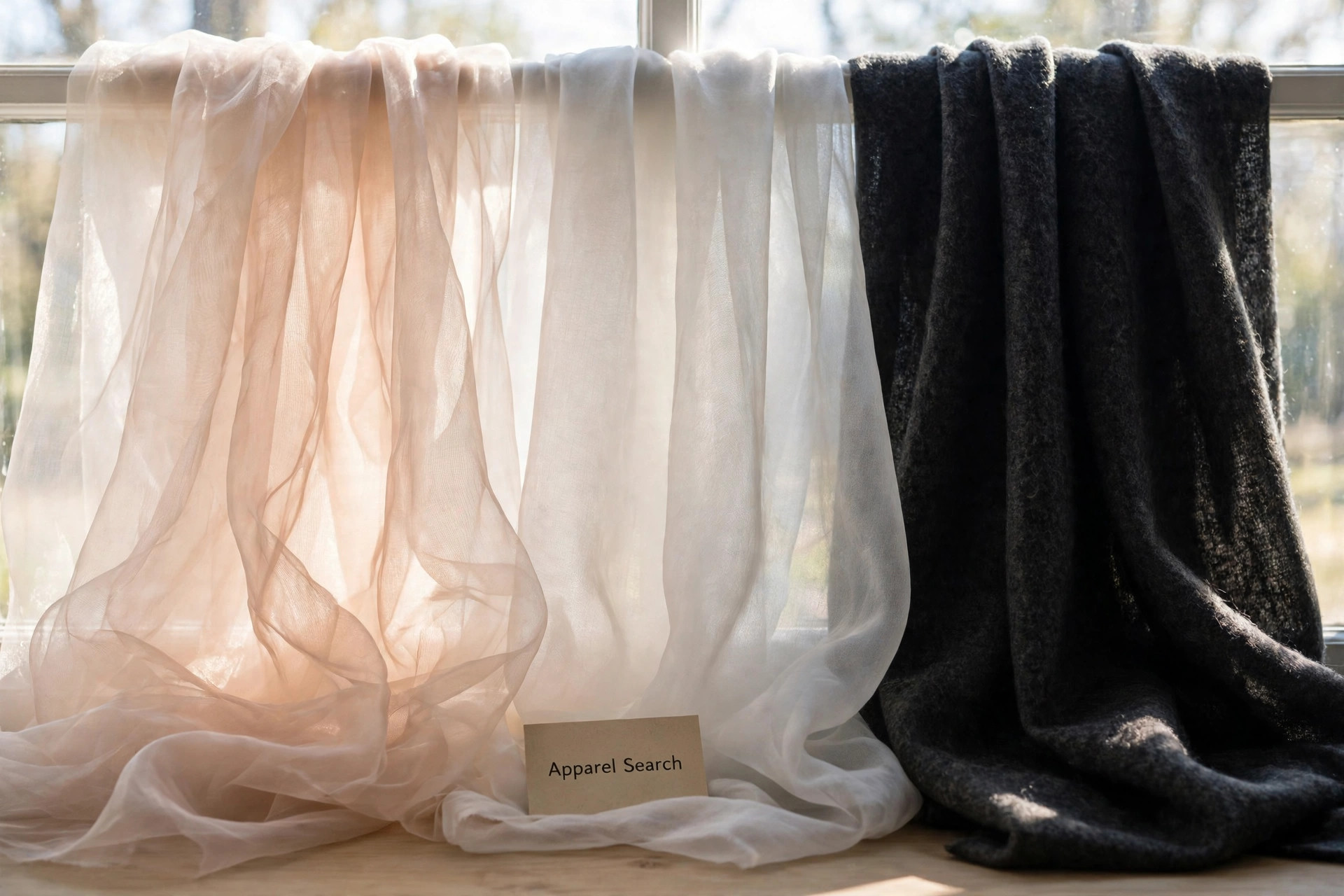
A Scale With Three Named Points
Opacity is best understood as the end of a scale. At one end, transparent materials pass light so freely that objects behind them are seen clearly — clear plastic film, glass, organza and fine net approach this in textiles. In the middle, translucent materials pass light but scatter it, so what lies behind shows as brightness and shadow without detail: frosted glass, voile, chiffon and many lightweight knits live here, glowing against light while blurring the body beneath. At the far end stands the opaque: no light passes, nothing behind is visible, and the surface shows only its own colour and texture. The definition is absolute — an opaque object does not allow light through it — even though in practice fabrics are judged by degree, and degrees of opacity is a phrase every apparel buyer understands.
The vocabulary around the scale does everyday work in the trade. A fabric described as opaque is being promised as single-layer coverage; one described as sheer or translucent is being flagged as a layering fabric, to be worn over something else or lined. The same scale is used in reverse for hosiery, where the yarn's denier sets the product's opacity category from ultra sheer to thick opaque. In science the phrase “an opacity” may also be used to describe an opaque object itself, and opacity is often used as a metaphor — in describing written and spoken language, opaque means confusing or unintelligible, and governmental decision-making that is not conducted publicly may be called opaque — but in the textile dictionary the optical meaning governs.
What Makes a Fabric More or Less Opaque
Opacity is built, not wished. It rises with the thickness and density of the material: yarns packed closely leave no gaps for light, heavy yarns block what passes between them, and dark colours absorb light that pale colours reflect onward through the cloth. Weave and knit structure matter as much as weight — a loose plain weave in a fine yarn can be sheerer than a lighter but tighter fabric — and finishes and coatings can add opacity to a cloth that lacks it. Even an open fabric such as scrim shows the principle from the other end: its value in theatre and window use comes precisely from how its openness plays with light.
Stretch is the silent variable. A knit that is opaque on the roll becomes translucent pulled across the body, because stretching opens the spaces between its loops — which is why fit and opacity must be judged together on garments such as leggings and swimwear. Fibre and yarn choices feed the same calculation: a dense worsted suiting in wool sits at the opaque end by construction, while a fine, pale, loosely woven summer cloth may need help to get there. Testing reflects the wearing reality: fabric is assessed against light, over contrasting backgrounds, stretched and sometimes wet, because a swimsuit or a rain-soaked shirt changes its opacity with its condition.
Opacity as a Garment Decision
In garment terms, opacity is a promise about coverage, and its failure is a classic quality complaint: white trousers that reveal their wearer, a blouse that needs a camisole the buyer did not plan on, a dress lining omitted to save cost. Designers manage the scale deliberately. Sheer and translucent fabrics are chosen where layering is the design — an organza overskirt, a chiffon sleeve — and opaque fabrics where a single layer must do the whole job. Linings, slips and built-in bra cups exist largely as opacity insurance for fabrics at the translucent border.
The word serves other fields — opaque paints cover what is beneath them, and opaque projectors take their name from showing solid objects — but for clothing the test stays the same: light either passes through a material or it does not, objects behind it are seen clearly, blurred or not at all, and opacity names the state in which they are not seen at all. Buyers who judge a fabric flat, unstretched and under shop light are judging a different garment from the one that will be worn; the definition earns its keep when it is applied in wearing conditions.
Not to Be Confused With
Opaque is not translucent, and neither is transparent. A transparent material lets light through clearly enough that objects behind it are seen distinctly. A translucent material lets light through but scatters it, so objects behind it are not seen clearly. An opaque material lets no light through at all, and its property is called opacity. If you can see shapes through it, it is not opaque.
Common Questions
What does opaque mean?
A substance or object that is opaque is neither transparent nor translucent. It does not allow light to pass through it, and the property of being opaque is called opacity.
What is the difference between opaque, translucent and transparent?
A transparent material lets light through clearly enough that objects are seen distinctly through it. A translucent material lets light through but scatters it, so objects are not seen clearly. An opaque material lets no light through at all.
Why does opacity matter for clothing?
Opacity decides whether a fabric can be worn alone or needs a lining or layer beneath. Lightweight and light-coloured fabrics, worn unstretched in the shop, may become translucent when stretched, wet or seen against strong light, so opacity is judged in wearing conditions.
What makes a fabric more opaque?
Thickness and density: closely packed, heavy yarns leave no gaps for light, dark colours absorb light, and tight weaves and knits block more than loose ones. Finishes, coatings and linings can add opacity to a cloth that lacks it.