Parisian Stitch
Sewing Definitions — the needlepoint stitch that pairs a longer stitch with a smaller parallel one, its ends alternating in a staggered pattern, from Apparel Search
Search Apparel Search
At a Glance
Definition: Parisian stitch is a longer horizontal or vertical stitch used in needlepoint next to a smaller parallel stitch, with the end points on either end alternating in a staggered pattern.
Category: Sewing Definitions
Parisian stitch is a longer horizontal or vertical stitch used in needlepoint, worked next to a smaller parallel stitch. The stitch is therefore a pair — one long stitch, one short companion lying alongside it — and the end points on either end of the pair alternate in a staggered pattern as the work proceeds. That combination of pairing and stagger gives Parisian stitch its broken, rhythmic texture, distinct from the even field of tent stitch and from its closest relative in this section, brick stitch. This page covers how the pair is built, what the alternating ends do to the surface, and how Parisian stitch sits in the needlepoint stitches family.
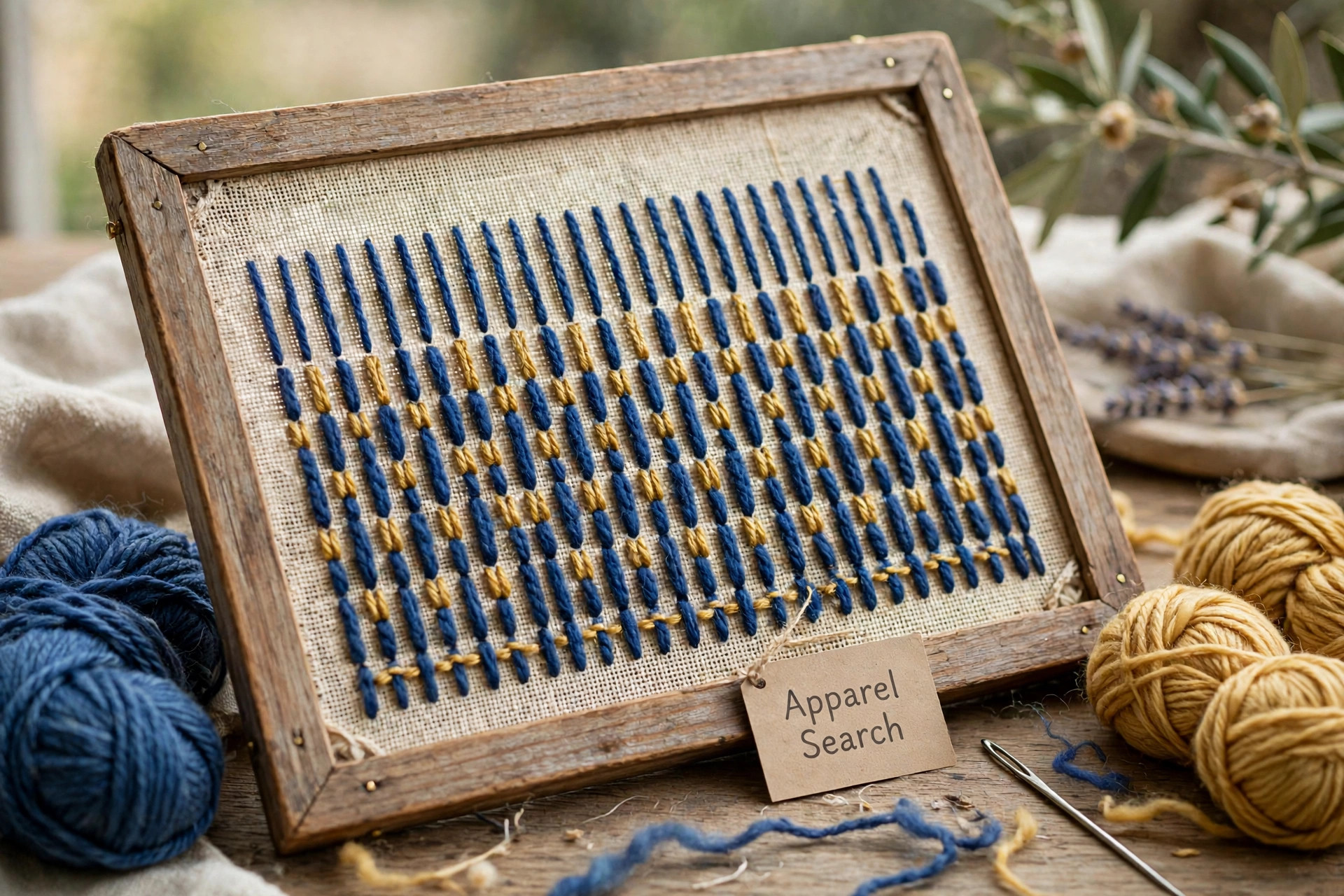
A Long Stitch with a Smaller Companion
Most needlepoint stitches repeat a single unit; Parisian stitch repeats two. The unit is a longer stitch — horizontal or vertical, according to the direction chosen for the area — with a smaller stitch worked parallel to it, immediately beside it. Long and short travel together across the canvas, pair after pair, so the surface is built from couples rather than from identical single stitches.
The pairing is what the eye notices first. Where a field of even stitches reads as flat texture, the long-and-short rhythm of Parisian stitch reads as pattern: each pair declares itself, and the alternation of lengths catches light unevenly along the row. It is a decorative stitch in the plain sense — chosen not merely to cover canvas, as tent stitch covers it, but to give the covered area a texture of its own.
Ends That Alternate: The Staggered Pattern
The second half of the definition governs the ends. The end points on either end of the stitch pair alternate in a staggered pattern: as the pairs succeed one another, their ends do not settle into one continuous straight line, but step alternately, so the joins between pairs are distributed across the surface instead of stacked into a seam.
That stagger does the same work here as it does in brickwork — it keeps the surface interlocked. A design area whose stitch ends all aligned would show a visible fault line wherever one row of pairs met the next; with the ends alternating, the rows knit into one another and the texture stays unbroken. Keeping the alternation regular is the stitcher's discipline in this stitch: the pairs must stay even in length and the stagger must never drift, or the rhythm that makes the stitch attractive breaks down into irregularity.
Parisian Stitch and Brick Stitch
Parisian stitch's nearest neighbour is brick stitch, and the original definitions of the two make a matched pair. Both are straight needlepoint stitches, worked horizontally or vertically, and both rely on staggered end points. They differ in the unit being staggered: brick stitch offsets single stitches of one even length, so its surface resembles a brick wall course by course, while Parisian stitch staggers a two-part unit — the longer stitch and its smaller parallel companion — so its surface is more broken and syncopated.
In practice the two stitches are used as variations on one idea: where a design wants the calm regularity of brickwork, brick stitch supplies it; where the same staggered structure is wanted with more movement in it, Parisian stitch is the choice. Both belong to the family surveyed in our needlepoint stitches guide, alongside the tent stitches and the decorative stitches, and the wider stitch vocabulary is covered in the embroidery stitch definitions.
Common Questions
What is Parisian stitch?
Parisian stitch is a longer horizontal or vertical stitch used in needlepoint, worked next to a smaller parallel stitch. The end points on either end alternate in a staggered pattern.
Why does Parisian stitch use two stitch lengths?
The stitch is built as a pair: a longer stitch with a smaller parallel stitch beside it. The contrast of lengths gives the surface its broken, rhythmic texture, distinguishing it from fields of even, single-length stitches.
What does it mean that the end points alternate in a staggered pattern?
As the stitch pairs succeed one another, their end points step alternately rather than lining up, so no continuous straight seam runs through the work and the rows knit into one unbroken texture.
How does Parisian stitch differ from brick stitch?
Both are straight needlepoint stitches with staggered end points. Brick stitch staggers single stitches of one even length, like courses of a brick wall; Parisian stitch staggers a pair — a longer stitch next to a smaller parallel stitch — giving a more broken, rhythmic surface.