Assisi Embroidery
Embroidery Definitions — embroidery and needlework definitions from Apparel Search
Search Apparel Search
At a Glance
Definition: Assisi embroidery is a form of counted-thread embroidery from the Italian town of Assisi, practised since the 13th century, in which the background is filled with stitching and the motif is left blank.
Also known as: Voiding
Category: Embroidery Definitions
Word Origin
The technique takes its name from Assisi, the Italian town where it has been practised since the 13th century and where the traditional version is still worked today.
Assisi embroidery is a form of counted-thread embroidery from the Italian town of Assisi, practised since the 13th century and still worked today. It is a negative embroidery — also known as voiding — because the background is filled in while the motif itself is left blank. Cross-stitch fills the background, usually in the traditional colours of red, blue, green and gold, and blackwork in Holbein stitch then outlines the motif and part of the decoration. Traditional motifs were largely heraldic, especially heraldic beasts.
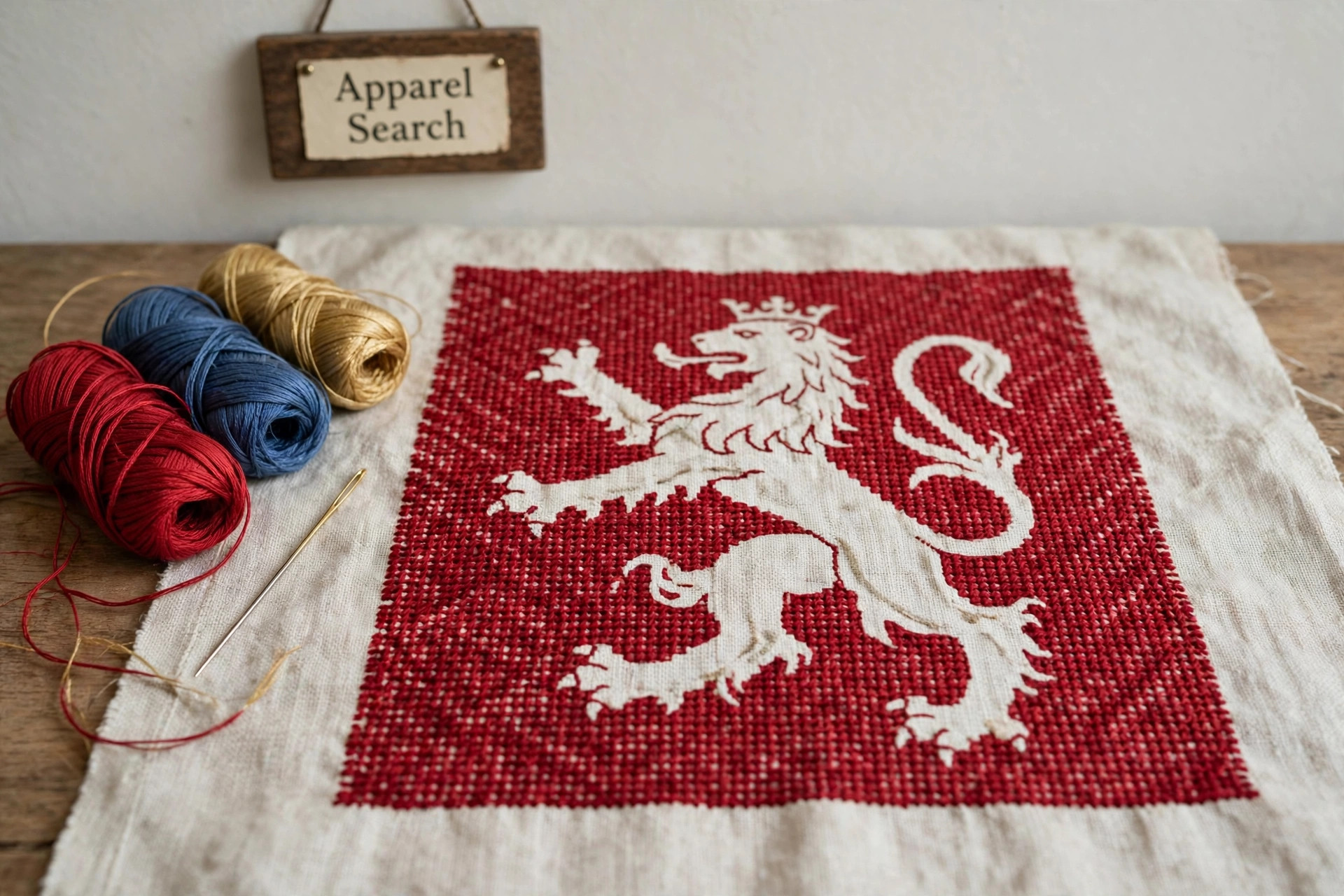
Working the Background Instead of the Picture
Voiding reverses the stitcher's instinct. In most counted work the motif is stitched and the ground is left alone; in Assisi work, hours of cross-stitch go into everything except the motif, which exists only as a reserved silhouette. That inversion dictates the workflow, and it is why the outlining stitch does double duty: it defines the motif, and it forgives small irregularities in the filling behind it. Assisi work stands or falls on contrast, so its materials are chosen for a clean silhouette — a smooth, even counted ground that will not blur the reserved motif, and a background thread dense enough to read as a solid field. Scale matters as well: a heraldic beast that reads boldly at one count turns fussy if the count is too fine and the background stitches shrink into texture, so workers test a motif's outline against the intended fabric before committing to the long background fill.

The Stitches: Cross-Stitch Ground, Holbein Outline
Traditionally, Assisi work was rarely executed in plain cross-stitch; the background was most often worked in long-armed cross-stitch. Examples in other stitches are also known, including plain cross-stitch, Italian cross-stitch and Algerian plait stitch. The outline is a different technique borrowed from another tradition: Holbein stitch, the double running stitch of blackwork embroidery, traces the motif and some of the decoration, separating the blank shape from the filled ground with a crisp, counted line. The two elements — a solid stitched field and an unstitched figure edged in blackwork — are the whole grammar of the style, which is why traditional and modern pieces remain recognisably the same technique even when their palettes differ completely.
Old Pieces, New Pieces
There are two ways to approach Assisi embroidery. In the oldest pieces, the figures were drawn on the fabric freehand, surrounded with Holbein stitch, and the background was filled as well as possible around them. For more modern pieces the pattern is constructed carefully on paper first, like an ordinary cross-stitch chart — because a miscount in the ground distorts the blank shape it surrounds, and no stitched outline is strong enough to hide a background that has drifted by a thread. Today Assisi work is always done the charted way. In the last twenty years a modern version of the style has also evolved: many different colours and patterns are used for the background, and the motifs are extremely varied, as the whale piece illustrated here shows — a contemporary subject left as a plain silhouette against an ornately patterned ground.

A Town That Kept Its Stitch
Few embroidery styles remain tied to a living local trade the way Assisi work is tied to Assisi. The traditional version is still practised in the town, where local women can be seen sitting in front of their houses embroidering Assisi work items for the local cooperative embroidery shop. That trade rests on the Laboratorio Ricreativo Festivo Femminile San Francesco di Assisi, a handicrafts workshop established in 1902 to give employment to poor women, supplementing their income. The modern evolution of the style — patterned, multicoloured backgrounds and a far wider range of motifs — has not displaced that traditional practice: a heraldic beast left blank in a red ground and a contemporary design in a patterned ground are the same technique, separated by palette rather than by method. See also the embroidery stitch definitions and Hardanger embroidery, another counted tradition with a strong local identity.
Common Questions
Why is Assisi embroidery called voiding?
Because the design works in negative: the background is completely filled with stitching and the motif itself is left as unstitched, voided cloth. The blank shape reads as the picture, edged by a Holbein stitch outline that separates it from the filled ground.
Which stitches are used in Assisi work?
Cross-stitch fills the background, traditionally most often long-armed cross-stitch, though plain cross-stitch, Italian cross-stitch and Algerian plait stitch are also known. Holbein stitch, borrowed from blackwork, outlines the motif and some of the decoration.
What motifs are traditional in Assisi embroidery?
Traditional motifs were largely heraldic, especially heraldic beasts. Modern work uses extremely varied motifs and many background colours and patterns, while the traditional version is still practised in Assisi itself, where local women embroider for the cooperative shop.