Hardanger Embroidery
Embroidery Definitions — embroidery and needlework definitions from Apparel Search
Search Apparel Search
At a Glance
Definition: Hardanger embroidery is a counted-thread form of drawn thread work from western Norway, built from satin-stitch blocks, cut and withdrawn threads and woven bars, traditionally worked in white yarn.
Pronunciation: har-DANG-er
Category: Embroidery Definitions
Word Origin
The name comes from the Hardanger district of western Norway, the region this embroidery comes from; the evenweave cloth woven specially for the work carries the same name, Hardanger cloth.
Hardanger embroidery is a form of embroidery worked in white yarn on Hardanger cloth, using drawn thread work. It is a form of counted-thread embroidery, and it originates from the Hardanger district in western Norway. The traditional description gives white yarn on coloured cloth; the better-known modern presentation reverses that to white on white.
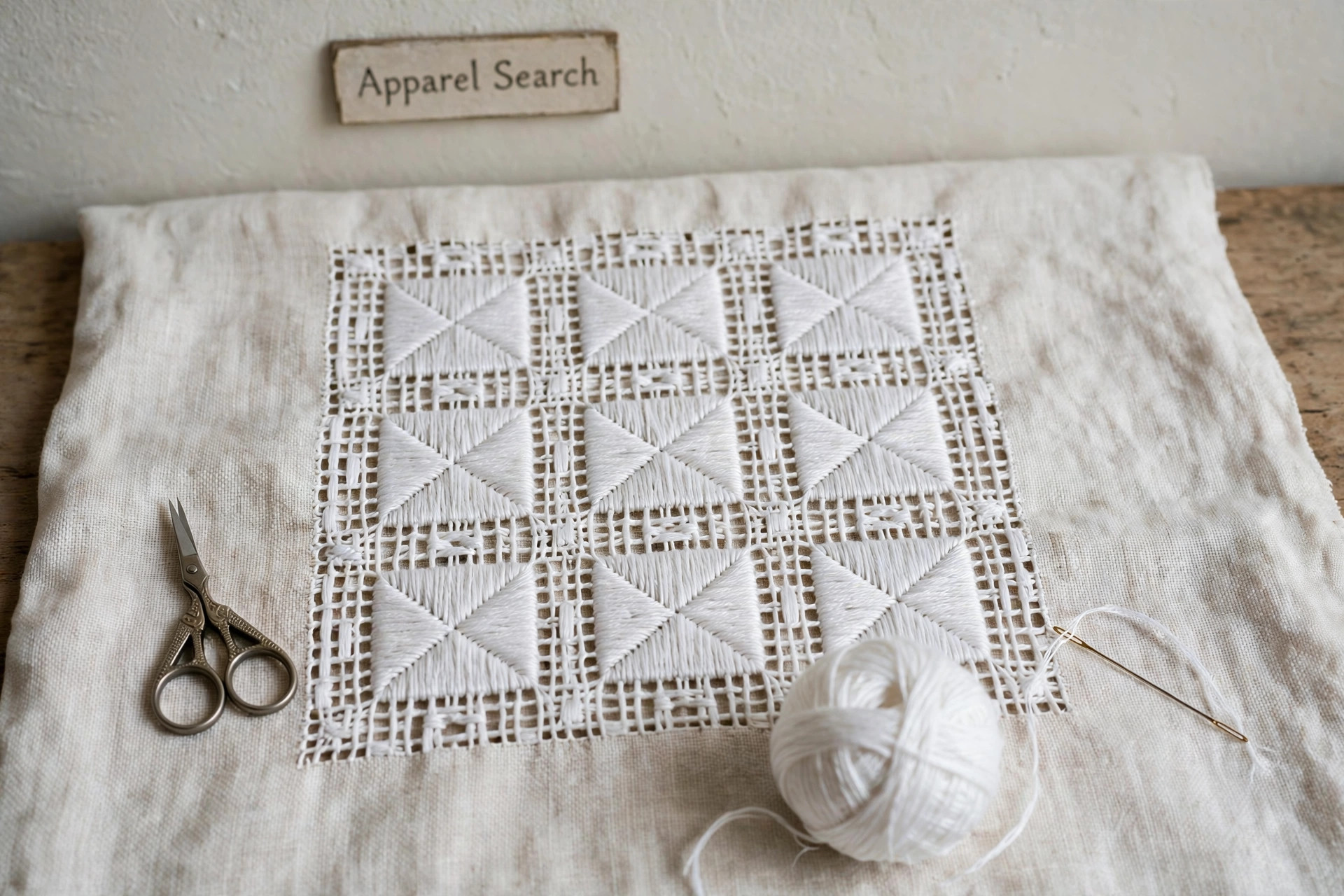
Blocks First, Then the Cutting
Hardanger is built in an order that protects the work. The solid geometry comes first: blocks of flat satin stitches are worked across the counted cloth, outlining the areas that will later be opened. Only when those blocks are complete are the fabric threads inside them cut and withdrawn. The satin blocks act as a secured frame, so the cut area ends exactly where the design intends and cannot unravel further.
The exposed mesh of remaining threads is then woven into bars, sometimes with picot loops along them, turning a hole in the fabric into the laciest part of the design. Reversing the order would leave nothing firm to stitch into, which is why Hardanger patterns are always sequenced block, cut, weave.
The Four Signature Techniques
Four special techniques give Hardanger its character. Cording overcasts over several threads to make a cord. Woven bars are made by weaving the needle over and under three threads until they are completely covered. Picot twists the thread once round the needle before the needle is inserted. The four-sided stitch forms adjoining squares, reinforcing the square geometry the whole technique is built from.
Geometry Imposed by the Grid
Hardanger designs tend to be geometric, and any flowers within them highly stylised, because the technique's units are squares: counted blocks, square cut areas, bars woven across a square mesh, and the four-sided stitch forming adjoining squares. Rather than treating that as a limitation, the tradition builds its richness from repetition and contrast — dense white blocks against open woven mesh, corded outlines against flat ground.
The coarse fabric and thread usually used keep the counting legible and the woven bars strong. This is openwork meant for household linen and garments that will be washed and used, not only framed, and Hardanger is the style of drawn thread work most popular today. Its appeal rests on that combination of strict structure and forgiving scale: the work is intricate, but every step can be learned from written instructions and checked by counting. The embroidery stitch definitions set its stitches alongside the wider stitch vocabulary.
The flat stitches form the backbone of the design; in the open areas, both warp and weft threads are removed and the remaining mesh is secured with weaving or wrapping, or with a limited number of simple filling patterns. That restraint in the fillings is part of the look: the contrast is always between the solid counted blocks and the open, regular mesh they frame.
Cloth Made for the Technique
Hardanger cloth is woven for this work: an evenweave with paired threads that group naturally into the blocks and bars the designs require, traditionally in counts coarse enough for the woven bars to be strong. The definition's white yarn on coloured cloth describes one traditional presentation; the modern white-on-white presentation groups Hardanger with whitework. Either way the structure is identical — satin blocks, cut areas, woven and wrapped bars, picot edging — and the colour choice changes only the mood, from folk contrast to heirloom restraint.
Common Questions
Where does Hardanger embroidery come from?
It originates from the Hardanger district in western Norway, and takes its name and its evenweave Hardanger cloth from that region. It is the style of drawn thread work most popular today.
What are the special techniques of Hardanger?
Cording overcasts several threads to make a cord; woven bars weave the needle over and under three threads until they are completely covered; picot twists the thread once round the needle before inserting it; and the four-sided stitch forms adjoining squares.
How is a Hardanger design structured?
Flat satin stitches form the backbone of the design in geometric blocks; in the open areas, fabric threads are cut and withdrawn and the remaining mesh is secured with woven or wrapped bars and simple fillings. The designs tend to be geometric, and any flowers are very stylised.