Brick Stitch
Sewing Definitions — the straight needlepoint stitch whose staggered ends build a pattern like a brick wall, from Apparel Search
Search Apparel Search
At a Glance
Definition: Brick stitch is a vertical or horizontal stitch used in needlepoint, similar to a Gobelin stitch, in which the end points are staggered so the worked pattern appears like a brick wall.
Category: Sewing Definitions
Word Origin
The stitch takes its name from the surface it produces: with the end points of the stitches staggered from row to row, the finished pattern appears like a brick wall, each stitch standing for a brick and each offset joint falling, as in real brickwork, in the middle of the stitch below.
Brick stitch is a vertical or horizontal stitch used in needlepoint, comparable to a Gobelin stitch. Its character is in its ends: the end points of the stitches are staggered rather than lined up, and that stagger is what makes the finished pattern appear like a brick wall — row upon offset row, with no continuous vertical seam running through the work. It is one of the straight stitches in the needlepoint stitches family, where it supplies a firm, architectural texture quite unlike the smooth diagonal field of tent stitch. This page covers how the brickwork effect is built, why the stagger matters, and where brick stitch sits among its neighbouring stitches.
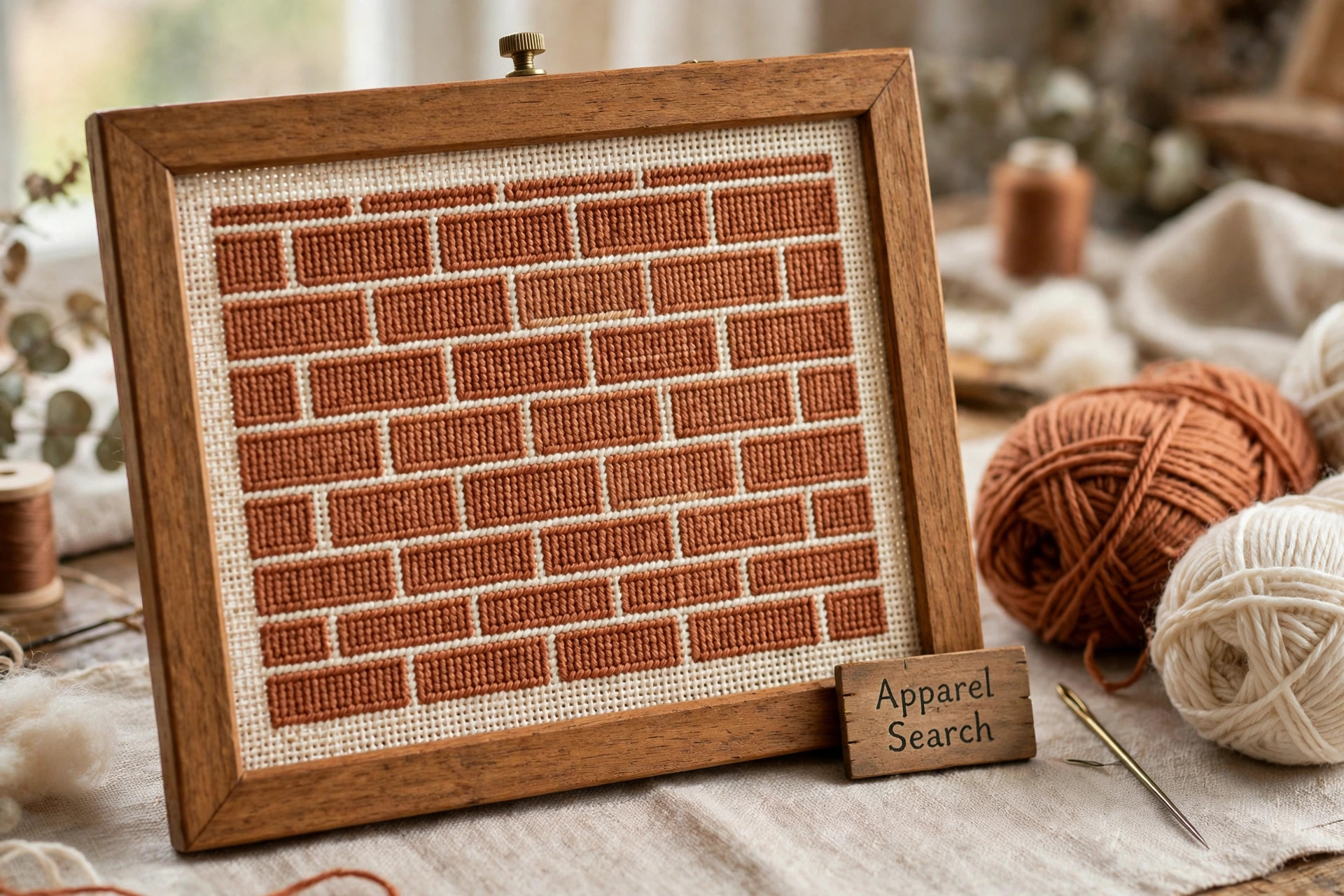
A Straight Stitch Laid Like Brickwork
Brick stitch is worked as a straight stitch, running vertically or horizontally across the canvas. A single direction is chosen for an area of the design and held to, so the stitches lie side by side in orderly rows, like courses of bricks in a wall. The comparison the original definition draws is with the Gobelin stitch, another straight stitch of needlepoint: brick stitch belongs to that upright, canvas-covering family rather than to the diagonal stitches.
What separates brick stitch from a plain row of straight stitches is the placing of the ends. In each successive row the stitches are offset, so an end point in one row falls against the middle of a stitch in the row beside it. No two end points line up across the rows, and it is exactly that staggered arrangement — the staggered nature of the end points, in the original's words — that makes the pattern appear like a brick wall.
Why the Stagger Matters
The brick-wall effect is more than a resemblance. In real brickwork, offset joints are what stop a wall from splitting along one straight line, and the same visual logic works on canvas: because the end points never align, the eye reads the surface as one continuous, interlocked field instead of a stack of separate rows. A design area worked in brick stitch therefore holds together as a texture — firm, regular and slightly architectural — which is why the stitch suits areas that want structure: backgrounds that should recede evenly, and shapes that benefit from a woven, masonry-like grain.
The direction of the rows is part of the effect. Worked horizontally, the courses run across the area like the courses of a wall; worked vertically, the same stagger turns the grain upright. Either way the discipline is the same — keep the stitch length even and the offset consistent, so the brickwork rhythm is never broken by an end point landing where the pattern does not expect it.
Brick Stitch Among the Needlepoint Stitches
Brick stitch keeps close company with Parisian stitch, the other staggered straight stitch in this section. The two share the staggered end points, but they build them differently: brick stitch staggers stitches of one even length, while Parisian stitch pairs a longer stitch with a smaller parallel stitch beside it and alternates the ends of the pair. Worked side by side in one design, the two give related but distinct brick-like textures. Both are surveyed, with the rest of the family, in our needlepoint stitches guide, and the wider stitch vocabulary is covered in the embroidery stitch definitions.
Against tent stitch, the contrast is one of surface: tent stitch covers canvas in small diagonal stitches that disappear into a smooth field of colour, while brick stitch keeps its structure visible, the rows and offsets reading as pattern in themselves. Needlepointers combine the two kinds of stitch in a single piece — tent stitch where the design needs flat, precise colour, brick stitch where it needs texture and rhythm. Stitchers who want to take the craft further will find its organisation in the American Needlepoint Guild, listed as this page's external resource.
Common Questions
What is brick stitch?
Brick stitch is a vertical or horizontal stitch used in needlepoint, similar to a Gobelin stitch. Its end points are staggered from row to row, which makes the worked pattern appear like a brick wall.
Why is it called brick stitch?
Because of the surface it produces. With the end points staggered so that no two line up across the rows, the finished pattern of straight stitches reads as brickwork — each stitch a brick, each offset end a staggered joint.
Is brick stitch worked horizontally or vertically?
Either. Brick stitch is a straight stitch that can be worked in vertical or horizontal rows; one direction is chosen for an area of the design and held to, with the stagger maintained from row to row.
How does brick stitch differ from Parisian stitch?
Both are straight needlepoint stitches with staggered end points. Brick stitch staggers stitches of one even length, while Parisian stitch pairs a longer stitch with a smaller parallel stitch beside it, and the end points on either end of the pair alternate in a staggered pattern.