Textile Dyeing & Finishing · Methods
Dyeing Methods & Stages
Color can enter a textile at four points — as loose fiber, as yarn, as woven or knitted fabric, or as a finished garment. Each stage has its own machines, economics and risks, and the choice is made long before a shopper sees the garment.
Every colored textile you own was dyed at one of four stages, and the stage explains much of its appearance. A heathered sweater, a woven plaid shirt, a solid-dyed sheet and a softly faded garment-dyed tee each got their color at a different point in production. This guide — part of the Textile Dyeing & Finishing Guide — walks the four stages in order, from the earliest (before the fiber is even spun) to the latest (after the garment is sewn), and the batch and continuous machinery that does the work. The governing trade-off is simple: the earlier color is committed, the more patterned the result can be; the later it is committed, the more flexibility the brand keeps — and the harder it is to keep the color perfectly level.
Stage One: Fiber Dyeing (and Dyeing Before the Fiber Exists)
In fiber or stock dyeing, loose fiber is dyed before spinning, in large vats or pressurized machines. The dyed fibers are then blended and spun together, which produces the soft, intermixed heather and melange effects no later stage can imitate — every yarn is a blend of colored fibers. The extreme version applies to synthetics: in solution or dope dyeing, pigment is mixed into the polymer melt before the fiber is extruded, so color runs through the fiber itself. Solution-dyed fibers have outstanding wash and light fastness and use a fraction of the water of conventional dyeing, but colors must be committed in large quantities at fiber production, which limits the palette to proven, high-volume shades.
Stage Two: Yarn Dyeing
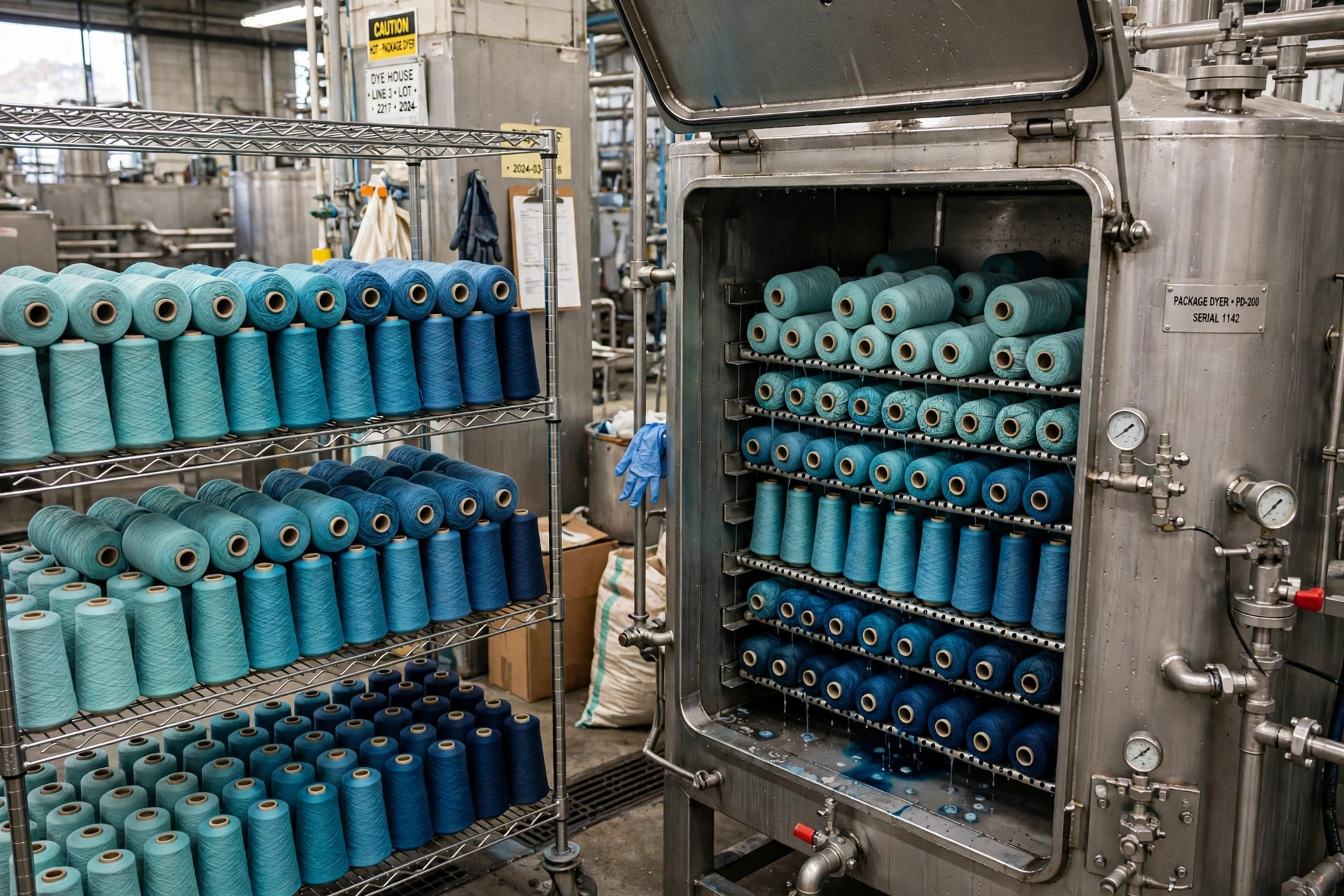
Yarn dyeing colors the yarn after spinning and before weaving or knitting. It is the only way to build color patterns into the cloth itself — stripes, checks, plaids, jacquards with colored motifs — because the colored yarns become the structure. The dominant industrial method is package dyeing: yarn is wound onto perforated packages and stacked in a pressurized vessel while dye liquor is pumped through them from inside out and outside in. Hank dyeing, in which loose skeins hang in the bath, survives for delicate and hand-knitting yarns. Warp yarns for denim are dyed on a grand scale by rope or sheet (slasher) dyeing with indigo — the process behind the warp-faced blue of jeans, detailed in the Denim Fabric Guide. Yarn dyeing demands early color decisions and costs more than fabric dyeing, and it is chosen when the pattern is the product.
Stage Three: Fabric (Piece) Dyeing
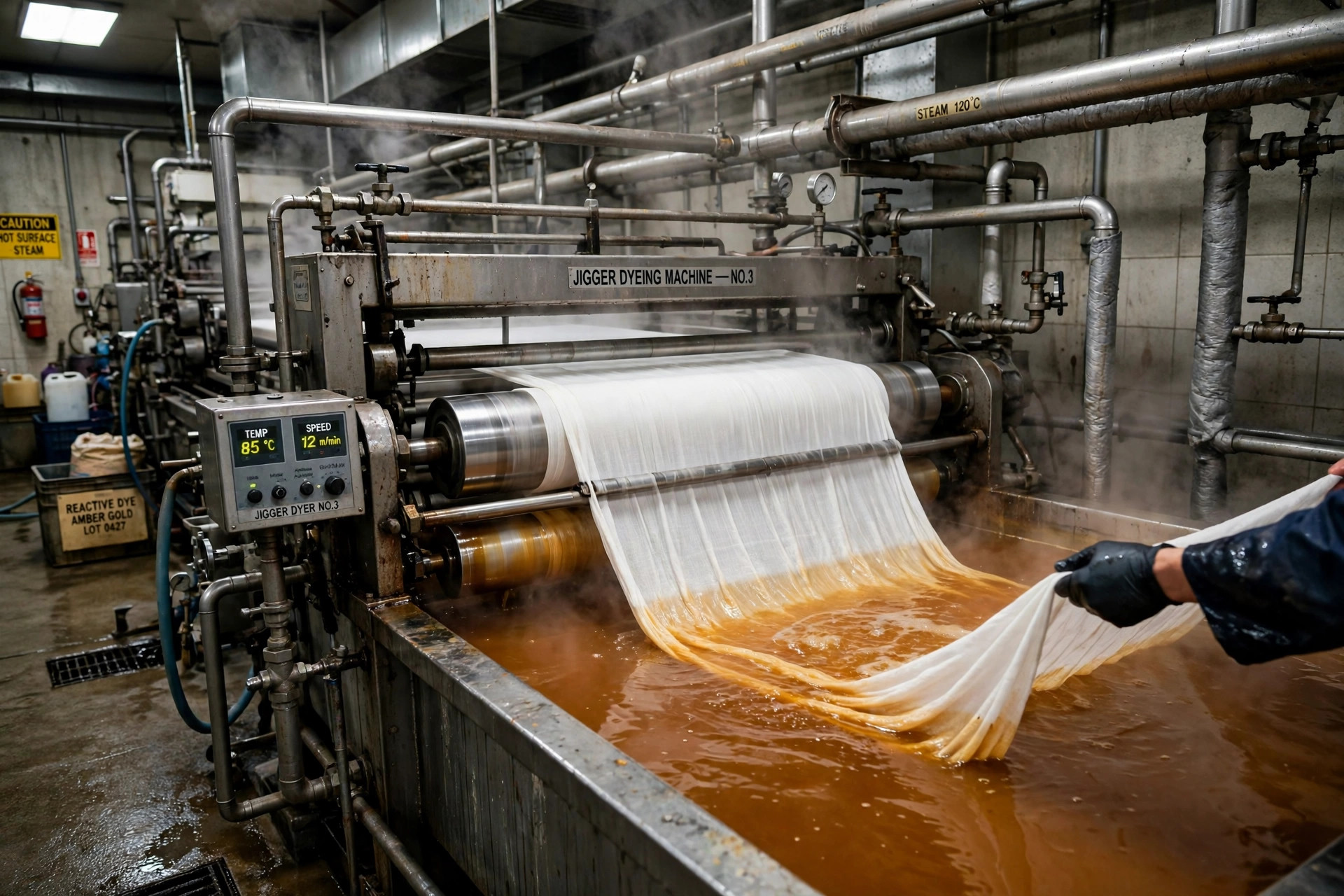
Piece dyeing — coloring woven or knitted fabric after it is made — is the most common method in apparel, because it postpones the color decision. Mills and brands can hold undyed greige fabric in stock and dye it when orders and fashion confirm the colors. Most piece dyeing is batch work in exhaust machines, each suited to a fabric type: jet and overflow machines carry delicate knits and wovens in a rope of fabric propelled by the dye liquor itself; winch (beck) machines are gentler still; jiggers pass open-width woven fabric back and forth through a shallow bath — the machine in this page's opening photograph; beam machines wind fabric on a perforated beam and pump liquor through it. The dye gradually exhausts from the bath onto the fabric over a controlled cycle of temperature and time.
Batch Versus Continuous
Batch dyeing, described above, dyes a set quantity in one machine cycle: flexible, economical for short runs and frequent color changes, but slower per kilogram. Continuous dyeing takes the opposite approach for long runs of woven fabric: the cloth is padded through dye liquor, squeezed to an even pickup, then dried and fixed in a pad-dry-cure or pad-steam range without stopping. A continuous range produces very level color at high speed, but it only makes sense when a single shade runs for thousands of meters — setting up and threading the range for a short lot wastes more than it saves. Most apparel fabric, with its short runs and many colors, is batch-dyed; shirting, sheeting and uniform fabrics are where continuous ranges earn their keep.
Stage Four: Garment Dyeing
The latest possible stage colors the finished garment. Garments sewn from undyed, prepared-for-dyeing cloth are dyed in rotating machines that resemble heavy-duty laundries, gaining a soft hand, tonal seams and a pre-shrunk fit in the process. Because the color decision happens after sewing, brands can respond to which colors are actually selling — the strategic point of the method. Garment dyeing has its own physics and its own failure modes, and it is covered in full in the companion guide, Garment Dyeing Explained.
Choosing a Stage
The stage is chosen by the product, not by preference. Patterns woven into cloth force yarn dyeing; melange effects force fiber dyeing; late color commitment and solid shades point to piece dyeing; the soft, washed look and fast color response point to garment dyeing. Cost follows commitment: each earlier stage ties up more capital in colored inventory for longer, and each later stage concentrates the risk of unlevel color into a shorter, more visible moment. Good sourcing teams treat the stage as part of the fabric specification, right alongside fiber content and the dye classes covered in the dye types guide.
More in the Textile Dyeing & Finishing Guide
Common Questions
What is piece dyeing?
Piece dyeing means dyeing fabric after it has been woven or knitted, while it is still in piece — bolt — form. It is the most common method for solid-color apparel fabrics because the color decision can be made late: mills keep greige (undyed) fabric in stock and dye it to order in batch machines such as jets, jiggers and winches.
What is solution dyeing (dope dyeing)?
Solution dyeing adds pigment to the polymer solution or melt before a synthetic fiber is extruded, so the color is part of the fiber itself rather than applied afterward. It gives outstanding wash and light fastness and uses far less water than conventional dyeing, but colors must be committed in large quantities at fiber production, which restricts it to high-volume shades.
What is the difference between batch and continuous dyeing?
In batch (exhaust) dyeing, a set quantity of fiber, yarn, fabric or garments is dyed in one machine cycle, with the dye gradually transferring from the bath to the material. In continuous dyeing, fabric passes steadily through a range — padded with dye liquor, then dried and fixed — which suits long, uniform runs of woven fabric but is uneconomical for short lots.
Why are striped and checked fabrics usually yarn-dyed?
A stripe or check woven into cloth needs colored yarns in the warp or the weft before weaving, so the yarn must be dyed first. Fabric (piece) dyeing colors finished cloth a single shade; it cannot create woven stripes or checks, although the same designs can be printed on the surface of piece-dyed cloth instead.
Back to the Textile Dyeing & Finishing Guide
The Textile Dyeing & Finishing Guide hub covers the whole of wet processing — dye types, dyeing methods, garment dyeing, finishing, natural dyes and shade approval — with a map of every guide in this cluster.