Textile Dyeing & Finishing · Dye Classes
Types of Textile Dyes
Six dye families color nearly everything you wear. Each one bonds to a different fiber chemistry — match them correctly and color survives years of washing; match them wrong and it rinses away.
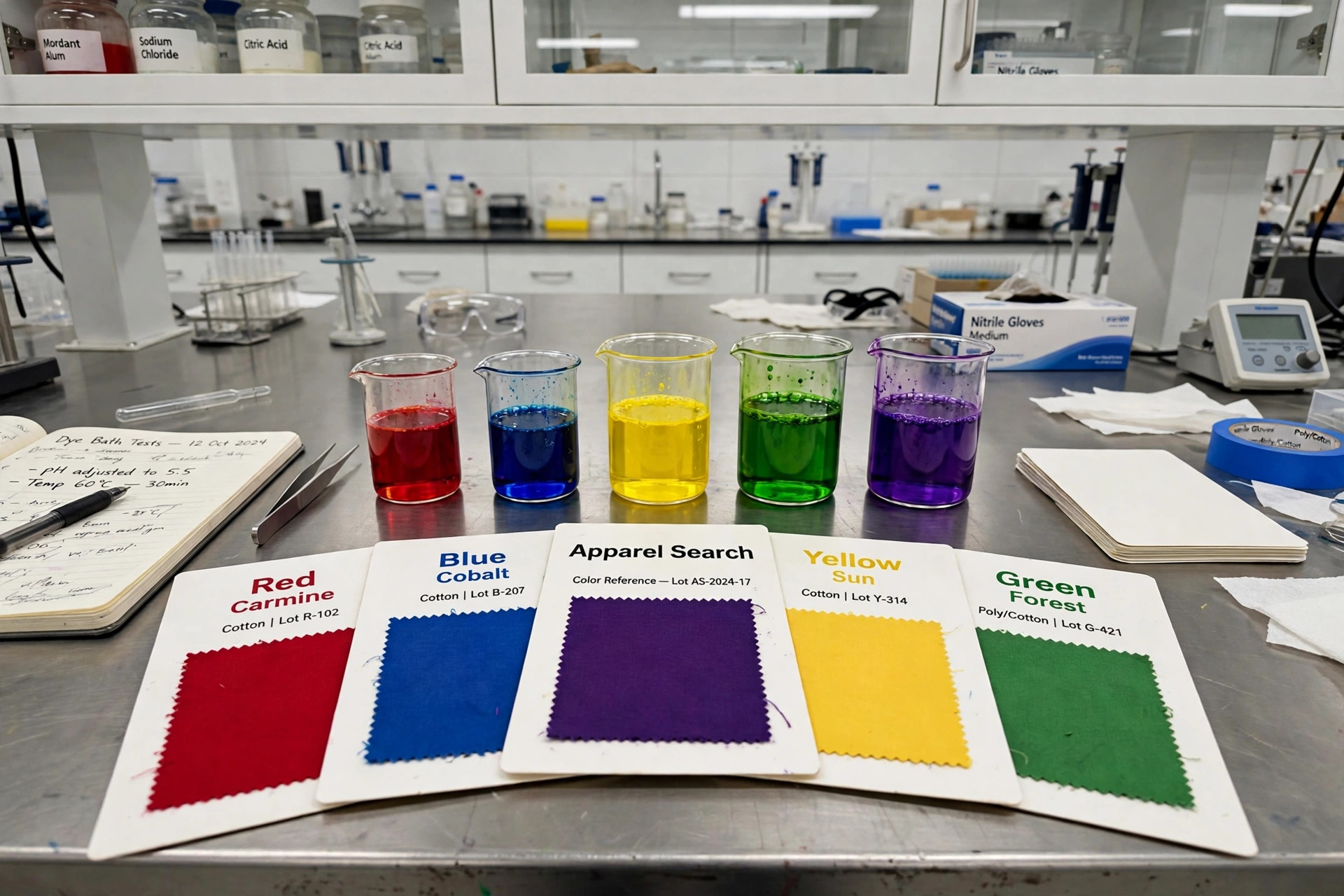
Ask a dyer what a fabric is made of before you ask what color it should be. That order is not pedantry — it is the whole logic of the dye industry, and this guide, part of the Textile Dyeing & Finishing Guide, exists to explain it. A dye is a colored substance that forms some kind of durable attachment to a fiber, and fibers differ fundamentally: cotton is cellulose, wool and silk are proteins, nylon carries chemical groups that behave a little like protein, and polyester is a hydrophobic plastic with almost nothing for a dye to grab. Over the last century and a half, chemists built a separate dye family for each of those chemistries. Six families — reactive, disperse, vat, acid, direct and sulfur — do nearly all the world's textile coloring.
How a Dye Stays in the Cloth
The families differ mainly in how the attachment works. Reactive dyes form a genuine covalent chemical bond with the fiber — the strongest hold, and the hardest to wash out. Disperse dyes never truly bond at all: heated, their tiny molecules dissolve directly into polyester the way sugar dissolves into tea, and they stay because the cooling fiber traps them. Acid and direct dyes are held by ionic attraction and weaker molecular forces between dye and fiber. Vat and sulfur dyes play a different trick: they are applied in a soluble form, soak into the fiber, and are then converted back into insoluble pigment inside it — the color is physically locked in. Understanding which mechanism a dye uses predicts almost everything about it: its fastness, its cost, and the fibers it can serve.
Reactive Dyes — The Cotton Standard
Reactive dyes are the workhorse of quality cotton, linen, viscose and other cellulosic fibers. In the dyebath, under alkaline conditions and with salt to push the dye onto the fiber, the dye molecule reacts with the cellulose itself and becomes part of it. The result is bright, clear shades with excellent wash fastness — the benchmark against which other cotton dyes are judged. Derivatives of the same chemistry also color wool, silk and nylon. If a well-made cotton shirt keeps its color for years, it was very likely reactive-dyed.
Disperse Dyes — The Polyester Solution
Polyester defeated the early dye industry: it absorbs almost no water and offers no bonding sites. Disperse dyes answer the problem by not bonding at all. They are nearly insoluble in water, milled to a fine dispersion, and applied at high temperature (or with heat in a thermosol range) until the fiber softens enough for dye molecules to migrate inside; on cooling, they are trapped. Disperse dyes also color acetate and, less strongly, nylon. Their heat-driven mobility has a famous second use: under heat and pressure they sublime — turn directly to vapor — which is the basis of disperse-dye transfer and sublimation printing, covered in the Textile Printing Methods guide.
Acid Dyes — For Wool, Silk and Nylon
Acid dyes are named for the mildly acidic bath they are applied from, not for any harshness in the dye itself. Their molecules carry negative charges that attach to the positive sites on protein fibers — wool and silk — and on nylon, whose chemistry imitates protein closely enough to accept them. Within the family, leveling acid dyes give bright, even shades with moderate wet fastness, while milling and super-milling types trade a little brilliance for much better resistance to washing. Silk scarves, wool suiting and nylon hosiery and swimwear all owe their color to this class.
Vat Dyes — Locked Inside the Fiber
Vat dyes are insoluble pigments that dyers temporarily make soluble. In an alkaline reducing bath (historically a vat, giving the class its name), the dye converts to a soluble form that cellulose absorbs; exposed to air or an oxidizing agent afterward, it converts back to insoluble pigment — now trapped inside the fiber. The fastness is outstanding, which is why vat dyes serve workwear, towels, awnings and uniforms. The most famous vat dye is far older than the synthetic industry: indigo, the blue of denim, whose surface-weighted dyeing of warp yarns produces the fade patterns explained in the Denim Fabric Guide.
Direct Dyes — Simple and Economical
Direct dyes earned their name by dyeing cotton directly from a salt bath, with no separate bonding step or auxiliary chemistry. Long, flat molecules align along the cellulose chains and hold on by molecular attraction. The process is simple, cheap and gentle, and the shade range is wide, but the grip is weaker than a reactive bond, so wash fastness is only moderate unless aftertreatments (such as cationic fixing agents) are applied. Direct dyes serve economical cotton and viscose goods, and paper and leather as well.
Sulfur Dyes — The Economical Dark Shades
Sulfur dyes are applied much like vat dyes — reduced to a soluble form, absorbed by cellulosic fiber, then oxidized back — but built from sulfur-containing chemistry that makes them inexpensive per unit of color. Their territory is depth rather than brightness: sulfur black is the classic colorant for black cotton workwear, denim wefts and dark casual fabrics, and deep navy, brown and green shades are also common. Wash fastness is good; resistance to chlorine bleach is poor; and sulfur-dyed goods stored badly for long periods can weaken as acidic byproducts form, so dyers control the process and afterwash carefully.
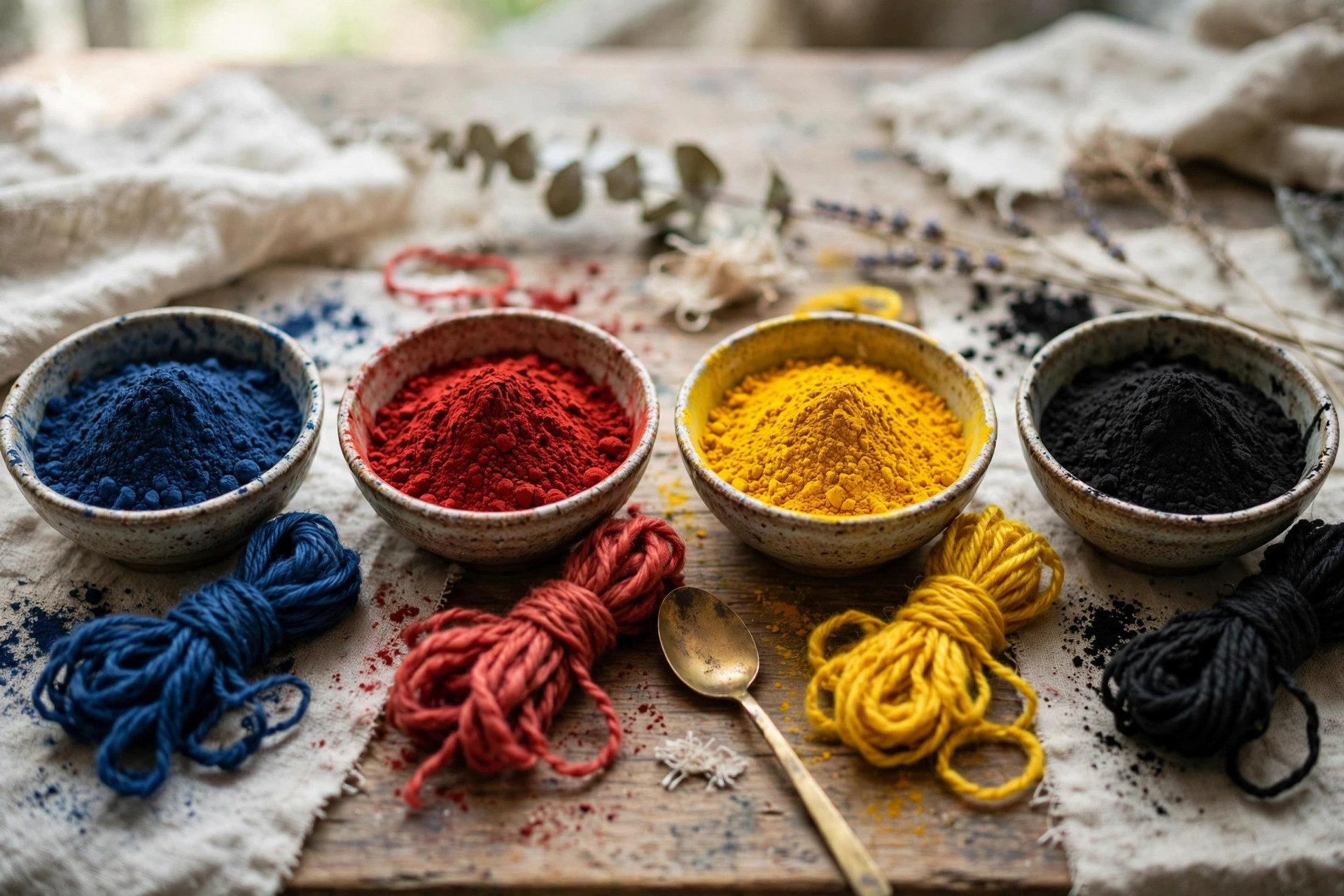
The Six Classes at a Glance
| Dye class | Main fibers | How it holds on | Known for |
|---|---|---|---|
| Reactive | Cotton, linen, viscose and other cellulosics | Covalent chemical bond with the fiber | Bright shades, excellent wash fastness |
| Disperse | Polyester, acetate, some nylon | Dissolves into the fiber at high temperature | The only practical route to polyester; sublimation printing |
| Acid | Wool, silk, nylon | Ionic attraction to protein-type sites | Silk scarves, woolens, nylon hosiery and swimwear |
| Vat | Cotton and other cellulosics | Insoluble pigment formed inside the fiber | Top wash fastness; indigo denim |
| Direct | Cotton, viscose | Molecular attraction along cellulose chains | Simple, economical dyeing; moderate fastness |
| Sulfur | Cotton and other cellulosics | Insoluble pigment formed inside the fiber | Cheap depth: sulfur black, dark workwear shades |
Other Colorants Worth Knowing
Three more colorant types complete the picture. Basic (cationic) dyes give exceptionally bright colors on acrylic fibers, which the six main classes barely touch. Mordant or chrome dyes serve wool, using a metal mordant as a bridge — the same principle as the mordant dyeing in the natural dyes guide. And pigments are not dyes at all: they are insoluble colored particles glued to the fabric surface by a binder, which is why they can color any fiber — and why pigment-printed and pigment-dyed goods feel and fade differently. The Apparel Search definition of pigment explains that distinction in glossary form.
Choosing the Right Class
In practice the fiber decides first, and requirements decide second. Among the classes that can color a given fiber, the dyer weighs the fastness the product must survive — a swim garment and a curtain face different tests, measured by the methods in the colorfastness testing guide — against shade range, equipment, water and energy costs, and price. That is why the same fiber, cotton, is dyed four different ways across the market: reactive for quality brights, vat for hard-wearing utility, direct for economy, sulfur for black.
More in the Textile Dyeing & Finishing Guide
Common Questions
Which dye is used for cotton?
Cotton and other cellulosic fibers are colored mainly with reactive, direct, vat and sulfur dyes. Reactive dyes give the brightest shades and the best wash fastness on quality goods; direct dyes are cheaper for simpler applications; vat dyes, including indigo, suit workwear and denim; and sulfur dyes are the economical route to deep blacks and other dark shades.
What dye colors polyester?
Polyester is colored with disperse dyes — almost the only class that works on it. The dye is not water-soluble in the usual sense; at high temperature it dissolves directly into the polyester fiber itself. That is why polyester holds color so well once dyed, but also why it needs heat, pressure or chemical carriers to dye at all.
Is indigo a vat dye?
Yes. Indigo belongs to the vat dye family: it is insoluble in water, so dyers reduce it to a soluble form that cotton yarn can absorb, then expose the yarn to air, where it oxidizes back to blue inside the fiber. Because indigo concentrates near the yarn surface, denim fades with wear as the surface wears away and the paler core of the yarn shows through.
Why do some colors fade faster than others?
Fastness depends on the bond between dye and fiber and on the dye molecule's own stability to light, water, rubbing and chlorine. A reactive dye chemically bonded to cotton resists washing far better than a direct dye held by weaker attraction, and within any one class some dye molecules are simply more light-stable than others — which is why two garments of the same fiber can age very differently.
Back to the Textile Dyeing & Finishing Guide
The Textile Dyeing & Finishing Guide hub covers the whole of wet processing — dye types, dyeing methods, garment dyeing, finishing, natural dyes and shade approval — with a map of every guide in this cluster.